Stories from fourteen years of travel, starting on this page with ‘1993’, a journal of my travels through the Caribbean, Central America and the westside of South America that year.
Note: these stories are also in ‘talking book’ form at spotify and other podcast sites.
Here’s the link to ‘we’re only here once’ at spotify:
Cheers!
1993
Chapter One
Paris
I recognised the knife from when we were kids building hideouts in the park. It was a simple penknife, the type a dad might give his twelve-year-old son: sharp enough to whittle a twig, but not sharp enough to chop a finger off. This one had seen better days. Its blade was rusty and what had once been the sharper edge had nasty little divots. These details I knew because its ugly tip was hovering just a train’s-jolt away from my left eyeball.
I’d noticed the Africans huddled in the warmest corner of the carriage; about ten of them, sharing some kind of alcohol and sullen conversation. Their eyes glazed across the mostly empty seats. Over the last few years, I’d spent months travelling alone in east and north Africa, sharing hundreds of mini-bus rides with guys just like these. While they sure looked mean, I wasn’t going to be the racist. They were poor and outcast, and I owed them my empathy, not my fear.
When one of them meandered down the aisle to the other end of the carriage, his coat brushed my shoulder as the train lurched. A stench of dirt, sweat, urine, alcohol and marijuana lingered in his wake. On his way back, he reached behind my shoulder, grabbed the right side of my face, and pulled my other cheek hard against his hip. With my head trapped in this vice, his free hand swung the point of the penknife towards my left eye. “Give me your money”, he slurred in French. Beyond the blade, his fingernails were filthy and his smell filled my head. “I don’t speak French,” I mumbled, stupidly, in my schoolboy French. The knife was too close to bring into focus, but it was clear it would make a mess of my eye.
Trumping rational thought, my subconscious swung into inaction. Every muscle in my body went limp. His stinking, mittened hand began to cradle my chin as I slumped gently to the right. But the point of the penknife stayed wedded to my eye, gently swaying with each bump in the tracks.
Through my mental haze, from somewhere behind me, I heard someone shouting. As the African twisted toward the voice, the train burst from the dark tunnel into the surgical lights of a station. Blurred people-shapes flew by the windows as we slowed. The African let go of my cheek and began to shuffle unsteadily back to his seat. The voice behind me yelled again: “Jump off here with us!” and my brain and body re-engaged. I grabbed my bag, lurched to the carriage exit behind me, and escaped onto the platform.
Jimmy, whose voice had come to my rescue, and his fiancée, Karole, introduced themselves and checked I was okay. They’d have liked to help me more, but they were already late to their own engagement party. I’ll be fine, I promised them. It won’t be long till the next train. So they gave me their phone number and told me to call in a couple of days. But when they’d gone, the lonely silence overwhelmed me. A couple more Africans emerged from a passage down the platform and, to my shame, I lost my nerve.
Finding my way up to the street wasn’t easy. The underground walkways had few signs that made sense to me, and each airless, fetid corner was populated by still more impoverished Africans. My composure frayed further. When I finally reached the empty street, I found I’d arrived at the least populated exit. The dim street lights barely took the edge off the dark, and soft rain was falling. No taxis waited to whisk me to safety. I moved a few doors down from the station and feebly resolved to ask the first non-dangerous passers-by for help.
So, New Year’s Eve in Paris, eh? What a great idea. After six years living and travelling in Europe, how could I go home to Sydney, as I was planning to do this year, without visiting the home of the Enlightenment, the Revolution, the legendary writers and artists? And the home, no less, of young Alice and Marianne, the first people to pass my shivering figure as they headed to the station. Excuse me, I said, in my terrible French, is there a taxi stand close by? I don’t know, said Alice, but where do you want to go? The Latin Quarter, I said, but it was a semi-educated guess at best.
Typically for those freewheeling days, I thought I’d just fly into Paris on New Year’s Eve and, with the ‘Rough Guide’ I’d bought the day before, find a place to stay in the Latin Quarter for next to nothing. Ah, the idealism and chaos of youth. When I explained my plan, the girls led the way to a phone booth round the corner. Realising my French might not be up to the job, they waited patiently outside. But after watching my inept, unsuccessful phone-calls to a couple of the recommended hotels, they took over. Soon they’d found me a top-floor room not far from the Latin Quarter for only a few more francs than I was hoping to spend. Then came the proposal they’d been working on for the last few minutes: why didn’t I go out with them for New Year’s Eve? Have I ever known a more dramatic change in fortune? So we walked to the nearest main street and hailed a taxi to the hotel.
What the hotel manager must have thought as I checked in and went to my room with two young, attractive Parisiennes was completely mistaken. Let me disappoint you now: this is not the way this story goes. Shame on you for thinking it. The girls had been intending to spend New Year’s Eve together in the centre of town. Taking me along for the ride gave them some insurance against being harassed by other males… and somehow they perceived that I had the brains to know my place. And that’s the way it went.
We walked the streets of central Paris hand-in-hand, arm-in-arm, all night: across the bridges, along the river, through the parks. Through every street of the Latin Quarter; the Pont-Neuf; the Ile de la Cite, the Ile de Saint-Louis, the Champs Elysees to the Arc de Triomphe and back. We stopped at cafes for an occasional glass of beer or wine, a crepe, or a coffee to keep us warm and awake. At midnight there were some fireworks: real, not metaphoric. Paris, the city of love. Sigh. I drew admiring and bemused, mostly bemused, looks from men and women, young and old, every step of the way. “How have you got two?” jealous men would call. Hilarious. When eventually we were too tired and too cold to walk and talk any more, I rode the bus home with them to the Bois de Vincennes. By the time I got back to my hotel, alone and frozen to the core, it was nearly dawn.
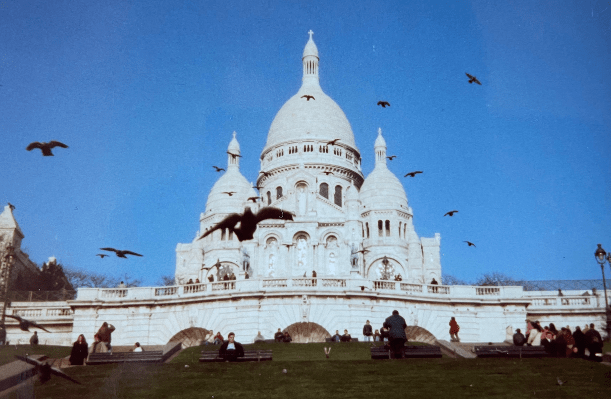
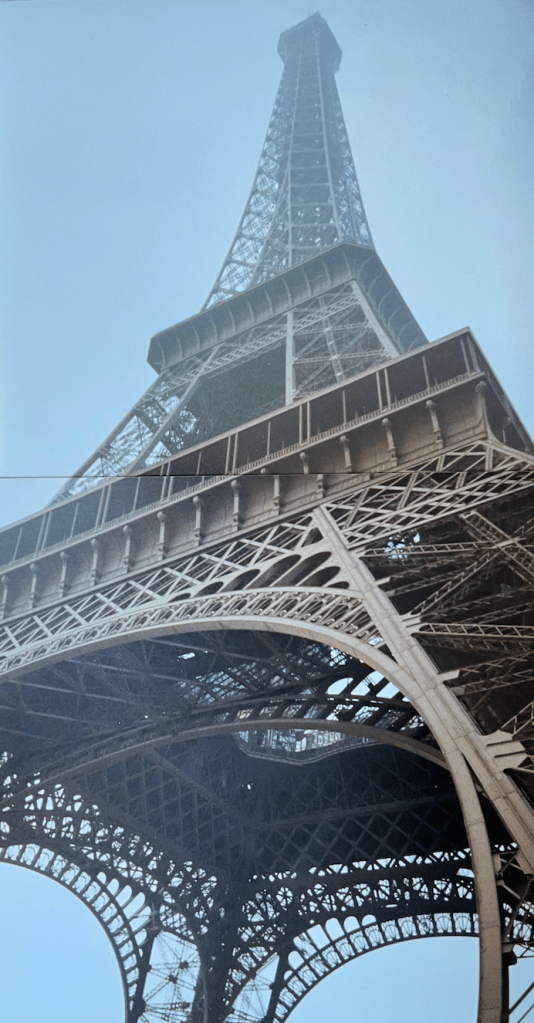
Nonetheless, by noon I was up and walking like a looney past the Pantheon, Notre Dame, up the Champs-Elysees again to the Arc de Triomphe, and to the Eiffel Tower. I decided the Louvre was boring, apart from Rodin’s ‘Thinker’ and the hordes of tourists grimly elbowing each other to take a photo of the monumentally underwhelming ‘Mona Lisa’. The next day it was sunny and cold and I marched across the river again, through Montmartre to Sacre Coeur and back.
Then Alice, Marianne and I met at the Pere Lachaise Cemetery to visit Jim Morrison’s grave. For any that don’t know, Jim was the charismatic lead singer of The Doors, the best of Los Angeles’ psychedelic bands from the late-sixties. In the early seventies Jim had moved to Paris and died mysteriously there at twenty-seven. Numerous signs graffitied on other people’s graves made Jim’s quite easy to find among the half million or so dead residents of the suburb-sized graveyard. Screeds of poetry, joints and half-bottles of spirits were left as odd offerings to Jim, the latter two being some of the reasons why Paris is his forever-home.
Melinda and Karen, two sisters from Sydney, arrive from Holland to spend a few days in Paris. We’d met in the hot, dry desert of southern Morocco the year before. This time we freeze. We shiver up the Eiffel Tower and through the brilliant modern art at the Pompidou Centre.
Jimmy and Karole, my saviours during the knife-in-the-eye incident, invite me to a magical dinner at her parents’ place. Her dad’s a pretty famous artist and the conversation is fantastic. On the way home, floating on great food, whiskey and wine, I take photos of street fountains turned to ice.
Like a centurion I trek repeatedly up and down the medieval, brick-paved Rue Mouffetard from my hotel to town and back. I gaze in awe at the Van Goghs in the Musee d’Orsay. I find bullet and shell holes from past wars in the old buildings around the Champ de Mars, and the best patisseries in the world. I come down with a terrible cold and a split in my lip so bad I can barely talk, let alone smile.
1993 was barely ten days old.



Chapter Two
Barbados
Barbados was a complete fluke.
I’d known for months that 1993 would be the year I travelled back to Sydney. I’d left my job, shipped home six years of memorabilia, and tried to tick off some final items on my ‘must-do-in-Europe’ list. But I’d left the actual details of my journey home completely undecided. I knew I’d go west through the Americas somehow; and, whether by air or sea, I’d need to cross the Atlantic and Pacific Oceans. But it wasn’t until I got back to London from Paris that I finally went shopping for options. At first it seemed the budget-friendly Aeroflot flight to Cuba might be best. The Cold War had been resolved a couple of years earlier by Russia’s attempt to open up and modernise, but nothing could eradicate Aeroflot’s ‘Plummet Airways’ reputation. Then British Airways had a flash-sale of the last few seats on a flight to Barbados at the end of the week. I couldn’t believe my luck.
A few months before, Mike and Margie, the parents of one of my Irish prep-school students, had told me: If you’re ever in Barbados in January, look us up. They knew I was planning to travel west from Dublin to Sydney sometime in the new year, but I’m sure they never expected me to rock up; and neither did I. But when I phoned them to say I’d be in Barbados on Sunday, they told me to come stay for as long as I liked. This was a better start to the trip than I ever could have planned.
In my last days in England, Mark, my old schoolfriend who’d moved to London years before, lent me his VW Golf to drive to Oxford to say a final goodbye to Grandpa, Lucy, Mallory and Jilly. On the Friday night, some lunatic with a knife (yes, the second in a fortnight) attacked Mark’s car while it was parked safely under a streetlight just off Woodstock Road. They slashed the soft-top roof and one of the tyres; and they took a few CDs and some coins from inside. When I telephoned Mark to tell him, he said No worries; it’ll be covered by insurance. But a few minutes later he called me back to ask if the golf clubs were still in the boot. What golf clubs? I said, and there was a pause. Never mind, he said stoically, I forgot I’d left them in the car. When I got back to London, I found they’d been custom-made in St Andrews and Mark wouldn’t take any money in compensation. I’m still thinking of a way to pay him back.
The nine-hour flight from London to Barbados was the biggest jump towards Sydney I’d make for the rest of the year. It was also the biggest jump in seasons and cultures. As the humid, tropical air enveloped me at the plane’s exit, and the exclusively dark-skinned airport staff welcomed me to their island, I felt as much a foreigner as it was possible to feel. In a corner of the world where the majority of the population is descended from slaves brutally transported from West Africa four hundred years before, I looked forward to losing my luminescent Irish-winter pallor as soon as possible.
Given the amount of luggage I had and the quirks of the public bus system, a taxi from the airport to Mike and Margie’s house in Gibbs Bay was the only viable option. My connection with the Afro-Caribbean taxi driver got off to a rocky start when I insulted him by trying to negotiate the price. However, once we got going and he discovered I was Australian, we bonded over cricket. Unknown to me, a few hours earlier the West Indies’ national team had beaten their arch-rivals Australia in the final of the One Day series played in Melbourne. The driver had sat up all night listening to every ball on the radio, and as he drove he recounted every twist and turn of the match as if he’d been playing himself. The timing of my arrival couldn’t have been better.
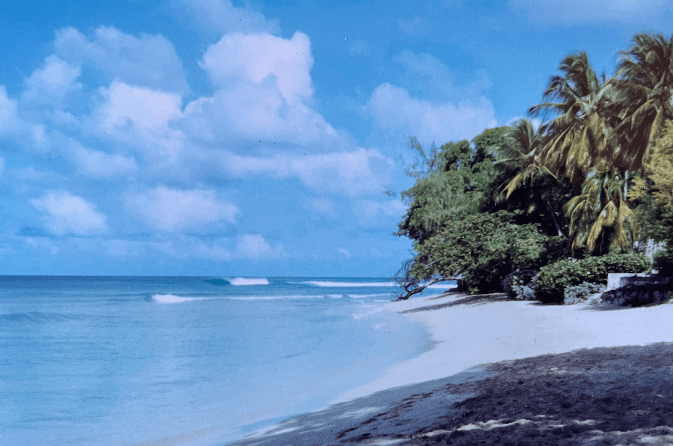
As we rattled up the west coast, the bright, fragrant, warmth of the island flooded the old Chevrolet’s open windows. We arrived after a trance-like forty minutes, and I wondered if I’d been pranked: Mike and Margie’s house was more an estate than a holiday home. And here, up the drive, came the house staff to meet me. Carrying my bag and surfboard, they led me through the tropical garden, past the pool and up the wooden stairs to the balcony beside my room. Through the casuarina trees, the Caribbean stretched from gleaming aquamarine to its sapphire horizon. Tiny waves whispered a cartwheel’s distance from where our garden turned to white-sand beach. Mike and Margie will be home in an hour or two, Mr James, one of the ladies said. Can I bring you a beer? You little ripper.
That afternoon I discovered I’d stumbled into the biggest week of 1993’s Bajan social calendar. This was Robert Sangster’s annual amateur golf tournament at the Sandy Lane resort. Unknown to me while I was teaching their son, my hosts were an integral part of Sangster’s legendary Irish horse-breeding-and-racing circle. On holiday from being parents at a strait-laced private prep school, Mike and Margie were hilarious. Mike raced about the place in his mini-moke, promising any conceivable wrangle with the police could be solved with a jovial “Good c*nsternoon, arsetable!” This apparently would get everyone laughing and all would be forgiven. He might have been right.
Since I was now suddenly their houseguest, they included me in everything. I was too late to get a start in the golf, which was just as well. But every night they included me in the epic dinners at way-out-of-my-league restaurants like Carambola, La Cage aux Folles and 39 Steps, where every member of the circle celebrated the wins and losses of the day. Another night, the Sangsters threw a party at their house (well, estate; it sold a while ago for something like $50 million). I nearly committed what would have been social suicide (if I’d had a social entity to kill) when I accidentally danced with Robert Sangster’s wife. After half a song I realised who she was and made my excuses.
It was bizarre to be involved in conversations and debates with these people from a world so far removed from my own. Perhaps they found this nomadic, hippy schoolteacher with no dress sense, attempting to find his way around the world on the smell of an oily rag and no prospect of an income, just as fascinating as I found them. I was honoured to be as welcome as they made me feel.
Among the hundred others, there’s no doubt the peak moment in the miles-out-of-my-own-orbit genre came when I discovered Led Zeppelin’s Jimmy Page, undoubtedly one of the twentieth century’s greatest musicians, and quite possible a god, sitting directly in my eyeline at the restaurant dinner table next to ours. How should I react?
Obviously, asking for an autograph was completely the wrong thing to do. Jimmy was at a table for two with, it must be said, beautiful company. He didn’t want to be pestered and I didn’t want to be that guy. He didn’t need a complimentary drink or an extra pudding from a random diner, and I couldn’t have afforded to pay for them anyhow. Then it hit me, this would be my simple gift: I’d pretend I didn’t know who he was. I congratulated myself on this decision: how many others would have thought to give instead of take? Through all three courses, I kept my eyes from roaming to his table.
But a final challenge came as I returned from the loo several magnificent wines later. Jimmy was walking straight toward me, his rockstar gait exceeding all expectations. He was even taller and his arms even longer than I’d thought. If we weren’t careful, our shoulders would touch. Our eyes met for a second, probably more. He smiled and nodded. I smiled and nodded back as if he was any other bloke down the pub on a Sunday afternoon. I think I may have offended him.
While the week in Gibbs Bay far exceeded any expectation I might have dreamed up for the start of my journey home, my gaze had already been distracted. On my second day, Margie lent me her car to explore the island. Armed with ‘Surfer’ magazine’s ‘Surf Report’ on Barbados, I charted a clockwise course around the coast.
Before the age of google, google maps, and cameras that live-stream vision of nearly every coast on the planet, The ‘Surf Report’ was the only source of information about foreign surf-zones. Each ‘Surf Report’ consisted of just two yellow A4 pages of roughly typed information about that edition’s destination. In preparation for this year’s trip, I’d spent a small fortune, via bank-cheque and international post, on about thirty editions of ‘The Surf Report’ to give me intel on just about every surf destination to which the winds of fate might take me.
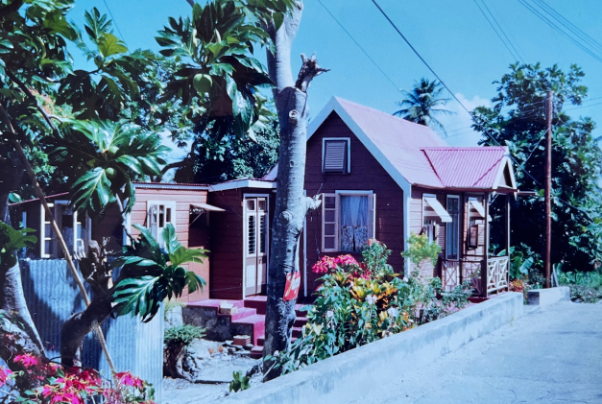
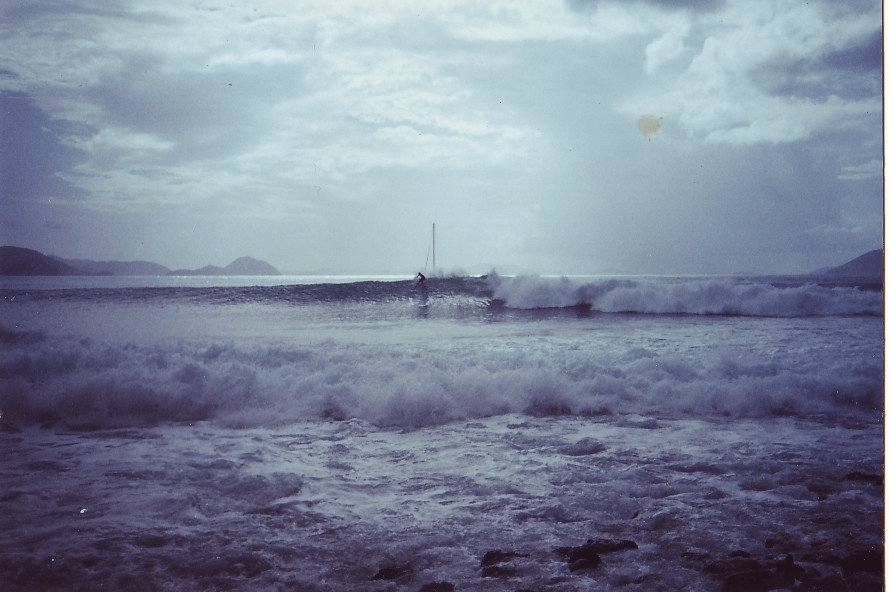
The ‘Surf Report’ on Barbados advised there were good waves on every coast of the island. But the best of them was called Soup Bowl, on the east coast at the little village of Bathsheba, an hour’s drive across the island from Mike and Margie’s place. Halfway through my first surf at Soup Bowl on that second day, I knew I had to live in Bathsheba for a while. On the way back to Gibbs Bay that afternoon, I discovered ‘Matilda’, an empty yellow wooden shack with a picket-fenced lawn facing the ocean just a minute’s walk from Soup Bowl, and I knew I’d found my next home.
But when I eventually tracked down the landlord of ‘Matilda’, a gruff old Afro-Caribbean man in a cabby’s hat named Mr Bostic, I made the fatal error of trying to bargain on the price. (You’d think I would have learned from the first day’s taxi debacle). If you want to argue about the rent, you can find somewhere else to stay, Mr Bostic said abruptly; and he walked away with a wave of his hand. Oh crap, I’d really crashed the car. After a restless night back at Gibbs Bay, I drove back over the hills to Bathsheba, eventually found Mr Bostic, and made a grovelling apology. Oh, you’re from Australia, he said. We beat you last night! We beat you by a run! Oh, your last batsmen nearly gave me a heart attack, but we beat you by a run! He expected me to know, but shamefully I didn’t, that a few hours earlier the West Indies had won the Fourth Test in Adelaide by a single run after the Australians had nearly pulled off a miracle comeback win. I don’t know how he would have treated me if the West Indies had lost, but after describing every twist and turn of the final day’s play, he agreed to rent me ‘Matilda’, at his price, and we shook hands as friends. I was home.
Within an hour of moving in, the silhouette of a massive, dark rasta man filled one of the windows that looked out to sea. I was playing my tiny traveller’s guitar in the front room. What you play? he said quietly when I rose to greet him. Taking this, accurately, I think, as my audition for acceptance into the village community, I chose Bob Marley’s ‘Get Up, Stand Up.’ Under the pressure of his presence, it was probably the best I’ve ever sung it. When I stopped, he deadpanned You can play, and left. He never visited ‘Matilda’ again, but I think I saw him leading his goats through the village a couple of times.
In his place, however, came a handful of the other local boys, all Afro-Caribbeans, who invited themselves to hang out on ‘Matilda’’s front verandah every day. At around mid-morning on my first day there, they sauntered off the road, across my lawn and onto the verandah, with its unrivalled view of Parler Beach and the only road through the village. They introduced themselves but avoided eye contact and kept their distance, even while we shared the same space. If they needed, they helped themselves to my food, but never too much of it. They were kind of friendly, but I understood that, even though I was paying the rent, this was their place. I was just a visitor. They called me a ‘soft haole’, which was the local term, borrowed from Hawaiian surfer slang, for a white visitor who didn’t cause any harm. It was kind of denigrating, but approvingly so. These guys were heavy; they would have killed me in a fight. They were poor and most likely always would be. They lived hand to mouth and, when necessary, stole. Another surfer, Chuck, a staggeringly unabashed racist from Florida, turned up in a smart hire car, rented a fancy house up the hill, and started calling the local boys off waves at his first surf at Soup Bowl. He was robbed of everything except the clothes he was wearing within twenty-four hours of his arrival. I don’t know if it was the guys I knew or someone else. In retrospect I reckon my house must have become a protected area. If they or anyone else stole from me, I’d be forced to leave the village, then they wouldn’t be able to hang at ‘Matilda’ anymore! I was proud to be a ‘soft haole’.
Mr Bostic had warned me about only one of the locals: Watch out for Snake, he said. He bite ya. Sure enough within a day or so Snake came to the front door – alone, as ever, for the other locals avoided him – to ask if I needed any dings in my board fixed. There were a couple of cracks on the rails, and I thought it would be wise to support local industry, so I gave him the job. Secretly I hoped that my standing as a ‘soft haole’ with the other local surfers would keep Snake honest. He asked for payment in advance, so he could buy the materials, he said. I agreed to give him half the fee, telling him I’d pay the balance when the work was done. He vowed to return my board, fixed, first thing the next morning. But an hour after dawn the next day, the surf was cracking, but there was no Snake and no board.
One of the boys on the beach gave me directions to where Snake lived up the hill. When I found the simple house, there was my board, neatly fixed, lying on the dewy grass outside. Snake was inside with another guy, a pimply, pasty, dodgy-looking white American. They were both awake, despite the early hour. Snake took my cash, the balance of my payment, and handed it straight to the American. From a small plastic bag in the American’s pocket, they each chose a tiny rock. In turn, they lit these rocks in a pipe fashioned from alfoil and an empty matchbox. The small rocks popped and cracked and made a strange smell and after sucking up the smoke, each of them sat back, stunned. I made my excuses, told them the surf was pumping, and fled to the beach with my board.
The day I’d met Snake at ‘Matilda’, he’d told me he was one of the original gang of local boys who’d copied the tourists and taught themselves to surf. It was hard to believe. I’d never seen him anywhere near the waves. But a few days later, Snake came to ‘Matilda’ to asked if he could have a go on my board. It was a reach to trust him again, so I walked with him and my board to the Soup Bowl. Snake paddled out in filthy jeans instead of boardshorts, but as I watched from the rock, it was easy to see the remnants of his addled skill. This despite the ruin his life had become.
Mark Holder, on the other hand, not only danced with the waves, he flew. The other local boys, especially Zed and Arlon, surfed every day. Mark only appeared the first day it got big and nasty, after a big storm had passed far away to the north. These occasional groundswells were far bigger and more powerful than the everyday windswells I’d surfed so far. I was on the beach resting after an early morning surf that had tested the limits of my ability, when this Afro-Caribbean bloke with sun-bleached dreads jogged past me and paddled out. With his hair still dry, he chose his first wave and took off ten metres further up the reef than was humanly possible. He air-dropped, turned square off the base and disappeared as the wave turned inside out. He reappeared at the speed of sound and levitated onto the roof of the wave, skating weightlessly for longer than physics would allow, before airdropping down to reconnect with the face. It was the best surfing I’d ever seen.
The next day the waves were even bigger and I was giving it another crack. For the first hour, with Mark’s encouragement, I scratched into a few of the biggest waves I’d caught in years. From close up, his surfing was even more spectacular and artistic. As the tide ran out, the waves got steeper and the other surfers went in. James, he said, every wave’s like this, and he made a cliff shape with his fingers. But I didn’t heed Mark’s warning. A wider one crested out the back and I paddled out to meet it, turned round and took off. It was a long way down; much, much further than I’d anticipated. I arched my back, trying to reconnect the inside edge of my board with the vertical face. The wave formed a second sky as I fell. When I finally hit the water, it snatched me up and hurled me into the reef. Thank God my buttcheek took the impact. I walked up the beach a legend. My housemate, Joy, told me it was as big as a truck and wouldn’t stop talking about my bravery. But I wasn’t proud of overstepping the limits of my ability. It wouldn’t be the last time that year.
Later in my stay, Mark asked me a favour. Two old friends of his were flying in from a neighbouring island. Could I help him collect them from the airport in my rental car and show them round? No worries. It was an honour to be asked. At the airport, Mark’s two friends turned out to be two French girls, Valerie and Marie. Valerie was from Martinique, an island not far from Barbados, and Marie was… holey schmoley, I recognised her: the beautiful wife of the world’s best surfer at that time, Tom Curren. Mark had entrusted me with the safe-keeping of the First Lady of Surfing. For a few days we day-tripped round the island, surfed Soup Bowl, somehow by ourselves, and on Valentine’s Day we all shared electric blue waves at a south coast point called Freights.
The other member of our party was Joy, my housemate. Joy was one of a very small societal sub-group in those days: a woman who surfed. Sure, there had been a women’s world surfing champion every year since 1964, but to the average surfer, women who surfed were very rarely seen. In fact, come to think of it, before those days in Bathsheba I’d shared just one single session with a female surfer. It was at Fairy Bower at Manly one morning in 1983 when I should have been at uni. And what a surfer she was! It was Pam Burridge, then aged about eighteen, and she was ripping. It was no surprise she won the women’s world championship a few years later.
Somehow the 1970s to 1980s society I grew up in didn’t see surfing as something women did. Why ever not? What was not to like about sharing waves with women? Why was surfing some sort of man-shed? Come to think of it, up until the 1970s, there were ‘Ladies’ Lounges’ in many pubs so men and women could drink in their own company. These were still the dark ages of gender equality and social inclusion. These were also the days when middle-aged drunks were a familiar sight, even in daylight hours. Were these the men who’d fought in World War Two and returned to society brutalised and broken? Had they been brutalised by their fathers who’d been brutalised by World War One? Was it the example set by the older males that led the younger surfers to belittle and intimidate any woman who attempted to share the waves? A recent documentary called ‘Girls Can’t Surf’ explores this period in surfing and how women eventually gained the respect of their male peers.
Anyways, back to Joy and ‘Matilda’.
Joy was Philipino-American, originally from Virginia Beach, but she’d moved to Hawai’i to surf. She found work at one of the posh hotels on Kaua’i and was living her dream until in September 1992 Hurricane Iniki flattened the tourist industry, leaving Joy long-term unemployed. With months to kill before she could return to work, she’d set out to make the most of her lay-off by surfing the world, or as much of it as she could before her savings ran out.
Joy was walking a tightrope in a few ways. First, she had to watch every cent she spent. Second, she was an outsider in a chauvinist culture. And third, she was determined to retain emotional independence. For the first months of her trip, these challenges had been met by sharing the adventure with another Hawai’ian female surfer. But when her friend returned home, Joy needed a new travel partner. With no other surfing females available, she chose me.
I was honoured to be her travel partner, but it was a bit awkward for both of us. I had to suppress the truth that I found her attractive. Yes, I know these days we’re all so evolved and can negotiate these delicate situations as if we were picking apples, but this was thirty years ago. It was hard sharing these wonderful, unique days with a woman who I had to keep my distance from. It was tricky for her too. While she sometimes wanted to exercise her independence, she didn’t want me to feel neglected and exploited, especially as she knew that my presence saved her from the advances of other maIes who wrongly presumed she was my girlfriend. In our time together, several other men tried to get close, but she artfully kept us somewhere between hand and arm’s length. It was a complex situation, but I so valued our time together.
Each day began with a glassy early morning surf at Soup Bowl. By mid-morning, the trade winds blew in like clockwork, ten to twenty knots from the northeast, until the late-afternoon calm. By 4pm the wind-swell had settled into sets and we’d surf long, powerful, glassy waves until dark. The last of the wind-swell would be there the next morning, then the cycle would begin again: a cosmic wave machine.
In between surfs we’d eat, rest, play music, talk and write diaries. No-one went to town and there was no work to do. The furthest we went was Mrs Marshall’s bakery up the hill for bread and currant buns, or the Rum Shack for beer. Most nights we’d be asleep by ten to be ready for the early surf. Only one night we stayed up till after midnight. We built a fire on the beach in front of Soup Bowl and watched the full moon rise. When I suggested we go for a surf, the local boys warned me “the duppies’ll get ya”. (Duppies are water spirits; the souls of those who’ve drowned, apparently.) I thought they were only winding me up, and I dared them to come out with me. Only Arlon took up the challenge, but as soon as he was out the back he freaked out and in raced to shore in genuine fear. Somehow I survived another few minutes before surrendering to superstition… or maybe the sharks in Barbados are nocturnal.
Duppies is the name given to one of the island’s wildest waves, breaking a long way out to sea from steep cliffs on the northwest coast. The local boys came for the drive in my car, but wouldn’t dare surf, even though the water was mid-sunny-day-crystal-clear. Federico from Argentina caught the best waves that session. Maycocks was another right point we surfed; and when another big groundswell arrived from the north, there were perfectly shaped, powder-blue, waves on Gibbs Reef, just up the beach from Mike and Margie’s, where I’d stayed the first week. In near darkness that evening, I split the peak of our last wave with the drummer from the Tom Tom Club.
On Saturdays the locals played cricket on every available patch of semi-level turf. Each bowler steamed in off a long run and the batsmen tried to hit every ball beyond the horizon. Success and failure were met with rowdy cheers or heckles from the women and children round the boundary. On Sundays the church next door to ‘Matilda’ rocked with a hundred voices in three-part harmony. One day, Mike and Margie came to lunch at ‘Matilda’ and had such a good time they stayed for dinner as well. I was glad to offer some hospitality in return for all they’d given me in my first week on the island.
After a fortnight, I drove Joy to the airport for her flight back to Virginia. On the way, she suggested we stop at one of the beaches on the southern shore. We talked for an hour or two then watched her flight disappear into the sun’s glare. Joy ended up staying in Barbados for a fortnight longer than me. When I left, she told me to phone her in a couple of months to see if we might meet later that year somewhere else in the world.
Barbados had given me a decade’s-worth of adventures and waves. If I’d had to go straight home to Sydney, I could have lived with that. But knowing it was unlikely I’d ever see this corner of the world again, I bought a Leeward Islands Air Transport excursion ticket that would take me to any three of the other Caribbean Islands. Though it felt like gluttony, I chose Tortola, Guadeloupe and Puerto Rico.
And what about those other twenty countries between the Caribbean and Australia? I didn’t need to be back in Sydney for another ten months… if I could make my savings stretch that far.
.






Chapter Three
Tortola and Guadeloupe
“Tortola.”
That’s all Mark Holder said when I asked him where else I should go in the Caribbean. Mark was the best surfer in Barbados, so I was all ears. He didn’t say if Tortola was a town, a beach, an island or the name of a wave. And the conspiratorial, reverential way he said it told me I’d have to join the dots myself. I’d never heard of it and wasn’t sure how to spell it, but that night’s research revealed it was one of the British Virgin Islands, eight hundred kilometres northwest of Barbados. Cheers, Mark! Has a single word of advice ever given me more?
My flight to Tortola arrived late at night and it took a couple of hours for the friendly airline staff to declare that, yes, my backpack was officially lost. Luckily, the backpack contained nothing essential. Most importantly, I still had my surfboard. All unreplaceable luggage – passport, camera, surfboard fins, ‘Surf Reports’, used camera film, money and so on – travelled in my money belt or my carry-on daypack. The backpack carried only clothes, a cheap tent and a couple of guidebooks to places I may or may not visit in the coming months. So living without it for a few days would be no drama.
The major setback was that I had to stay that night at the over-priced airport hotel to see if my pack turned up the next morning, as the airline staff thought it might. Trying to get some value out of the money I was wasting, I gave American cable television a try for the first time. All fifty-plus channels presented nothing remotely entertaining: just news, canned-laughter sitcoms, cliched conversations about basketball, and advertisements for sugary foods and weight-loss medications.
The next morning, I found the backpack was still lost and probably would be for some time. With the ubiquitous ‘have a happy day!’ smile, the airline staff gave me a cheque for fifty US dollars to spend on ‘essentials’. But that didn’t cover the cost of last night’s hotel, and it didn’t cover the cost of a taxi ride across to the surf coast of the island. So in the rising heat of a blue-skied day, I walked a couple of kays from the airport and waited an hour or two to hitch a ride.
Arriving in Apple Bay, the village at the centre of the island’s small surfing world, I saw head-high waves breaking just out to sea. But first I had to find a place to stash my stuff. The cheapest accommodation I could find was an airless fleapit for another ball-crushing fifty US dollars a night, at least five times over my projected budget for the year allowed.
Resigned to my stay on Tortola being a short one, I went for the sweatiest surf of my life. Unpacking my surfboard from the yellow-fabric-lined-with-bubble-wrap sleeve that passed for state-of-the-art boardbags in the late 1980s, I discovered my boardshorts were the one essential item that was trapped in my lost backpack. The most viable alternative to surfing nude was to wear the crusty full-length wetsuit I’d brought from Sydney six years before. While I thought it might come in handy in the latter stages of my journey home to Sydney, it’s ongoing purpose was to serve as extra padding for the rails of my board in the bubble-wrap sleeve. Since it was designed for the Sydney winter, not the Caribbean spring, the wetsuit was going to induce hyperthermia, so I borrowed scissors from the unfriendly landlady, and chopped the wetsuit’s arms off above the elbow. I thought about chopping the legs off too, but a few months later I was glad I hadn’t.
Thus resplendently attired, I introduced myself to the Apple Bay reef and its inhabitants. The wave was a gentler version of Soup Bowl in Barbados. Every morning started waist-high and glassy, breaking right and left across the friendly reef: a perfect way to greet the day. Between nine and ten, northeast trade winds blew in until around four. When the wind dropped in the evening, the wind-swell formed into increasingly well-spaced, head-high-plus waves. From lunchtime until it got too dark to see, you could surf to the music floating across the water from the Bomba Shack, an open-walled pub built of driftwood just above the high tide line. We surfed good Apple Bay nearly every day for four weeks, and on six of those days, when a groundswell swung down from a distant storm to the north, it absolutely pumped. Easy fast take-offs led to two or three fast, long-walled sections, with room for a cutback between each. If it was small, the left let you practise riding switchfoot, or taking off fin-first.
My surfboard, named Byron, loved the Apple Bay waves. Warren Cornish from Byron Bay had shaped her for me back in late-1987. So Byron was five years old and a bit road-weary by the time she reached Tortola, but she still surfed well. For the four years prior to getting Byron, I’d ridden an antique Russell Hughes Crystal Vessel from late 1967. As much as I loved it – oh, the things the massive deep vee and bendy fin let you do on a wave – the Vessel wasn’t an international traveller. At over two and a half metres and nearly ten kilograms, it would cost me a fortune in excess baggage. Further, the Vessel sported an unremovable thirty five centimetre fin that would be irreparably destroyed within a few flights. So I’d asked Cornish to make me a board that was as big as would fit into the lain-down passenger seat of my friend’s yellow mini; and strong enough to survive the roughest treatment by man, wave or reef. Byron was a statuesque seven foot two with three thick stringers, a wooden tail-block, two leg-rope plugs and loads of fibreglass. Her paddle-speed gave me mobility round the line-up and made any wave catchable, big or small. She flew off the bottom, then went faster and faster with each pump; but she turned on a dime and hung on in the barrel.
Boards like Byron came to be known as ‘mini-mals’, which was short for mini-malibus, the nickname for 1950s and 60s longboards. ‘Mini-mals’ were pronounced uncool by mainstream surfers, despite one or two of them nearly always commenting that my board (quote) ‘really suits the conditions today’. Thirty years later, boards of this type are called ‘mid-lengths’ and are state-of-the-art cool thanks to the classically brilliant surfing of ‘free-surfers’ such as Torren Martyn, who have thrown off the dual shackles of competitive surfing and the crippling conformity regarding equipment to which many surfers still submit. For the previous five years, Byron and I had caught waves together in England, Ireland, France, Portugal, Spain, Morocco and the Canary Islands. Apple Bay soon became one of her favourites, alongside Barrtra, Coxos, Anchor Point, The Bubble and Soup Bowl. And then she surfed Cane Garden.
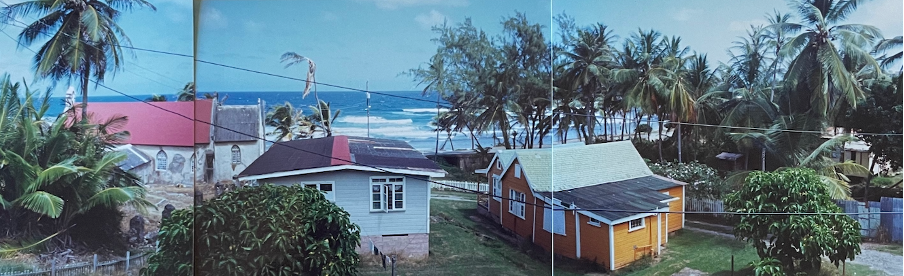
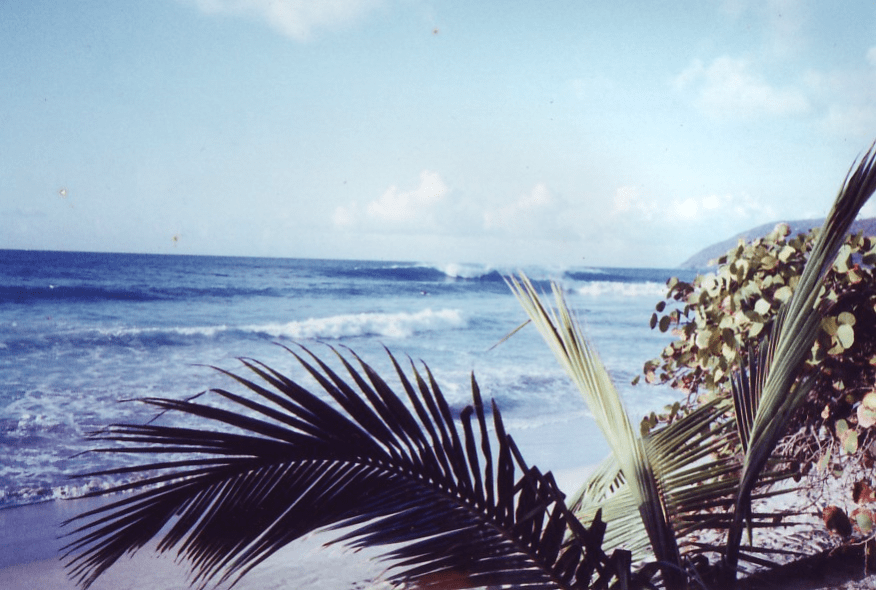
Cane Garden Bay was seven kilometres northeast from Apple Bay. It was the archetypical tropical paradise of sparsely populated, steep wooded hills falling into a tranquil turquoise sea. (Well, sorry for the cliches, but that’s what it was, and still hopefully is). Normally it was an occasional anchorage for a handful of the luxury yachts that frolicked round these islands. But, as I soon learned from the few local surfers, when the big groundswells rolled down from the northwest, the bay’s northern point produced one of the best waves in the Caribbean.
After a week of good to epic waves at Apple Bay, we heard a groundswell arrive in the middle of the night. At dawn, Johnno and I set out to walk to Cane Garden with our boards. After an hour of walking and half-running while watching the new swell surge onto the beaches and reefs, we got lucky with a lift on the daily milk truck and arrived to be nearly the first surfers out. It was still a bit raw and wild, but if you got a good one, you’d race a three-metre-high face for two hundred metres at warp speed. The afternoon session was even better: slightly smaller, but more lined up and groomed by the every-day trade-wind. The middle section was hollowest and you could hear the rounded river stones and old coral heads rolling against each other just beneath your fins. The waves turned electric blue and ruler edged, literally the waves of my dreams. In the evenings the local pelicans gathered out the back, just outside the first peak. A few times as I took off just inside them, they spread their wide wings and took off in front of me with the updraft from the wave. They’d glide a few metres ahead in perfect formation through the first section, then bank back out to sea as the wave shot into the hollow section near the rocks. It was bonkers; surreal. We had about six days like this.
Bizarre, also, was a few years later finding a photo of me surfing Cane Garden’s inside section stuck to the fridge in a beach house in the far south of New Zealand’s South Island, not far from Antarctica. The day I found the photo, I’d been surfing a left point called Porridge with a bloke called Wayne Hill. We were the only surfers for a hundred kilometres so we soon got to chatting. Afterwards, he invited me back to his house for a cuppa to warm up. As we shared stories he stopped and fetched a matchbox-sized photo from the side of the fridge. Is this you? he said; and it was. One of his friends had been crewing a yacht in the Virgin Islands and had sailed into Cane Garden that day. He’d taken a quick snap while they’d dropped anchor. He had no interest in the surfer but he knew Wayne would be interested in the wave. He’d had a mini-print made and sent it with a letter to New Zealand. I’m hardly ripping, but I reckon the photo captures a little of the speed and beauty of the wave.
The highlight of the social life in Tortola that month was spending time with John and Nancy. Johnno was a Bondi boy who’d moved to New York, got a green card, then worked as a rubbish collector to fund surfing trips to the Caribbean, Central America and beyond. I’d hardly spent any time with Australians for over six years and hanging out with John was as good as being home again. Best of all, Johnno and his girlfriend Nancy rented me a room for twenty bucks a night in a really nice house they were long-term renting in Long Bay, just a scenic ten minute walk over the hill from Apple Bay. Without that room, I couldn’t have stayed on Tortola for more than a week, so I owe most of these waves and experiences to you, Johnno and Nancy. Thank you! I hope the last thirty years have treated you well.
John caught me up with a lot of the Australian bands I hadn’t yet heard: The Cruel Sea, Celibate Rifles and the Died Pretty, among others. When his mate arrived from Australia with gifts of Tracks (surfing) magazines, Tim Tam biscuits and Three Threes pickles, John shared the precious treasure with all of us. On the other side of the ledger, like a true Aussie, he didn’t hold back when I thoughtlessly caught the cracking left at Apple Bay he’d waited an hour for. Then when I suspended myself from surfing the next day, he told me to get over it and get back out there. His girlfriend, Nancy, was a New Yorker who tolerated me for weeks and treated me like family when she cooked great meals. She also guided me to the island’s only clothing shop where I spent the airline’s emergency fifty bucks on the the bright-yellowest, most expensive, pair of boardies I’ll ever own. They were two sizes too big, meaning my bottom turns had two meanings from then on.
Another faction of our community were the surfers from the US east coast. A couple of them had sailed their own boats solo down to the island and had hair-raising stories of being caught in storms so fierce their boats had turned-turtle. They were a tough crew. When I flew to Puerto Rico in the last week of March, I met a lot more of them.
Before going to Puerto Rico, though, I’d better not forget Guadeloupe. This butterfly-shaped island lies halfway between Barbados and Tortola, so it made sense to have a short stopover there. All the Caribbean islands have interesting and often sad histories, but Guadeloupe has one of the saddest. After Christopher Columbus had arrived there in 1493, Spanish attempts to colonise the island were fought off by the indigenous people for over a hundred years. In the 1600s, however, France replaced Spain as the island’s colonial repressors and within a few decades, most of the indigenous population had died from gunshot wounds and European diseases. To replace the lost indigenous population, West African slaves were imported to build an obscenely lucrative sugar industry. In 1802, while France claimed to have achieved democratic freedom in their own country, they brutally suppressed a slave rebellion in Guadeloupe that concluded when the rebels collectively blew themselves up along with their store of gunpowder. In 1848, when slavery was finally outlawed in the French Empire, indentured labourers, who were slaves in everything but law, were imported from India to fill the labour gap. Just one of so many examples of how enlightened Christians brought joy and meaning to the rest of the world through capitalism. Um… not.
Being a French territory, Guadeloupe didn’t cater for vagabonds like me aiming to live on scraps. Accommodation, car hire, food… everything was beyond my means for any more than a few days. Nonetheless, I had some great times. I walked two hours in thongs (a poor choice, I discovered after half an hour) to ride head-high left-handers in what appeared to be a tropical aquarium at Petit-Havre. When I hired a car for a few hours on my last day, I found a great righthander all to myself and miles from anywhere at Pointe Plate on the northeast coast.
Christian, my host at the pension, also served as tour guide when he wasn’t working. He took me to Le Moule, the island’s everyday wave, and when a couple of other guests arrived from France, he loaded us onto the back of his ute and took us to Basse-Terre, the wild, beautiful southern half of the island, where we swam under the Chutes de Carbet waterfall. He also took us to someone’s house-party where I danced myself lame to local drum music I’ve searched for ever since.
And on that musical note, let’s go to Puerto Rico and learn some Spanish. The trip’s about to get rowdy.



Chapter Four
Puerto Rico
Puerto Rico was loose; too loose. It was only a hundred and fifty kilometres east of Tortola across the Caribbean Sea, but it was a whole ‘nother universe.
For surfers from the US’ eastern states, the Rincon / Puntas area in the northwest corner of the island had been a surf-party-draft-dodgers’ paradise since the mid-1960s. By 1968 it was high enough, pun intended, on surfers’ radar to host the World Surfing Championships. Being a US territory, but not a state, it was a bit like the Wild West. Every day held the possibility of the best or the worst of times, or both. Some of the local gringo crew had come for the surf; some had come for the parties.
The gang I spent most time with seemed to have walked straight out of songs Bruce Springsteen wrote about his New Jersey hometown on his first few albums. They said things like ‘You can’t read a book without turning the pages, you know what I mean, pal?’ Time with them was one long crack-up. They owned surfboards but never took them in the water. Often they’d be settling into party-mode before lunch-time. I’m not saying that’s wrong, it just meant we didn’t get much done.
Two of them were terrific guitar players and a couple played harmonica. I hoped our Rincon gang could make a band and look for work in the local bars and restaurants. I’d spent the downtime in Barbados and Tortola writing songs on the cheap travel guitar I’d bought in London. In my idealistic haze, I planned to record them somewhere, somehow, on the road. But though a dozen inspired jams went down in houses and bars and on beaches, we never organised a real rehearsal or a gig. And despite my Plan B to make an album by simply recording one of our jams down at their awesome farmhouse in the valley, that never happened either.
Pretty emblematic of this state of mind was when an American guy we half-knew came to find us in a bar called, appropriately, Trouble in Paradise, or TIPS for short. “There’s an open-mike night tonight up in Aguadilla; I can drive you there”, he told us. So we gathered our instruments and climbed into his car: two in the front and four in the back. The road from Puntas, our village, to the main road to Aguadilla is narrow and runs downhill through farmland. By the time we were halfway down the hill, we’d missed two head-on collisions by inches. I hadn’t fully realised before, but our driver was seeing-double-drunk. As passing headlights came towards us, he’d drive straight towards them. Since I was sitting on Jimmy’s knees on the left-side of the back seat with no seatbelt on and my head wedged against the roof, the coming collision was going to be infinitely worse than a rusty knife in the eye.
By the time we reached the bottom of the hill, we were doing about a hundred clics and I could see in slow motion what was going to happen next. Our road met the main road at such an angle that there would no need for our homicidal driver to slow down to join it. In the distance, a single car was heading towards us at the perfect speed to meet us head-on where the two roads joined. Sure enough, our driver ignored both stop signs and drove straight at the onrushing headlights. Marco, in the passenger seat, grabbed the steering wheel and pulled it to the right. By the grace of God, the driver of the other car did the same thing and at a closing speed of a couple of hundred kilometres an hour, we passed within a few centimetres of each other.
As soon as we’d stopped fish-tailing and regained coherent motion, I had to find a way to escape. Knowing that even a drunk can picture the consequences of someone spewing in their car, I announced I was about to throw up. My band-mates weren’t having any of it: “No, no, you’ve gotta come, man. You’re the only one who knows the words to the songs” and we continued weaving at high speed towards Aguadilla. With desperation approaching panic, I was surprised to discover that while my nausea had begun as a lie, I could now easily produce real vomit if required. But before that happened, the driver got the picture – he was probably renting the nice BMW I was trapped in – and he pulled over and stopped.
I climbed out and fake-stumbled to the roadside fence, pretending to be about to yak. Marco followed me over to see if I was okay. I’m fine, I said, but I’m not getting back in that car. Okay, said Marco, I’ll keep you company. So we grabbed our guitars out of the trunk, waved the others off to Aguadilla and walked the three kays back up the hill to Puntas. Whenever headlights appeared, we hid behind trees, giggling as if we were ten year olds playing ‘Spotto’, to avoid the attention of the night’s other drunk drivers.
Like the Wild West, it seemed there were no police in our corner of Puerto Rico. This was why most homes were completed by the addition of at least one brute of a dog who’d rip your leg off given half a chance. This I discovered the only time I walked the few kays home at midnight from the boys’ valley farmhouse. As I tip-toed past each one-acre property, a different breed of hellhound came crashing through the darkness to bark, snarl and salivate in my direction. All that stood between me and live disembowelment were flimsy wooden posts connected with just enough rows of barbed wire to keep the beasts on their home turf. The big stick and half-brick I’d picked up for defence would have been as good as useless if one of the dogs had broken through. The only effect these make-shift weapons had was to alarm the town drunk who witnessed me emerge from the darkness at the edge of town after I’d run the gauntlet.
Another American our gang knew had rented a house near Puntas for the six month surf season. He was living what he thought would be the dream: surfing every day it was good while growing a forest of hydroponic marijuana in his attic. He planned to sell this crop locally, or send it back to the states somehow, to pay for his next surf adventure or three. Intelligent and talented, he didn’t seem like the guy who’d choose that path. He told me this had been the worst six months of his life. As soon as the plants had started growing, he’d become paralysed by paranoia. He couldn’t share his secret with anyone, even his closest friends, in case their gossip found its way to the wrong ears. It wasn’t so much the police he feared. Much more dangerous were the invisible Puerto Rican criminals who had their own drug-growing operations and would tolerate no gringo competing with their trade.
The last time I saw my mate, let’s call him Billy, after the young drug-smuggler who ends up in the Turkish jail in ‘Midnight Express’, was at L’Estacion Bakery in Rincon one Wednesday at lunchtime after a morning of good surf. I’d watched Billy park his car in the ninety degree spaces across from the bakery. As he crossed the narrow two lane street, his truck silently followed him, rolling backwards down the gentle slope of the carpark, then curving sideways on its previous lock across two lanes of traffic. Billy must have left it out of gear and forgotten to pull the handbrake on. He was lucky it didn’t run him over. Instead, it swung gracefully past several slowing cars, somehow missing everyone and everything, until it came to rest against the curb. It wasn’t until I met Billy at the bakery door to point it out, that he saw what had happened. Over lunch that day, he told me he’d decided to get the hell out of Puerto Rico and disappear back to America. He’d leave the now fully grown crop in the attic for the landlord or the next tenant or someone, anyone, to deal with. The day before, we’d all heard the too-believable rumour that an American in a village just up the coast had been shot in the head by a Puerto Rican gangster for reasons that were too easy to guess.
The only time I saw police of any sort in Puntas / Rincon was on my first morning at Domes Beach. I’d got up before dawn and walked through the fire-fly-filled bush that separated my place from the sea. As I arrived by the decaying dome of the decommissioned nuclear reactor that gives the beach its name, I heard shouting and running. A hundred metres away, three rough young men were doing their best to disappear up the hill into the low trees and scrub. Pursuing them were half a dozen men wearing dark blue uniforms saying ‘Immigration’. By the time I’d checked the surf, two of the young men had been caught, handcuffed and man-handled into a van; the other might have got away. I learned later this corner of the island is a popular spot for illegal immigrants arriving by sea from the Dominican Republic, just fifty kilometres to the west across the Mona Channel. Since Puerto Rico is an American territory, illegal immigrants from the Caribbean try to use it as a stepping stone. If they can get to PR, it’s easier to sneak into the USA by some backdoor than it is from their home islands.
There were other manifestations of Puerto Rico’s relationship with the USA. My first hour in PR was spent in an ageing taxi trapped in a traffic jam on a twelve-lane highway in the capital city, San Juan. With zero public transport on offer, the only way to travel the hundred and fifty kays to the surf coast was via the most expensive taxi ride of my life. Luckily I shared the fare with a young kid who introduced himself as Danny from Brooklyn, New York. Danny told me he was making the journey to Rincon to, quote, ‘make something of my life’. Since he wasn’t a surfer, it’d be a fair guess to suspect he was beginning a career as a drug mule.
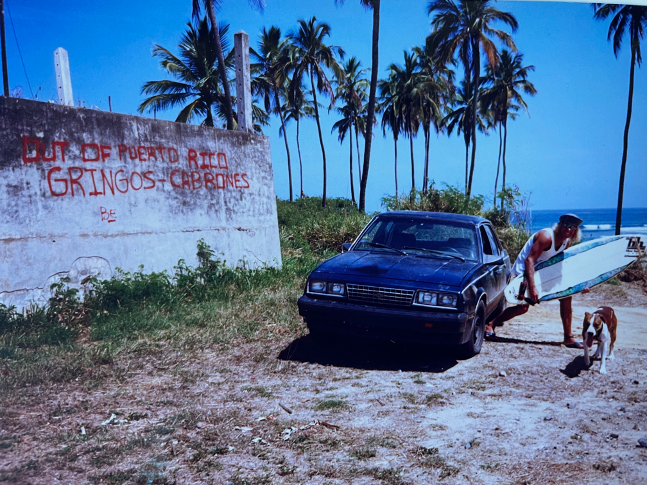
Another enduring monument to the USA’s relationship with Puerto Rico was the – to give it its full name – Boiling Nuclear Superheater Reactor that the US government had built and operated through the 1960s a hundred metres from the island’s best surf. This location had been chosen because the fallout from any catastrophe would be carried by the prevailing winds across the Caribbean Islands, Central America or Europe, instead of the USA. God bless America. The eerie, rusting dome of the decommissioned reactor loomed forever above the otherwise rural coast. It wasn’t surprising that on a concrete wall not far from the reactor, someone had spray-painted ‘OUT OF PUERTO RICO, GRINGOS CABRONES’. Cabrones is Spanish for arseholes. It wasn’t hard to see the artist’s point.
The local I got to know best was my landlord, Tony. He’d created a unique living space by painting the floor, walls and ceiling of my single-room apartment in an exuberant melange of red, white and blue. It was the perfect digs for me: enough of an ocean view for surf-checks; just a five-minute walk through the bush to the waves; and best of all, only fifteen bucks a night.
Tony had his demons, and one of them was a child’s baby-doll that hung by its neck from a length of wire nailed to the eave of his house so it was visible from the street. Tony grew very upset when I asked him why it was there. His English was only a little better than my Spanish, which I had just embarked on learning, but as far as I could understand, there had been some massive disagreement with someone in his family and he’d woken one morning to find the ghoulish baby-doll hanging there. It was Puerto Rican voodoo, an evil curse, he explained, and there was nothing he could do about it.
Tony blamed the curse for driving him to drink. Each time we talked during our four weeks as neighbours our conversation veered back towards the doll. I wanted to help him with it and hoped that my status as an outsider might prove useful. Like most Puerto Ricans, Tony was Catholic, so I deployed the theological lessons that had been hammered into us three times a week at school: Hadn’t God defeated Satan and thrown him into Hell? Hadn’t Jesus promised forgiveness? Surely then, ‘good magic’ must be stronger than ‘bad magic’? I don’t know whether Puerto Rican voodoo defers to Christianity, but on the second last morning of my stay, I saw the hanging baby-doll had disappeared.
Apart from my chats with Tony, and the occasional moment in the surf on weekends, I spent nearly no time with Puerto Rican males. It was as if they had given this corner of their island to the gringos, except for when the surf got epic. On the other hand, like the salsa music that strutted and bounced from every house, shop and bus, the Puerto Rican females were around us all day and into the night. I’d played a small part in a school production of West Side Story, and from that had developed the notion that Puerto Rican girls were sexy and sassy. Well, they certainly were. They were there on the beach, in the shops and bars, always smiling and introducing themselves. As far as I could tell, they weren’t prostitutes, and to my knowledge they never permitted direct intimacy. But by gum they could flirt. They reasoned, and with justification, it must be said, that their feminine charm could be their way, and perhaps their whole family’s way, to a more affluent part of the world. I learned early on not to be surprised or offended when the attractive girl who’d been so chatty to me the night before was even more chatty to the gringo who arrived at the beach the next day in an expensive hire car. They were beautiful, engaging and pragmatic. One or two of them brought young children, presumably theirs, when they made day-time visits to Rincon from Mayaguez, the city thirty kays to the south. Their relationship status was unknown, but it wouldn’t have been at all surprising if a father, husband, brother or boyfriend had turned up with a gun or a knife.
So due to the perennial party culture and the flirting of the local girls, it was also no surprise that when a good swell finally arrived after a week’s wait, my eye wasn’t on the ball. Remember: in those days, surf forecasting was your own responsibility and required access to meteorological information beyond my reach in Puntas. Wiping the sleep from my eyes at 10.30 after one beer and pool game too many the night before, I saw dark blue lines wrapping into the coast. Dagnabit! I grabbed my board and some breakfast and ran down to the coast. After jumping off the rocks at El Faro I ended up at Dogmans, about two kilometres south, surfing Indicators, The Point and Marias on the way. The waves were big, blue and powerful, sweeping southwards down our corner of the coast. The names of the waves were just sections of the same almost unbroken reef that stretched for five kilometres and beyond.
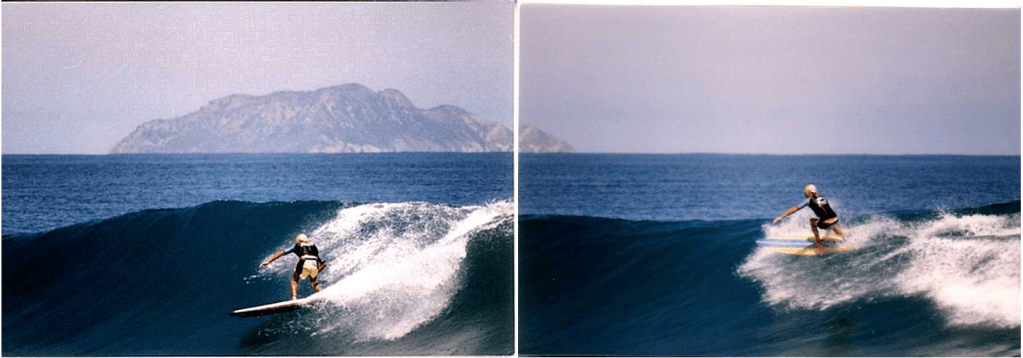
Being Good Friday, it was crowded, and for once the local boys were out in force. They surfed aggressively and well and, while we got some waves, us gringos were put firmly in our place. I shared my usually solitary lunch-spot under the trees at Domes Beach with a huge local holiday crowd while whales breached in the Desecheo Channel. The next day I surfed some of the biggest waves I caught that year at Dogmans. The waves weren’t quite as good as Soup Bowl or Cane Garden Bay but I got one of the waves of my life at Domes the next day when I rode a pretty big wave the length of the beach, about three hundred metres. Apparently this was a big achievement.
Rachel and Valerie, two American girls, had set up in the village for the winter, financing their extended stay by taking and selling good photos of the visiting surfers. Once a month they held a slide show at ‘Tamboo Beside the Pointe’, one of the local bars. The surfing community convened to review the month’s best rides and wipeouts. The atmosphere rivalled my first surf movie experience in 1975 when Hal Jepsen’s ‘Super Session’ was shown at the Balgowlah Cinema in Sydney. It was interesting to discover that a still image shown on a big screen in a crowded, dark room can elicit the same response as a moving image. The audience’s subjective guesses about what happened before and after that single captured millisecond create an unresolved tension with its own unique, unspoken drama. There’s also time to study every detail of that moment in much more depth than when watching a real-time moving image that rolls directly on to the next milli-second, then the next. Andrew Kidman and George Greenough, among others, have employed this principle in their seminal films by showing waves and rides in super-slow motion, almost frame by frame.
In the last few days on Puerto Rico, I realised I was asking too much of my beloved surfboard, Byron, to make the journey on her own. Water had been getting in through cracks in the fibreglass around her nose, and dents were deepening where the foam was starting to collapse. I asked the local boardmaker, Rusty Ellwood, to make Byron a companion: a modern six foot ten thruster with plenty of volume, wrapped in carbon fibre cloth for added strength. Then I bought a properly padded double-board-bag to replace the feeble bubble-wrap sleeve that Byron had braved all her life.
April was half-gone. It was time to leave the Caribbean islands and jump two thousand kilometres west to Central America.
Vamonos a Costa Rica!


Chapter Five
Before (and a bit after) 1993
Looking back, it seems pretty clear I was born with a strong case of the wanders. Was it a blessing or a curse?
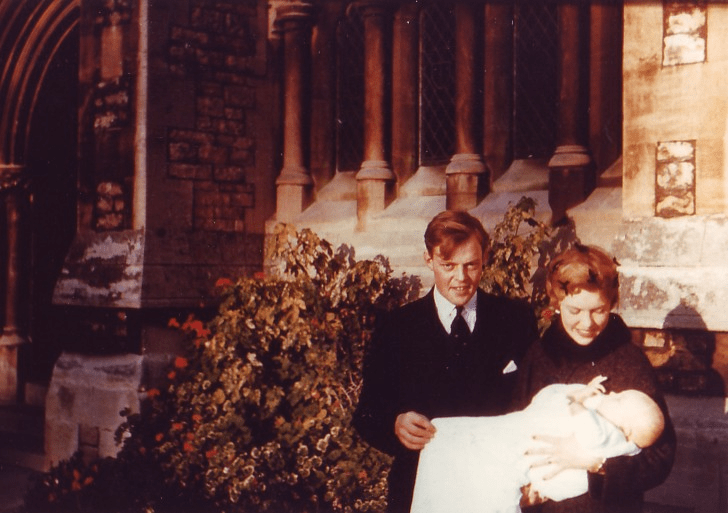
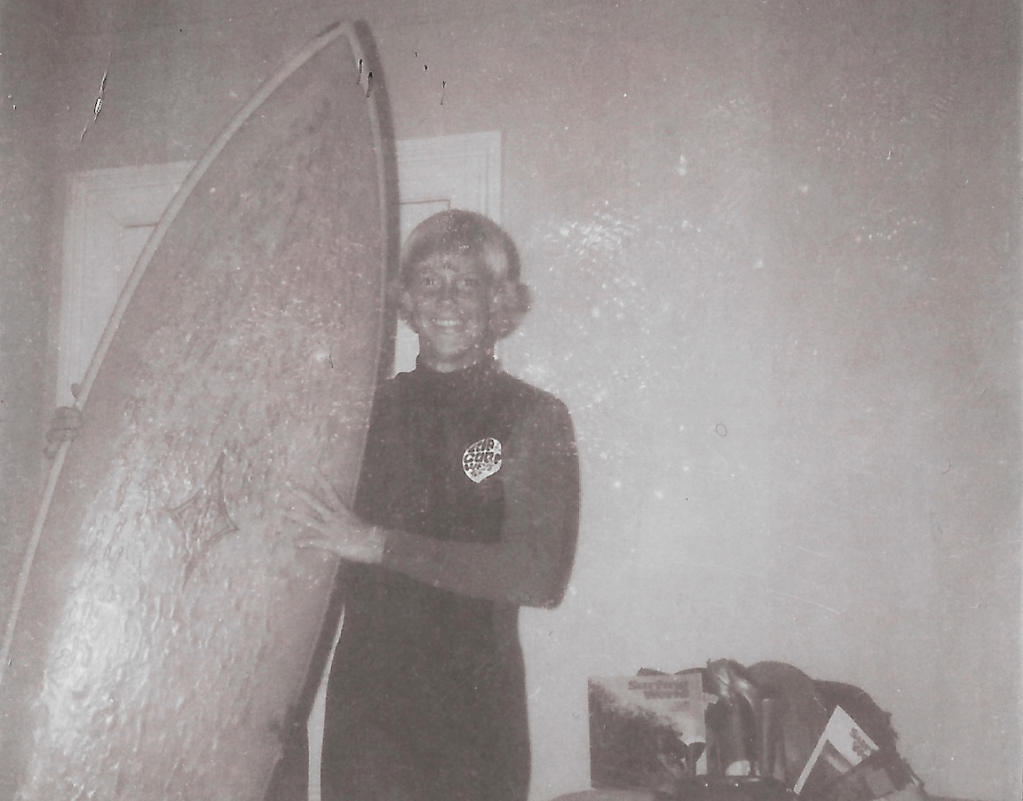
As soon as I could walk, I went adventuring. At a few months less than two years old, I escaped from my mother and tottered into the road to head-butt a fast-moving car. The bright light of the hospital’s x-ray room is one of my earliest memories. Alive by the skin of my teeth, I pursued an obsession with the railway lines that disappeared into a tunnel near Clifton Downs station. I liked the trains too, but it was the tracks’ harmonic curve and disappearance into a black hole in the hill that held me in thrall. Not long after, my trainer-wheeled bike took me wobbling round the paths and gothic quadrangles of Clifton College where Dad taught in Bristol. Then my parents bought a caravan and in summer time we followed Dad’s cricket games for Dorset round southwest England. In my first five years we had five homes, including my grandparents’ in London and Witney, and I discovered that nothing beat the thrill of waking in a different bed, in a different place.
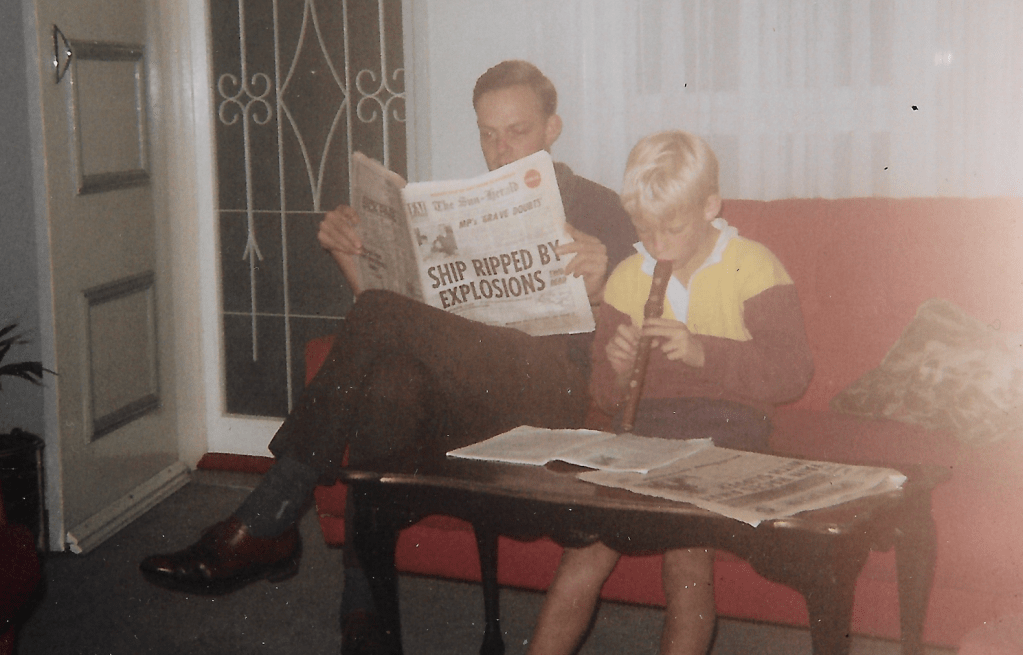
We emigrated to Australia when I was six. The flight was long and terrifying. Our first stop at Zurich was aborted due to a severe blizzard. We were forced to fly on to Beirut where we were struck by lightning as we landed. It would be ten years before I dared get back inside a plane again. Once safely settled in Sydney, my modes of exploration moved to the harbourside bushland, stormwater drains, naval bases and railways tunnels of Waverton. By the age of seven I’d been brought home by the police more than once.
At nine we moved to Chatswood, where the three tree-ed acres of Muston Park was our front yard, and Scotts Creek could be followed, through bamboo, factories, toxic mud and concrete spillways, as far as Castle Cove or Willoughby. Fishing rods, skateboards, bikes and billycarts were our evolving passports to adventure. A Sunday morning newspaper delivery round introduced me to the silent, dew-soaked solitude of the predawn world. It also gave me financial independence to explore other dimensions such as Led Zeppelin albums and weapons-grade fireworks, purchased each June from the newsagent, ever happy to encourage pyrotechnically minded pre-teens. With these, we’d set the park aflame, blow up model planes, glass bottles, and somehow not quite our fingers and faces. The excitement was heightened by the addition of a stray, manic kelpie that adopted me for a couple of years, until he mistimed his thousandth attempt to round up a speeding semi-trailer in four lanes of traffic and was run over. I cried for a month.
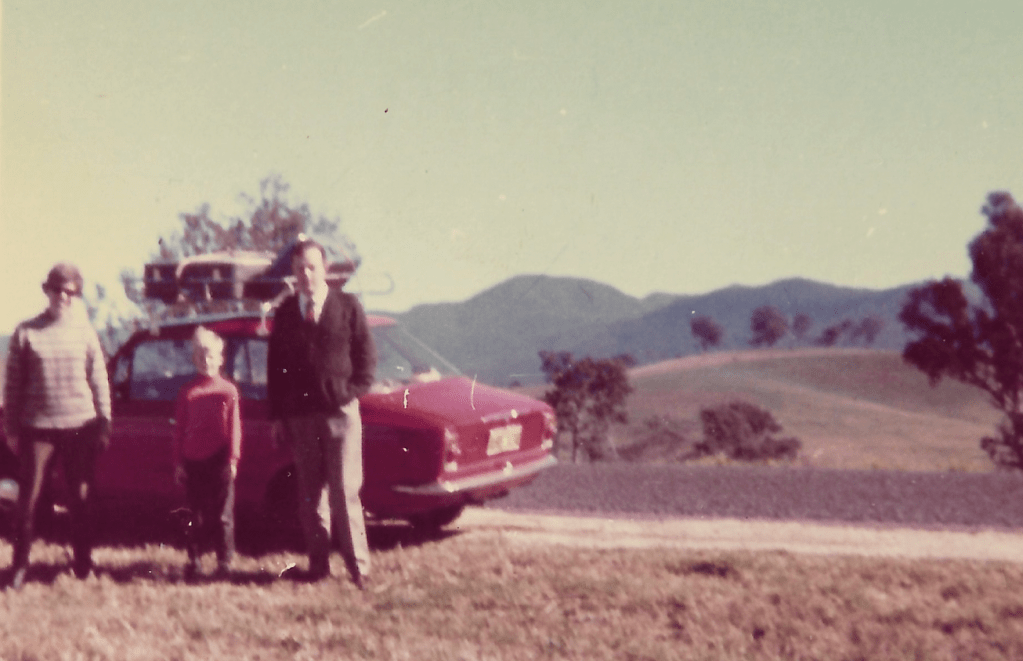
In the school holidays, Mum led us on random expeditions round New South Wales. Once we drove northwest towards Bourke, joining in Mum’s quest to (quote) “drive until we get to nothing”. Sadly we were forced to turn back unrewarded when our tiny red Corolla’s windscreen was shattered to a million pieces.
At thirteen we moved back to North Sydney and I fell in love with surfing via skateboarding and the epically romantic surfing magazines of the mid-1970s. Every issue featured electrifying stories and images of surfers travelling in ones and twos to ride undiscovered waves on the exotic coasts of every ocean. Dreaming of one day making my own leap into the unknown, most Sundays I’d get up at five to trek with my second-hand surfboard through the deserted office buildings to catch the snail-paced buses to Manly or Bungan.
My Year 11 maths tutor couldn’t help me with quadratic equations, but his Friday night slide shows gave another crystal clear vision of how spectacular life could be. Andi and his fellow mountain-climbing super heroes disguised as mild-mannered Clark Kents spent their uni holidays climbing progressively more challenging Himalayan peaks: first Changabang and eventually Everest, with no sherpas or oxygen, where Andi’s crampon broke fifty metres from the summit, leading to the loss of all his fingers on the descent. Not that it’s ever a competition, but the adventures that happened to me in subsequent years were tame compared to what these blokes experienced.
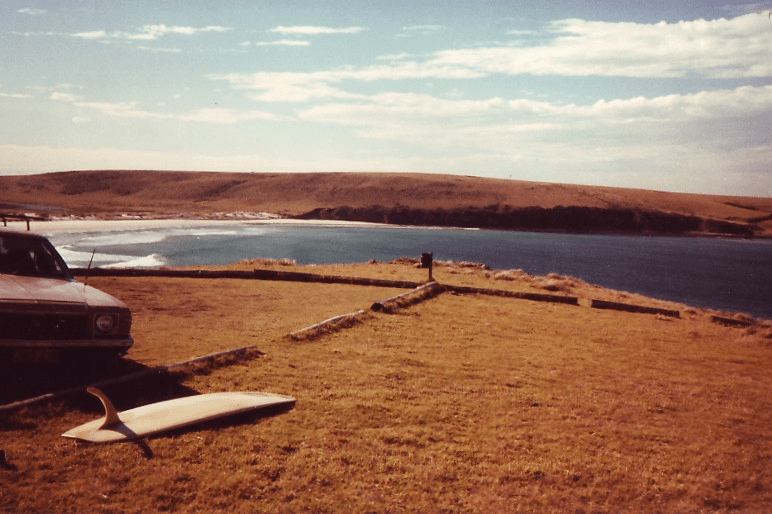
At uni my mates and I got cars and over the next few years explored Australia’s southeast coast from Noosa to Port Campbell. We slept in tents, musty caravans, Honda Civics and Kingswood station wagons. I discovered how much I loved living rough on a shoestring budget.
Another world opened up when I got a dogsbody job in a recording studio where Midnight Oil, INXS, Cold Chisel, Duran Duran and so many other great bands of the early eighties rehearsed for their Australian tours. Some friends and I made our own band and we did well enough playing in the pubs around Sydney to add two years to my ramshackle three year Arts degree.
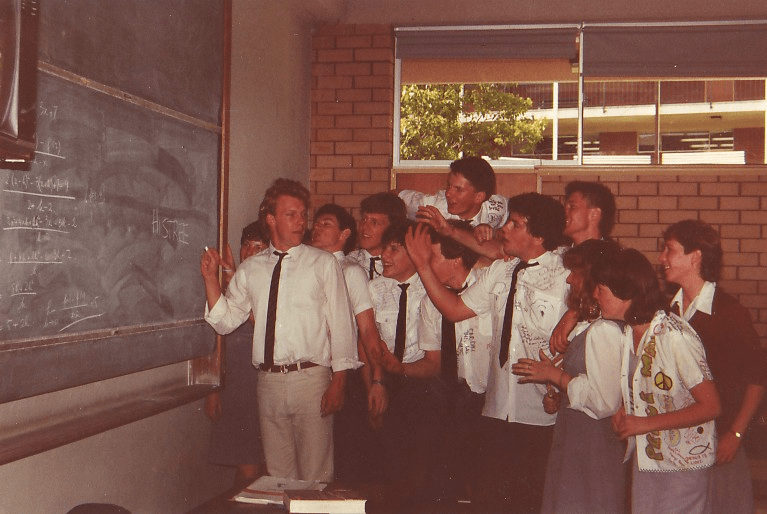
Then, out of the blue and by accident, I became a schoolteacher. I’d only called the school to enquire about the job to convince my parents I was serious about finding paid work. I had no teaching qualification, just my simple B.A., but to my surprise the Headmaster called me in for an interview, then gave me the job. Just three days later I taught the causes of the French Revolution to my first History class, and by recess I’d realised teaching was the best job in the world. The longest and most complex adventure of my life had begun.
Three years later it suddenly struck me I had enough money to leave and not come back. What was I waiting for? I bought a one-way ticket to London and sold everything I owned. For fourteen years I taught in England, Ireland, New Zealand, Canada and Indonesia. In the holidays and long breaks between jobs, I hitched, bussed and trained through Western Europe, Turkey, Africa, Asia and the Americas.
1993’s year-long journey home to Sydney through the Caribbean and Latin America was somewhere near the midpoint of this time of my life.
These nomadic years were as full an experience as this little black duck could ever have imagined. Every minute on the road was an education no school or university could give. Not knowing where you’d sleep that night or what you’d find for the next meal heightened your senses and thinking. You could meet anyone or no-one; end up at your imagined destination or somewhere utterly different. Where your wits intersected with the winds of fate, you appreciated every bit of luck and learned to cop the hard times on the chin.
I wondered what could ever make me want to stop.


Chapter Six
Costa Rica
After the funky jazz of Puerto Rico, Costa Rica was a good old-fashioned, country-soul surf mission. For twelve days, Joy and I searched for waves along the thousand kilometres of Costa Rica’s Pacific coast. We forded rivers, survived storms and slept mostly in the sweaty, lain-down front seats of our hire car.
When we’d parted in Barbados two months before, Joy had asked me to call her at her mum’s place on the US east coast sometime in early April. If Joy’s work at the hotel in Hawai’i was still on-hold due to hurricane damage, she’d been keen to join me on another surf-trip. So when I called from Puerto Rico and said I was heading to Costa Rica, Joy booked a flight to meet me two weeks later in San Jose airport at 7pm. All it took to confirm our arrangements was one more three-minute phone call a few days later: no flurry of texts, facetimes and emails required. Easy beans.
My flight arrived in San Jose an hour before Joy’s, so I passed the time by searching for a rental car. Every company with a counter at the airport told me their cars were either booked out or astronomically expensive. Amazingly, when I went back to the same counters accompanied by Joy an hour or so later, we found just the car we wanted at a very reasonable price. I wonder why.
By the time we’d done the paperwork and loaded our stuff into and onto on the car, it was too late to get any value out of paying for a hotel. So we began our adventure with the time-honoured tradition of an all-night drive to the coast. Finding the right highway to take us from the airport out of town was a trial. But once on track, it was a pretty straightforward three-hundred-kilometre, five-hour drive to our first destination: the waves at Witches Rock in Costa Rica’s far north. This isolated spot had become a favourite of the American surf magazines in the few years prior. The perfectly formed, cobalt-blue waves breaking on a white-gold beach in a pristine national park were made even more photogenic by the grey-white rock-stack that towered above the horizon half a kilometre out to sea. It was a surf-photographer’s dream.
While the empty, well-built highway made night-driving straightforward, staying awake proved more difficult, so a couple of times we pulled off the road to catch a half-hour’s sleep. Parked in the middle of nowhere in a hire-car full of gringo stuff and surfboards stacked high on the roof, we felt like an invitation to robbery, or worse. Our first lay-by was a narrow shoulder of the highway lit up by the bright orange lights of an oil refining plant. We weren’t sure if the lights made us more secure or more of a target, but we dodged that bullet and in the early dawn light we found the rough dirt track through the Santa Rosa National Park to the Witches Rock beach.
It was the first time I’d been beside the Pacific Ocean since I’d left Sydney six and a half years before. And this morning it was indeed pacific: no waves, no wind, just deep blue, like a lake, all the way to the wide horizon. But in the distance to the north, we could see the famous offshore monolith that gives the wave its name. So we packed the only food we’d brought – one small muesli bar each and a bottle of water – and went for a stroll down the long, empty beach.
We’d gone a couple of kilometres before we realised the mistakes we’d made: the carpark was in a corner of the beach protected from the swell; and the beach was longer, the rock was taller, than had appeared at our first dawn glance. As we walked, tiny lines of open-ocean swell grew from ripples to ankle-slappers and beyond. By the time we neared Witches Rock, the swell-lines were head-high and the waves were absolutely firing. Joy decided she was too tired to do anything more than catch up with some sleep on the beach, so in the rapidly climbing heat I jogged back alone to the car to get my board. By the time I’d completed the four kay round journey I was fully cooked, but I managed a few good rides before dehydration, hunger and exhaustion set in. The waves were every bit as good as the magazine photos had promised: hollow, fast and, for a beach-break, long.
At late morning we trekked back to the car, desperate for food and water. With none of either available in the national park, we made the hour-long drive on dirt tracks back to the nearest town. We’d planned to return to Witches Rock to camp and surf the next day, but by the time we’d found lunch and rested up, the decision was made to continue driving south in search of other waves, both known and unknown.
First up was Tamarindo, a well-advertised surf-town about two and a half hours’ drive away. Contrary to our Witches Rock experience, Tamarindo didn’t live up to its hype. Sure, we only gave them a couple of days to show their wares, but the quality of the waves seemed exaggerated. Even more decisively, the town was expensive and commercialised, with new tourist developments and quite a few older ex-pat Americans giving it the feel of a new suburb of Florida or Southern California. This wasn’t what we were travelling to experience, so after a couple of days we a drove a hundred kilometres further south towards Samara on the Nicoya Peninsula, to find places without postcards.
Someone somewhere had told us to look out for a beach called Camaronal, but it wasn’t mentioned on our undetailed map, and road signposts of any sort were few and far between. A good surfbreak only needs a couple of hundred metres of sand or reef to do its thing, so searching a patchily accessible one hundred kilometre stretch of coast with too little information is a helluva challenge. But the dreamed-of reward of finding and riding, ideally alone, an elusive wave in an exotic locale, makes this search forever enticing.
After Samara village, the decent road we’d been following turned directly inland, and the road that we guessed would stick closest to the coast grew rough. After following a series of frustrating, waveless dead ends around the little village of Puerto Carrillo, the track that seemed to carry the most promise simply disappeared into the River Ora. It seemed there might be a rough track about fifty metres away on the opposite riverbank, but wouldn’t some sort of punt be needed to get us across? Over a late lunch by the river, we debated our options. I was in the process of getting organised to wade and/or swim across the river to assess its depth when we heard an unseen truck approaching down the rough hills on the far shore. As the truck emerged from the scrubby country, it shifted down through its gears and followed the track gingerly into the river. It lurched around a fair bit as it bumped over big rocks on the riverbed, but the gently flowing water was less deep than we feared and the riverbed was plainly firm enough to take the truck’s weight. Okay then. Our four wheel drive rent-a-car didn’t ride as high as the truck, but it was clear we had too good a chance of making it to chicken out. We took the plunge.
After a couple of adrenalised moments when it seemed we might have wedged our wheels between rocks, we cleared the river and were rewarded with the roughest track and steepest hills we’d encountered. Adding to our growing anxiety about getting stranded in the middle of nowhere, a massive electrical storm blew in from the sea. Driving rain made it nearly impossible to see through the windscreen and several times it seemed we were trapped in deep divots in the red-mud road. While lightning and thunder seemed to aim personalised attacks on our lonely souls, we clawed up, then down, the winding spine of a series of low hills. Eventually, in the last light of day, we returned to flat land at sea level. As the countryside grew less wild, Joy thought she saw a handpainted sign saying what might have been ‘Camaronal’ illuminated by a lightning flash. But neither of us were in the mood to explore further. Instead we searched for a safe, quiet place to park up, have a bite to eat from the food we’d packed, and sleep. This haven we found a few kilometres further east at a lonely beach village called Playa Islita. Despite the last of the storm crashing around us, we fell asleep pretty quickly in the front seats of the car while little wind-born waves washed against the high-tide line.
The next morning dawned clear and calm and the ocean out front of where we’d parked was flat. Retracing our route from the evening before, we re-found the hand-painted sign saying ‘Camaronal’. Driving through an open wooden gate, we crossed an open field to the coast. The beach was completely deserted – we might as well have been the only humans on the planet that morning – but to our surprise a few waves were breaking on a series of sandbars divided by deepwater channels. Wisely cautious as ever, Joy said she’d watch from shore while I paddled out to wash off the sweat from last night’s driver’s-seat-sleep.
As I paddled out in one of the deep-water channels, I felt something like electricity. The water was barely translucent and each drop seemed to cling to my fingers as if it was alive. The rip raced me quickly seawards and I discovered the waves we’d seen from the car weren’t little waves at all. I was only half-way out the back and already I was watching some the biggest beachbreak waves I’d experienced alone. I paddled hard to get out of the rip and over the sandbank to the left where the most consistent waves were breaking. With my heart pounding, I took off on the first wave that peaked near me, a small one compared to some others I’d seen. Joy was watching and told me later it was double overhead. It exploded behind me and I bellied it a hundred metres to the beach to get the hell out of there. Phew.
Guessing this was the start of a new groundswell, and not being comfortable in the wild isolation of Camaronal, we decided to hightail it south to Pavones, the wave in Costa Rica we both most wanted to surf. It was five hundred kilometres and about ten hours’ drive away, but in the spirit of that trip, that didn’t seem a big deal.
We drove back over the sketchy hill-track we’d crossed the night before and returned to the river crossing. Both were made even hairier by the effects of the previous night’s storm. From Samara we followed the well-paved but slow-winding road through farmland north across the spine of the Nicoya Peninsula. We re-joined Costa Rica’s mainland by taking the old ferry across the Tempisque River. In 2003 this ferry was replaced by a bridge named ‘The Bridge of Friendship’ since it was designed and financed by the government of Taiwan. Four years later, when Costa Rica turned its back on Taiwan to build a close relationship with China, the bridge was re-named ‘The Back Stab Bridge’ by the locals.
From there we turned southeast past Punta Arenas and Jaco, before stopping for the night at a cheap hotel beside a mosquito-ridden beach in Dominical. There we had our first shower and decent meal in a couple of days. Not surprisingly we didn’t wake till ten the next morning, so it was mid-afternoon before we arrived at Pavones to find kilometre long waves rolling down the coast. It was pumping.
Pavones is in the far south of Costa Rica. The border with Panama is just a few kilometres away over the hills. The area is thick forest with just a few simple buildings by the shore, mostly catering for surfers. It’s very beautiful, even before the waves arrive. We drove our car out towards the rivermouth and found a quiet spot underneath the trees where we could sleep to the sound of the waves for free. For six days this was home.
The best section of the wave was two hundred metres long, even more if you wanted to walk back up the point instead of paddling back against the swell-driven current. Once you’d positioned yourself right, the wave would slingshot you through section after section. It was easily as good as the descriptions we’d heard.
Each day Joy and I walked up the Rio Claro (the Clear River) to swim and wash. Spectacular yellow-flowered corteza trees lit up the forest where little monkeys and a thousand types of birds chattered and sang. On the beach we met Jimmy Hansen, from Ventura, and his girlfriend Julie. Jimmy is still one of the best surfers I’ve known. By coincidence we met later that year in Peru, and seven years after that we met again by chance on the stairs leading down to Uluwatu in Bali. Wherever you are, Jimmy and Julie, I hope you’re doing well.
But it wasn’t all beer and skittles. One of Joy’s contact lenses grew brittle in the every-day heat and tore in two, with one half sliding behind her eyeball. With the nearest eye doctor at least six hours drive away, it was an anxious couple of hours waiting for the half-lens to eventually emerge.
Much worse came on our second last night. Among the dozen-or-so people staying in the simple rooms on the point was a family with three young children, perhaps eight, six and four years old. Each night they ate in the rustic cantina, where several of the village dogs hung out, hoping for scraps. One night, for some reason – it seemed so out of character – one of the dogs suddenly took the four-year old’s face in its teeth and shook hard. It was horrific. Both the child’s cheeks were punctured in several places and blood was everywhere. We all did what little we could to help, but the family faced a long, slow drive – probably more than several hours – to the nearest medical facility, and it would be much further to the first proper hospital. We didn’t see them again.
On May 3rd we drove the four hundred kilometres back to the capital, San Jose, taking the scenic route through the beautiful Quetzales National Park. Somewhere near the airport we took a wrong turn and Joy missed her flight home to the US east coast by a few minutes.
Oh well, she decided, I might as well come with you to Nicaragua.
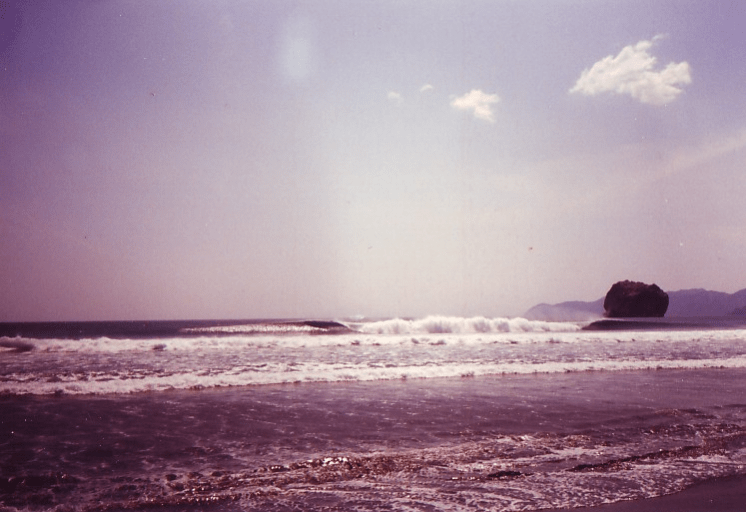
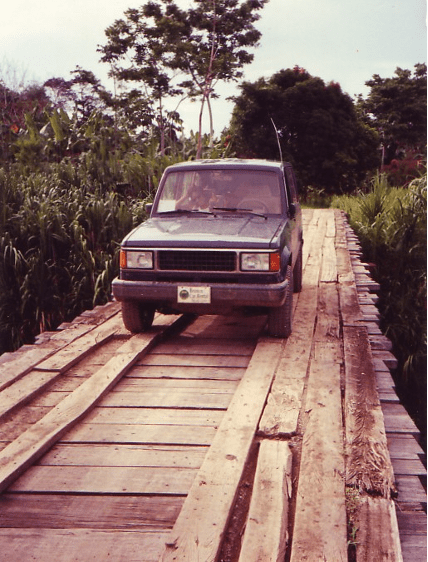
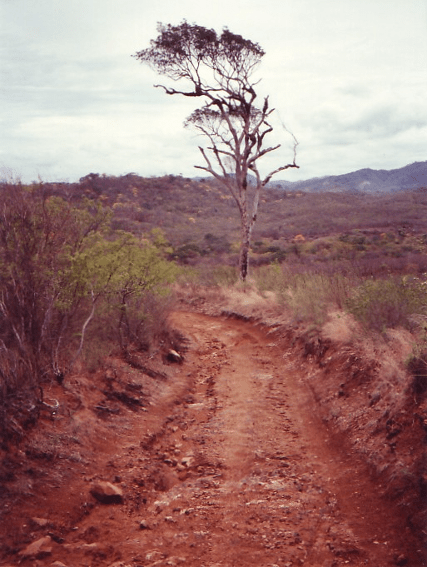

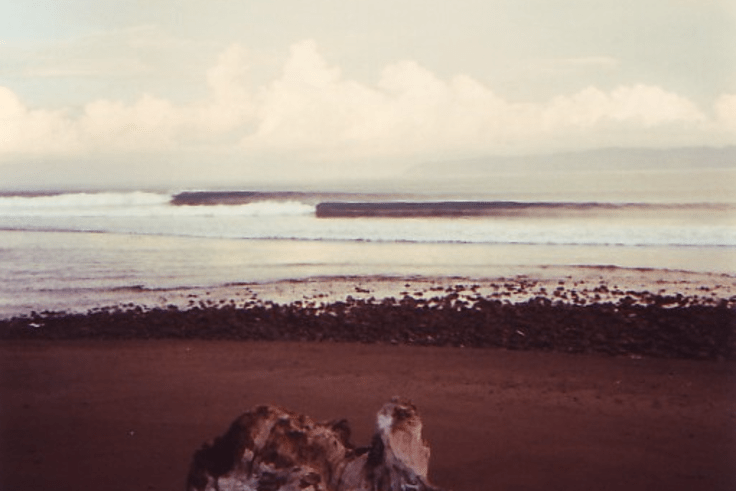
Chapter Seven
Nicaragua
Nicaragua was our first leap into a country whose waves we knew next to nothing about.
The one-hour flight northwest from Costa Rica with Joy, my Hawaiian travel partner, was a breeze and we rented the four-wheel-drive we wanted for a very reasonable price. But from there things got challenging.
In 1993, Nicaragua was struggling to recover from over a century of stop-start civil war. The most recent chapter of this ongoing tragedy had begun in 1979, when the Sandinistas, a ‘people’s political party’ and associated militia, had finally overthrown the murderous, hideously corrupt government that had ruled, with hefty US support, for over fifty years.
US President Reagan responded to this revolution by funding a paramilitary organisation called the ‘Contras’ to attack and destabilise the new Sandinista government by any means necessary, including terrorism. The US Congress refused to approve of the President’s initiative, but Reagan persisted with it anyway, secretly and illegally, by channelling profits made from selling weapons to Iran and Iraq to the Contras. This US-led counter-revolution caused at least thirty thousand more deaths and the impoverishment of all Nicaraguans through the destruction of their economy. One way this was accomplished was through the crippling of Nicaragua’s international trade by the laying of US-donated underwater mines in Nicaragua’s main port. God bless America. In 1986, the International Court of Justice ruled that the USA owed Nicaragua reparation for the US-sponsored crimes committed in this period. Of course, the USA refused to recognise the validity of the Court’s ruling.
With the end of the Cold War in the early 1990s, just a year or two before our visit, the political situation in Nicaragua became less tense. But the country we travelled through was still traumatised. Scars from the decades of conflict, division and repression were clearly visible in the graffiti and street art in each town, and on the people’s faces. Nonetheless, the locals we met made us feel welcome and safe, though I wonder if that would have been the case if we’d been American.
In the mid-1970s, intrepid surfers from the USA had discovered a few spots with good waves along Nicaragua’s Pacific coast, but in the 1980s the civil war had made further exploration too dangerous. So the information in ‘Surfer’ magazine’s one-typed-page ‘Surf Report’ on Nicaragua was patchy at best, and before we’d visited I’d never even seen a photo of a Nicaraguan wave. But since Nicaragua’s Pacific coast links the coasts of Costa Rica and El Salvador, two countries whose excellent surf had been well publicised, we knew Nicaragua must receive the same ground-swells from the South Pacific. And surely there must be at least a few beaches, reefs, points and rivermouths where these swells would morph into beautiful waves waiting to be discovered and ridden.
But finding these waves, even the ones mentioned in the ‘Surf Report’, wasn’t easy. Tourist infrastructure simply didn’t exist in 1993. We were very happy with the free-camping and cheap, half-star rooms-for-rent that were our only options for accommodation. But the only maps we could find were totally inadequate for our purposes. Once we left the main highways to search for the few spots mentioned in the ‘Surf Report’, we were shooting in the dark. (Remember, in 1993 the only people who knew about the so-called ‘world wide web’ were a tiny group of nuclear scientists sharing information only they could understand. There were no google maps, no tripadvisor.com, no ‘google search’ to offer a million helpful websites in under a second.) So most days Joy and I laboured for hours in the relentless heat searching for tracks to what we guessed might be the right corners of the Pacific coast while the chain of volcanos to our north played hide and seek in the clouds.
But eventually, at the second attempt, we found the real Popoyo. The Surf Report asserted that this beach had the best waves in the country, but the directions to it were vague at best. Our first attempt to find the Popoyo waves ended in failure. On May 6th we’d taken the sandy track to what called itself Popoyo, but the beach didn’t match the Surf Report’s description. Instead of a handy spot to camp in front of two reefs with great waves, we found a long, surfless beach with a few ruined houses. Later we learned that these had been destroyed by a tidal wave some years before. After another couple of sweaty hours following every rough track we could find, we concluded that the Surf Report must have got it wrong about Popoyo. So we ventured on to southern Nicaragua instead, where, after more hours of bouncing on rough dirt tracks, we found picturesque left-hand point waves at an isolated beach called Manzanillo.
That night, on the way back north from Manzanillo, we stayed in a cheap, truck-stop hotel in a small town called Rivas. The region vaguely marked as Popoyo on our inadequate map was only an hour’s drive from Rivas, so the next morning we left our luggage in our hotel room and mounted a second expedition to find the fabled waves. Once again we spent a frustrating couple of hours discovering the wrong stretches of coast. We’d all but given up and begun the drive back to Rivas, when a small sign painted roughly on a tree-shaded, three-bar wooden gate about half a kilometre inland caught our eye. It said simply: ‘Locals Only’.
Yes, it was written in English. And, as any surfer knows, these two words of surfer-speak mean: ‘This trail will take you to the waves we don’t want to share with you.’ Well, thank you very much! We’d never have noticed the gate if ‘Locals Only’ hadn’t been painted on it! So we opened the unlocked gate and drove in.
A few hundred metres later the rough track through dry bush ended at an expanse of black mud the size of several football fields. Tyre tracks were cut through the middle of the mud to where we could see the bush track resume a few hundred metres away. But we calculated our small four-wheel-drive wasn’t high or powerful enough to make this direct traverse. Instead we inched along the left edge of the mud-flat, even then having some dodgy moments as we sometimes slewed sideways into the mire. Once we’d gained the hot dusty track on the far side of the mud, it was only a few hundred metres more through the bush to the beach, and straight away we knew we’d found our mark.
Bright blue waves brushed by a light offshore wind were breaking on two reefs, one straight out front, the other a few hundred metres down the beach. And there in the trees was the archetypical surfers’ campsite. Around a rock-ringed fireplace, surfboards, towels and wet clothes hung from the branches of a grove of shade-giving trees just above the high-tide line. A Ford Transit van, filled with mattresses and the few other items needed for a longterm life on the road, had its back door thrown open to catch the breeze. This was the Popoyo we’d been looking for!
The campers weren’t home so, while Joy went for a walk down the beach, I paddled out alone to the wave breaking on the eastern edge of the reef straight out in front. It was a long way out to sea, further even than I’d thought, and the waves were big. The walls weren’t long but you could cutback and bottom turn till your legs hurt.
When I came in, the campers had returned: three Australians, two girls and a boy, and two American boys. After introducing ourselves and talking for a few minutes, one of the Australian blokes, Mal, suddenly said “Wait a minute. You’re Gynt’s mate. I’ve seen your postcards on his fridge”.
Yes, yes, I know coincidences are much more interesting in the event, not the telling, but what were the chances? This was the first time I’d met Mal, and hadn’t known he existed. In the six years I’d been living overseas, he’d become friends with my old school-friend, Gynt, and some of our mutual friends. Between us, Mal and I would travel fifty thousand kilometres over seven hundred days that year. That our paths crossed at all, let alone in such an epic location, was a helluva long-shot. Anyways, as you can imagine, there was six years of Sydney gossip to catch up on round the campfire while Midnight Oil blew with the offshore breeze from the tape player in Mal’s van.
That afternoon we surfed the reef further down the beach. These were some of the best waves I’ve surfed with just friends, alone. Along with Joy and Mal, there was John, a really good surfer from San Clemente, California. Near sunset, John and Pia, one of the Australian girls, swam out to the furthest edge of the front reef with spear-guns. They were back half an hour later with a big red snapper and a parrot fish. “We’ve caught too much for just us,” they said. “You should stay for dinner”. So we did. Too much fun.
It was ten o’clock before we finally tore ourselves away to drive the fifty kays back to Rivas. Heading back up the track from the beach in total darkness apart from the narrow, bouncing tunnel of our headlights, Joy and I both forgot about the mud flats we’d edged around twelve hours before. Coming from the beach, the mud began where the track emerged from the shoreline bush and suddenly turned right. Before we’d had a chance to remember, we found ourselves sliding at least twenty metres into the slosh. Knowing that stopping, then trying to reverse out, would never work, our only chance was to maintain forward momentum and try to fishtail the rest of the way across. This got us to the exact middle of the mudpit, where we slewed to a halt and sank up to our axles. After much swearing, Joy took the driver’s seat and I climbed out into the knee-deep, foul-smelling mud to push and pull like a man possessed. Half an hour later it was clear we were doomed. We took our boards from the roof, stashed them in the car, and retreated the half kilometre or so through the mud, then the bush, to the beach camp-site.
When we arrived, the campers were already asleep inside the back of the van, so we did our best not to wake them as we silently washed the mud off in the ocean. Then we tried to sleep on the cold sand under the mosquito net that had been set up under the trees for afternoon siestas. An hour or so later it started to rain; then it rained harder; then the lightning began. Pathetically, apologetically, we knocked on the door of the van to wake up our new friends and ask if there might be room inside for two more. There wasn’t really, but heroically they squashed up further to make what little space they could. Even then, the only way Joy and I could wedge ourselves in was with the side door slid wide open so that my legs dangled outside. Luckily, the rain kept the mosquitos and other bugs away, but the strongest gusts of rain fell on Joy and I, and none of us got much sleep.
In the sunny early morning Mal helped us rescue the car. We removed everything heavy from inside and carried it to the mudflat’s far edge. We dug away the mud from the tyres and axles. Then Mal and I jumped up and down on the rear bumper bar while Joy gently pumped the accelerator. It took us half an hour, but didn’t we celebrate when we made it to the other side. Mal then drove with us to Rivas to stock up on supplies for the camp. I found a garage to repair the tyre we’d punctured on the rough roads of southern Nicaragua a few days earlier: our third flat tyre in ten days. And Joy went to make phone calls at the town post office. Her travel funds had run dry and she was hoping to gain another day or two of surf-time by persuading the airline to let her fly home from Nicaragua instead of Costa Rica. My time in Nicaragua was running out too. The following evening, I had a flight booked to El Salvador, where we’re off to in the next chapter of 1993.
Meeting back at the hotel at lunchtime, Mal and I were keen to get back to Popoyo for another surf, but Joy decided to stay in Rivas. The airline had refused to let her change her ticket, and she was going to try another couple of phone calls to different offices that afternoon. Besides, she was exhausted from having so little sleep the night before and worried that her contact-lenses were cracking in the constant heat and dust. We felt a bit bad about going back to Popoyo without Joy, but Mal needed to be dropped back to his campsite as there was no local bus that afternoon. So it was just the two of us who made the one hour drive back to the beach. The waves were pumping, over head-high and green-orange-gold in the lowering afternoon sun. San Clemente John was already out alone, tearing into the waves at the reef down the beach, and we joined him in a flash.
About an hour into another all-time session, John fell awkwardly inside a barrel and the back fin of his board gouged a deep hole just above his knee on the inside of his left leg. It’s just a cut, he said, you guys keep surfing, and he paddled in without making a fuss. But an hour later when we came in, we could see the wound was much worse than he’d pretended. There wasn’t much blood by then, but you could see plenty of white stuff deep down inside the gash.
Still, John was determined not to kill the ‘another day in paradise’ vibe, and he refused to let us drive him to hospital. We collectively cleaned out the wound and closed it as best we could, and when the waves straight out front looked good in the late evening light, John insisted that Mal and I go out for a surf. Mal got a couple of big ones and went in, so I was alone and a long way out to sea when I caught one of the biggest waves of my life. As I stood up, the boils in the dark-green water made by shallow rocks and big fish seemed a long, long way down. That drop is burned into my hard-drive. I don’t know exactly how high it was, but it was definitely bigger than the one I’d fallen down a few months before at Soup Bowl in Barbados. I rode it all the way to the beach, just in time to run up the tall sand-dune to take photos of the sunset.
These days, thirty years later, the best and bravest surfers ride the left on the western side of this outer reef that we’d watched in awe from the shore. It’s a nasty, shifty, big barrel that often clamps shut half way through: one of the heaviest waves in Central America. Back then, before the advent of modern big-wave and slab-reef surfing, it was hard to imagine that anyone would ever have a crack at riding it, especially given the distance to any medical help.
Despite the gash in his knee, John insisted we stay at the campsite for another magnificent barbecued fish dinner. Then after, somewhat anaesthetised by a couple of hearty swigs of mescal tequila one of the girls had bought in Mexico, John boogied with us under the stars to the salsa tape I’d bought a few days earlier in San Juan del Sur. What an epic day and night!
But the chapter hadn’t finished yet. Leaving at about ten o’clock, there was still the mud flat to negotiate. This time we remembered to keep right as we came out of the trees and skirt the dryer edge. All good. Then as we neared Rivas an hour later, an almighty storm clobbered us. Visibility descended to zero, apart from when lightning flashes gave us ill-focused glimpses, then left us blinking and momentarily blind.
And still we had to find a doctor for John’s wounded leg. We drove slowly up and down the deserted, flooding Rivas streets looking for a sign. Finally we found some sort of medical place, it might have even been a vet, who told us, in Spanish, when we woke him up, that we’d have to go to another place on the other side of town. So it was long after midnight when we finally found Rivas’ simple hospital. As soon as John and I had parked the car and limped, soaking wet, across the muddy carpark, another enormous lightning strike knocked out the entire town’s power-supply.
In the smoky lamplight that replaced the hospital’s fluorescent lighting, the doctor apologised to John that the hospital’s supply of anaesthetic was low, so he could give him only half what would be needed. I wonder now, only half-seriously, if this would have been the case if John’s accent hadn’t been unmistakably American. The wound was ten hours old by now, so it needed to be fully opened and cleaned out before the stitches could be sewn. All this was done while John held a battery torch to illuminate the wound while the doctor went to work. If I’d known what was happening, perhaps I could have been more help, but as soon as the doctor had taken John away from the waiting room, I’d stretched out across the simple wooden bench and fallen asleep.
In my dream, a woman was screaming, over and over. After who knows how long, another flash and booming crash directly overhead half woke me up. In that haze between sleep and awake, I could still hear a woman screaming. Then I blinked fully awake and realised the screams were coming from somewhere within the pitch-black building. I lay paralysed, wondering what the hell. Then, came another scream like nothing I’d heard before: a baby’s first desperate cries, followed by the mother’s own cries of relief and joy. It’d be a dozen years before I came that close to childbirth again, when our first son was born.
Some time later, John came lurching back to me by torchlight. He was pale and traumatised and obviously not in the mood to recount his experience. “He worked me,” was all John managed to say through gritted teeth. We found our way back to the hotel around 2 a.m., where Joy was surprised to find I wasn’t dead. It wasn’t the time to tell the whole story, but the fat bandage round John’s knee went some way to explaining why we were so late. I gave John my bottom-bunk-bed and slept on my surfboard cover on the floor. Lights out.
In the morning we drove Joy down to the Costa Rican border so she could catch her flight home. Our parting was pretty melancholy. She was disappointed that her surf trip was over, and since we couldn’t take the hire car out of Nicaragua, she’d have to make the four-hour bus ride to San Jose airport with all her gear alone. (Joy and I met up again in Hawai’i five years later… but that’s another story, or two.)
So John and I drove alone the two hours to Managua to get our flights that evening. John was going back home to California to nurse his lacerated knee; I was off to El Salvador to explore for more waves. After the dramatic events of the last day or two, this journey to the airport should have been a straightforward non-event. But halfway through the suburbs of Managua, two pretty young girls approached our car while we were stopped at traffic lights. Would we like them to take us to the scenic lake not far from town? they ask in Spanish. Sure, says John. You’re kidding, says I. Get in, says John to the girls. But there’s no room for them to ‘get in’. Behind our seats, our stuff’s piled right to the roof. So one of them, Angel, climbs across John’s legs (yes, that’s right, you remember the stitches?) and sits on the low compartment between the front seats. The other, Vanessa, sits on John’s lap. (Yes, the stitches). We’ll need to get our bikinis first, they say.
You can see where this is going, but John was sure we could take them at their word. So we drive them round the corner to what might have been their house but looked more like a corrugated iron car repair garage, and they reappear a minute later with their bikinis. This way, they say (in Spanish) and they direct us out of town to this beautiful lake. They get their cozzies on and we all go swimming. We’re the only ones there. I’m pretty sure this was when their brothers and fathers and male cousins and friends were meant to turn up and steal all our stuff. Whether John and I got shot, stabbed or beaten to death in the process would be a mere detail.
Anyways, after ten minutes swimming, the girls decide they’ve had enough. Obviously the brothers, fathers, cousins and friends had taken too long to buy the ammunition. So we take the girls back to town. When we drop them home, they give us a number to call for ‘later on’. I’m changing my flight to stay here tonight, says John. I think he’s out of his mind, but to my surprise the airline I’m booked with doesn’t care if I fly tonight or tomorrow, so I change my flight and stay the night to keep him company.
We find an okay cheap room to rent and John calls the girls’ number. Surprisingly, it really is their number and John arranges to meet Vanessa somewhere in town. Take care, I say, and settle down to write my diary: there’s plenty to remember and I don’t want to forget a single minute of it. I fall asleep wondering if I’ll ever see John again. At about three in the morning he wakes me up when he returns. She let me down, he says quietly, and I can hear in his voice that his stitches are giving him hell. I reckon he dodged a bullet.
While I was recording these past days in my diary, I revisited the beautiful little waves Joy and I had discovered earlier that week at Playa Manzanillo, in Nicaragua’s south. In 1993, it had been a long, hot, rough ride on a tyre-ripping track to a deserted left point and beach-break. These days it’s a sophisticated tourist resort with a huge swimming pool and manicured golf course. And Popoyo now has at least one up-market ‘surf resort’ looking over what are globally known as some of Central America’s best waves. It’s a shame that development has re-shaped the ‘pure’ surfing coastlines we explored, but if it means that the Nicaraguan people are building better lives for themselves in a now stable country, I’m all for it.
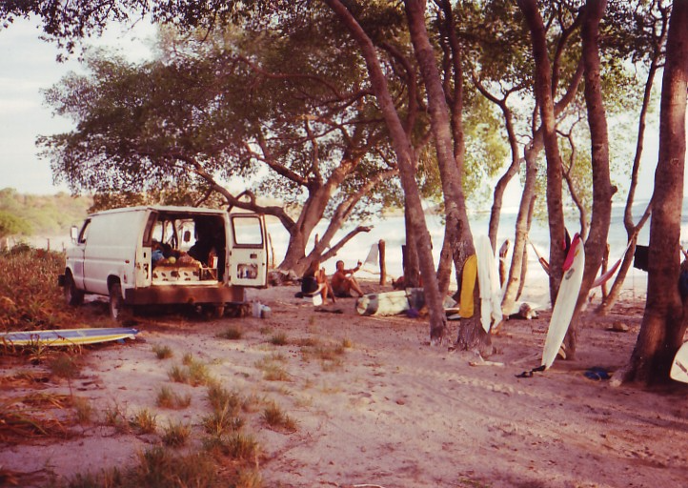

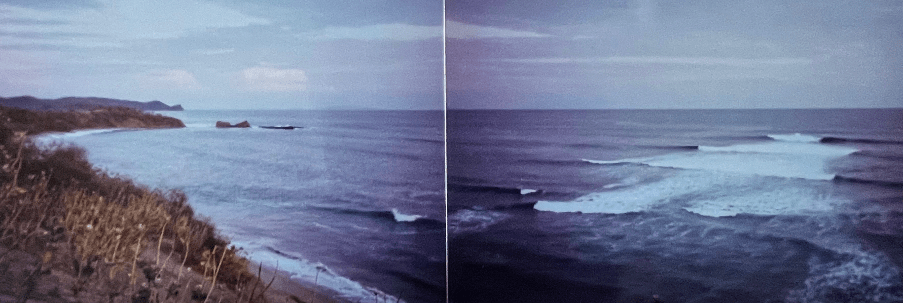
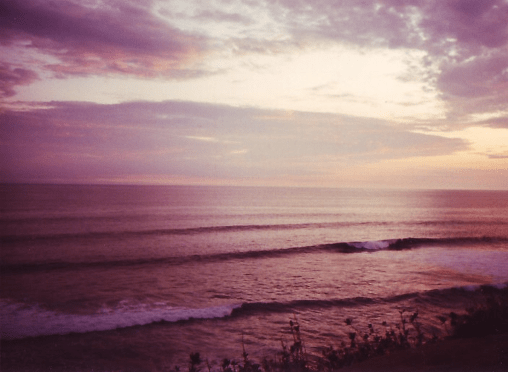
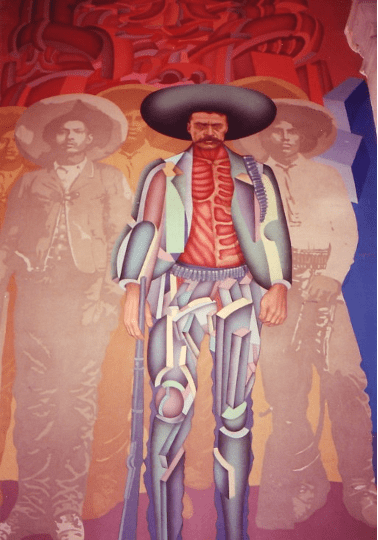


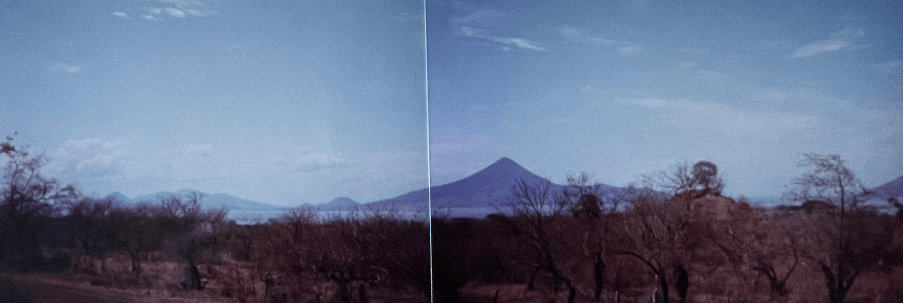


Chapter Eight
El Salvador
Every afternoon, just as the seabreeze dropped, the forty-strong tribe of pigs swaggered into our garden from who-knew-where to hoover-up the day’s excess mangos. Our acre-wide garden was dominated by these mango trees, perhaps a dozen of them, all more than ten metres high. From your hammock in the shade near the house, you’d hear a soft thump every few minutes as another perfect mango hit the grass. Usually we’d manage three or four each through the course of the long, hot day; but even with our best effort, by pig dinner-time there’d be a hundred uneaten mangos lying where they fell. Accompanied by much happy grunting, the nearly-wasted mangos disappeared whole into the pigs’ long mouths, to emerge as a big clean orange pip just a minute later: a far more efficient process than our sticky, human efforts.
The arrival of the pigs meant it was time to muster our energy, haul ourselves from the hammocks and walk down the rough track to catch the day’s last waves at the reef. When it got too dark to tell the wave from the horizon, we’d come ashore, dodge the mozzies by running up the track, take a quick, open-air, cold shower, then go for dinner. If we were early enough, we’d eat at Marita’s, but usually by just after dark she’d have taken her young children home to bed. So more often, we bought dinner at the ‘pupusa’ stand. These cornmeal flatbreads with simple fillings were cooked to order by the venerable Pupusa Lady on a griddle above an open charcoal fire on the verge of the only road through the village. Since our visit thirty years ago the government has declared pupusas the national dish of El Salvador, and the second Sunday in November is National Pupusa Day.
Pupusa Lady, or Dona Pupusa as I should respectfully call her, had a voice like a magpie and feet like potatoes. She ruled her pupusa stand with deadpan authority. You could ask for all sorts of fillings but there were only ever two: queso (which means cheese) or frijoles (which means refried beans)… but most often there was only frijoles. We’d try to make her laugh by ordering fillings we knew she didn’t have, but the only time she smiled was when I asked if I could take a photograph of her domain. (You can find it at jameswhiley.com if you like, and, yes, I gave her a copy). For a dollar you’d get four pupusas, but no matter how many you ordered, the wait was always half an hour or more. Dona Pupusa’s ‘slow food’ gave us even more time to swap stories, ideas and plans for the future while sitting at the few dimly-lit tables gathered round the fire.
Walking home from dinner along the sleeping road, we’d watch fireflies dance among the trees and lightning flicker from thick cloudbanks on the sea’s horizon. Usually there’d be several separate storms, each with a different shade from light gold to orange. Above the constant call of the night cicadas and gentle offshore breeze, no thunder could be heard. Sometimes we’d sit up to read, talk or play music by the light of candles or kerosese lanterns, but often we’d just crash. We saw no television, read no news, for a month.
Our accommodation was the grandly named Surfers Inn, a simple two-storey structure with a few spartan double rooms downstairs and an open-plan dormitory with single stretcher beds above. We slept under mosquito nets, disturbed only by the occasional rogue electrical storm that veered in from the sea, the more frequent nocturnal mango crashing onto our corrugated iron roof, and the odd gentle earthquake.
In the morning we’d wake at first light. The roosters down the road and lack of solid walls made sleeping-in impossible. We’d scuff the hundred metres down the rough dirt track to paddle out for a wake-up surf. The reef produced waves that rolled instead of barrelled, but when they were over head-high, as they often were, there was plenty of power and length of ride. This is the spot they filmed Jack’s last waves before going to Vietnam in the film ‘Big Wednesday’.
A simple breakfast of bread or toast and peanut butter with a cup of instant coffee, often teamed with the day’s first mango, prepared us for a second surf until the late morning onshore wind blew in. For lunch we’d walk two minutes to one of a couple of simple roadside restaurants, most often Marita’s. A couple of dollars bought a plate of ‘arroz’ (which means rice), ‘frijoles’ (you know what that means already), ‘huevos’ (which were eggs, fresh from the chickens that scratched for scraps between our ankles while we ate) and sometimes aguacate (which means avocado). If you wanted something different then ‘no eye’ (which meant there wasn’t any) and this was Pupusa Lady’s favourite saying. If we stretched the budget another thirty cents or so, we could add a small packet of ‘galletas’ (sweet biscuits), an ‘helado’ (icecream) or a ‘soda’ (soft drink). You can see my Spanish was improving by this stage of the trip.
While we ate lunch, the village went languidly about its business. The occasional horse-drawn cart clopped by; and two or three times an hour, an exhaust-belching truck lumbered past with hessian sacks full of maize, maybe, and the labourers balanced half-asleep on top of the load.
After lunch was siesta in the hammocks slung between the trees, sleeping, reading, writing or playing guitar under the soporific racket of a million well-warmed cicadas… until the onshore breeze dropped, the pigs rocked up… and the daily cycle began again.
But it wasn’t all beer and skittles. One of the fruit flies in the ointment was the grapefruit-sized toads who shared our outdoor shared toilet. I don’t know what kind of life these toads had; they didn’t seem to get out much. They were piled two deep in single file where the rotting wooden wall met the cool, damp, hard-dirt floor. Sometimes at night you’d find one sitting where your thonged feet needed to stand and you’d have to politely slide the pragmatic, hefty creature back to its mates. They were silent and all but motionless while you did your business. I guess they must have lived on the mozzies and flies that were drawn to the pungent smell of outside, septic tank toilet.
On weekends, a few people came down to our village from San Salvador, the capital city, about fifty kilometres inland. One of them, Laurent, was a young French surfer whose job with some European company provided him with a car. So with him we explored the less accessible right point waves along the road that leads west through a series of tunnels under the coastal mountains towards Guatemala.
One great wave we visited was on an isolated corner of the coast called El Zonte. This tiny village is now globally famous as ‘Bitcoin Beach’. In 2019, with the support of an American surfer, this rural community adopted Bitcoin as its currency. Two years later, the growing success of this initiative inspired El Salvador’s youthful President to declare his country the first in the world to accept Bitcoin as legal tender. It’ll be a good few years before we find out if this was a good idea.
Two other points we surfed were named K59 and K61, after the roadsigns where the rough dirt access tracks left the highway. These days there’s a surf resort at K59; back then there was nothing. Late one Sunday afternoon at K61, I finally took ‘Elwood’, the board I’d got made in Puerto Rico, for his first surf. (I’d waited a few weeks to ensure Elwood’s fibreglass coat set as strong as possible). Elwood was a bit smaller and much lighter than the now-ageing Byron; but as I’d hoped, it was an easy transition to make. We formed a great partnership from the get-go, but sadly it wasn’t long before our relationship soured.
One weekend, a couple of El Salvadoran city blokes who didn’t surf turned up on Friday night while we were at the pupusa stand. When we returned from dinner, we found their flash new four wheel drive parked in the Surfers Inn garden. They were seated on camp chairs drinking beer and staring at the stars, and they invited us to join them. It was great fun talking with them, trading Spanish and English lessons, while we listened to salsa on their car stereo. After an hour or so and two or three more beers, they decided it was time to get the guns out. Holy shit. From underneath the car’s front seat they pulled a black hard-case from which came a revolver… or a pistol… I don’t know much about guns. This black, shiny thing was passed around for us gringos to admire. I didn’t want to touch it. Then they fetched the ammunition.
I hated guns. I’d only fired one once, at a school Cadet camp, a Vietnam War-issue SLR 762. God help me, I was only fifteen. The sound of the guns, even with earplugs in, had made me dizzy while waiting for my turn to shoot. Then, when it was finally my turn to pull the trigger, the almost silent metal click as the bullet tore through the distant target made me want to throw up. After one shot I’d had enough and tried to retreat, but the officer made me lie back down and fire nineteen more. I didn’t want anything to do with a machine whose only purpose was to kill people as efficiently as possible.
Anyways, back in the Surfers’ Inn garden, I was scared of offending the city boys by showing them how their beloved gun made me feel, so I excused myself, saying I had to visit the toads in the toilet. Surely they weren’t going to BANG. The shot ripped a hole in the sleeping dark, then echoed back from the hills through the village. Drunken laughter ensued. Then BANG again. I guessed they were firing into the air, but who knew? Deciding the toilet was a poor place to be stuck if a killing spree was going to happen, I clambered into the bush to hide between the inn and the beach. The beer-drinking, gun-shooting and laughter went on for another hour, while I fought clouds of mosquitos and prayed the garden’s scorpions, snakes and spiders didn’t bite me. Finally the city boys retired to their downstairs room and I crept upstairs to my stretcher bed, trusting they wouldn’t shoot us while we slept. Next morning we shared coffee with them in between our first and second surfs. They were really good guys, but I didn’t like their gun.
The thing was, El Salvador had been a warzone, like Nicaragua, for at least three decades before our visit. Around 75,000 people had been killed in a struggle for power between the vast majority poor and the tiny minority rich. The rich had been backed by the USA, who identified any collection of desperately poor, oppressed people seeking social justice as a threat to US and global security. A situation had evolved where just fourteen families held power and obscene wealth. In return, these few gave the USA free and cheap access to any El Salvadoran commodity they wanted. 1% of the population owned 50% of the country’s assets, while 65% of the population owned nothing.
One evening we somehow met the housekeeper of one of the holiday homes built by one of the ruling fourteen families. She took a few of us a couple of kilometres down the road to show us around the property. It was like the Tracey family’s tropical home in Thunderbirds, or a set from a James Bond movie. With a miracle of cantilevered engineering, its three levels were built into the side of the cliff that fell into the sea from the road. There was a freshwater pool on level two, and for variety a seawater pool had been sculpted from the rocks below. We had a night swim while powerful open ocean swells exploded across us.
In the face of this abject long-term inequality, the poor’s political force had coalesced into the FMLN, the Frente Farabundo Marti para la Liberacion Nacional. Through the 1980s the FMLN fought to take power from the minority that oppressed them. Funded by the US, the government opposed the rebels ruthlessly. Human rights abuses were legion and hundreds of minefields were sown throughout the country. But as soon as the Cold War finished in 1991, the US withdrew its support for the fourteen families, and in early 1992, just eighteen months before we visited, a peace deal was signed and the FMLN morphed into a political party.
It was easy to understand why a gun-culture had developed among those who were wealthy enough to afford one, and those who were determined to seek a more just political system. PJ O’Rourke’s ‘Holidays in Hell’, especially the chapter on El Salvador, made useful reading during our stay. Another Saturday night, we crowded into Laurent’s car and set off to the disco we’d heard about in La Libertad, the bigger town a few kilometres away through the bush. As we got to the edge of our village, a local ran into the road to wave us down. Don’t drive to town tonight, he warned us, in Spanish; there are bandits waiting on the road who’ll slit your throat. It was too easy to believe, so we took his advice.
Another danger, though my surf-crazed-brain looked past it at the time, was the dusk surf. Each evening our every-day reef became a feeding ground. We knew the fish were there: we’d see the boils and swirls on the surface around us. One time near dark an invisible knife slashed the face of my last wave as I turned to take off. There’s no way it was a dolphin, and it was too big, too fast, too strong to be anything other than a shark. I rode that wave up onto dry sand. But we were back out there the next evening and every evening after that. I shiver now to think of the risks we took. And we did no favours to our karmic balance when we hoed into the spectacular fish-dish barbecued by Lundy from Queensland and his Colombian wife, Mel, at their rental house in the village. Lundi had asked the locals at the La Libertad fish market what the best fish was that day and was sold a dozen baby hammerhead sharks. Cooked in foil with garlic, herbs and lime juice, they were delicious. Six weeks later a local teenager was killed by a shark while swimming at the beach just east of our reef. If the universe was fair, it should have been one of us.
One more danger was the filthy water at La Libertad, the port-town a few kilometres down the road, where one of the best waves in Central America, Punta Roca, broke. This was the wave I’d taken a fifty kilometre taxi ride to from the airport on my first day in El Salvador. But my first surf at Punta Roca grossed me out. The rocky shoreline was littered with black oil, human excrement, dead fish and chicken; and the greasy water smelled like a sewer, which I guess is what it was. That afternoon I left La Libertad and moved ten kays down the coast to the Surfers Inn.
Still, when a strong swell came ten days later, I decided to give Punta Roca another go. For half an hour I had a shocker. The local boys were talented surfers and knew their favourite wave well. Frustrated by the serious competition, I paddled too far up the reef and got caught behind a shallow section on my next ride. I’d just about made it back out through the powerful lines of whitewater surging over the shallow rocks when, on a pretty run-of-the-mill duck-dive, Elwood was somehow twisted from my grip. He flipped upside-down and back-to-front underwater so the sharp trailing edge of one of his fins collided with the fleshy bit above my ankle. At first I thought it was just a bruise, but when I fought my way back onto the board and pulled my leg up to survey the damage, I found an ugly three centimetre gash. I let the waves wash me in and clambered up the foul rocks with blood flowing freely.
The cut was deep and looked a lot like San Clemente John’s knee-wound in Nicaragua a few weeks before. Remembering John’s trauma of watching a local doctor sew his knee up with too little anaesthetic, my first thought was that I wouldn’t get it stitched. My next thought was that I needed to clean the wound out with every sterilising agent known to man. I untied the bandage that kept my right kneecap in place when I did anything more than walk, and wrapped it round my ankle. After a melancholy, and expensive, taxi ride back to the Surfer’s Inn, I doused the cut with every product in my fellow guests’ first aid kits, and hoped for the best.
For the next few days, wet weather and poor surf set in, so I didn’t miss much by staying out of the ocean. But ten days later, the wound was still wet and open. Too late, I realised I should have bit the bullet and got it stitched. Then I caught a stomach bug, then a bad flu, and I barely left my stretcher bed for four sweaty days. At least the lack of movement gave my ankle a better chance to heal.
During this fortnight, a new crew coalesced in our village: Andy, a really good surfer from Bird Rock on the southern coast of Australia; Steve, a learner-surfer punk-rocker from St Kilda in Melbourne, just up the coast from Andy; Andrew, a gaunt, wild-eyed, dread-locked surfer-skater from Florida; Mike, a tall, creative, surfer from Dunedin, New Zealand; and me, from I wasn’t quite sure where any more. Over the long dinners at the pupusa stand, the five of us hatched a plan to adventure to the fabled right points in the countryside west of the town of El Cuco near El Salvador’s south-east border.
Thirty years later, there are at least three ‘surf resorts’ on this stretch of coast, but back then the only way to saty there was to find a place to camp in the bush. And the only way to access the waves was by paying one of El Cuco’s simple fishing boat crews to ferry you there and back. Getting to El Cuco from our village would be done by bus.
As we were to learn in the next weeks, for just a few dollars there was a bus waiting to take you and your luggage to every village in Central and South America. Choosing these buses instead of hire cars stretched our travel funds beyond the horizon, and even beyond the equator. None of the buses were younger than twenty years old and most rarely saw the northside of sixty kays an hour. Each had a few long-term defects that made safe arrival anywhere a cause for celebration. And best of all, riding on these buses brought us into contact with the local population. We learned their language, their ways of life; we saw their country through their eyes. And we earned the respect of the locals by being in among them, not zooming through their country in a hermetically sealed, five-star rent-a-car. On the buses, we were treated as equals, which is about the highest compliment a traveller can be paid. Despite the odd grumble over the few minutes we needed to tie our surfboards to the roofrack, not once were we ripped off or mistreated in any way. In the next six months, these buses carried me more than ten thousand kilometres. None of what was to come could have been done without them.
When the next good swell finally arrived on June 9th, the boys were mad keen to go. But I wasn’t sure I was fit to join them. My cut had only just started to dry out and close up, and I was still wiped out by the flu. But the boys were certain I’d be okay, and they promised to carry my stuff, and me if necessary, until I got my strength back. Legends. So, knowing this was a once-off opportunity, and still hurting from missing my first ever surf trip due to overcaution fifteen years before, I took a punt. The boys gave me one more recovery day, then we hit the road.
The next three days were hard work. First up was the all-day trek a few hundred kilometres east to the small port-town of El Cuco. Each of our four bus rides involved a long, hot wait (while I tried to sleep by the side of the road); then a laborious load-up of our bags and boards onto the roof of the bus; then a sweaty, crowded, bumpy, sometimes hair-raising ride. On the last leg of the journey, we stupidly persuaded the driver to let us ride on the roof with our luggage and the cages of chickens. If we’d known how often these buses had to swerve or brake sharply to avoid a stray cow, bicycle-rider, or extended family, we never would have asked. Madness. Somehow, again, fate allowed the foolish to survive and we weren’t flung to a mangled death.
Arriving in El Cuco, we were struck by its poverty. Back then – is it different now? – it was just a poor, dirty fishing village, and it seemed to be the spitting capital of Central America. Still, we found a market where we could buy enough food for a week of camping. And that evening on the beach we found a man whose small boat could be commissioned for a reasonable fee to take us the ten kays down the coast to what he said were the best waves in the area. I think it’s now called Punta Mango, or perhaps it’s Punta Flores, but we came to know it as Punta Scorpio or Punta Secreta. We paid the boat-driver half that night, with the agreement that we’d pay him the rest when he ferried us back to El Cuco five days later.
At dawn, our skipper came to wake us up in the revolting beachside slum we’d rented, and we lugged our stuff down the black sand to where his simple boat waited in the promising lines of white-water just a few metres from shore. The boys loaded my bags on board, then heroically carried me above the thigh-deep water to the boat so my ankle wound stayed dry. Getting out beyond the waves in our heavily laden boat with a barely powerful enough single outboard motor was an adventure all its own. But once in open water heading west, we entered a part of El Salvador that was then untouched by development. An hour or so later the skipper artfully negotiated the headhigh shorebreak to land at a small beach beside a perfectly formed rocky point made even more picturesque with the addition of a single local native hut.
As soon as we’d unloaded and made sure the skipper understood he was to collect us in five days, not five weeks, the boys headed out for a surf. The waves were pretty good but I felt too weak for anything more than a meander up the point to take a few photos. When I wilted in the heat, I wandered back to our tree-shaded campsite, set up my tent and fell asleep. That afternoon the rain blew in and I got soaked moving my tent out of the path of a small stream. At dusk the storm cleared, the waves turned on and the boys headed out for a second surf… without Steve. He’d just been bitten high on his inside leg by a mean-looking scorpion that had made a home inside his boardshorts while they lay on the ground.
Steve was dizzy and feeling pretty ill, so now there was someone sicker than me. That night he slept in my tent so I could keep an eye on his breathing. As the rain and cold set in again, I got the worries and wished I could somehow find a way back out to El Cuco: perhaps there might be some kind of rough track through the bush we hadn’t seen from the boat.
The next morning I woke late to find that Andy, Mike and Andrew had found enough dry wood to get a roaring fire going. And here was a big bowl of porridge with mango and cinnamon, teamed with a cup of coffee. Somehow they’d known and / or remembered this was my birthday. And what a day it turned out to be. The sun came out and the fuzz from my brain and body was lifting at last. Even better, despite the trials of the last few days, the cut in my ankle seemed to have almost closed up. So I wrapped my foot in a thick plastic bag, strapped a tight bandage around that, and caught my first waves in over two weeks. Some of them were rippers and it was great to rebuild my relationship with Elwood.
After a long siesta, we all hit it for the dusk session. The waves were bigger, even better, than the morning and we all got some good ones, including Steve who’d survived the scorpion sting. I rode my last wave through to the closeout shore-break and kicked Elwood out in front of me as the wave barrelled hard on the shallow sand. Somehow I managed to put my right arm through a loop in my legrope that was trailing behind. In all my surfing life I’ve only done this once, and what a perfect place to pull it off: no access to medical help whatsoever … You genius.
As the exploding wave hit the board, the urethane loop tightened round the top of my bicep, then tightened some more, and some more. It felt like a knife slicing into my flesh. Then suddenly, with searing heat, the loop ripped over my bicep and elbow, down my forearm, over my wrist, across my knuckles and off. Still underwater, I expected to come to the surface to find my arm just a few bloody, fleshless bones. Instead, when I finally dared to look, my arm was still intact, but my hand looked like a blown-up rubber glove: blue and more than twice its normal size. There was pain like a burn on my upper arm where the legrope had ripped, but none in my hand. Surreal.
I arrived back at our camp resigned to the reality that my surfing days, and maybe my whole trip, were over. I took the bandage off my ankle to wrap it instead round my massive hand. It was nice to find that the cut in my ankle had stayed sealed through the day, but what good was that now my hand was a useless balloon? The boys cooked up another great campfire dinner before another fierce electric storm sent us scurrying to our tents. If a lightning strike had struck the metal poles that framed my tent to complete the sequence of disasters, it would have come as no surprise.
In the morning I was surprised to wake up alive and with a normal-sized hand. Yeehah. And no bruising, no pain, whatsoever. Go figure. And for the first time in a fortnight, I felt my normal energy had returned. After a cracking early morning surf, Mike and I walked two kilometres through beautiful country to where we’d been told was a well – yes, an old fashioned well – to get water. On the way he described the pristine empty waves around his hometown of Dunedin, New Zealand, and his plan to open a café near the university. He’d have pinball machines, a stage for musicians, he’d sell organic food and coffee… and did I want a job there? Of course, until the business grew he could pay me only free food, accommodation and the occasional use of a decrepit VW. What was not to like? I knew Dunedin had a great alternative music scene and thought maybe Mike and I could write some songs and get work with a band while we got the café up and running. Well, that was 1994 and maybe even beyond all organised. That afternoon, I bush-bashed through the jungle on the hill above our campsite to take some photos of the surf. While waiting for some photo-worthy waves to arrive, I remembered that more landmines had been sown in this region of El Salvador than any other. This thought made the scramble back down while trying to retrace my steps exactly, a bit tense. After another excellent late evening surf, Mike and I began writing songs for our first, still unreleased, album.
By the fifth day the social dynamic of our crew had evolved to the point where we were surfing in shifts. It was an interesting case study in human behaviour. St Kilda Steve was the least able of us, yet he kept paddling a couple of metres inside, meaning he had first choice of every wave. Time and again, despite our increasingly less subtle comments, he’d either paddle for a wave and miss it, or catch one and fail to beat the first section. This led to a lot of wasted waves and friction. On the biggest day, Skatepark Andrew lost his patience and paddled so far inside Steve that he was trying to take off where the high-tide backwash met the shallowest sand. Somehow he made an epic vertical backhand drop, but the dredging lip drove straight through the middle of his only board. Not happy, Jan. Bird Rock Andy’s solution was to avoid surfing with Steve by choosing the lowest tides when the waves got most challenging. Andy got some barrels that week that looked like he was behind the rock at Snapper. Mike and I often surfed together, which gave us time between sets to make plans for the café in Dunedin.
On the last day I got lucky when I woke up before dawn. With nothing else to do inside the dark tent, I packed all my things in my backpack. Then at first light I packed my tent, ready for the boat-ride home. With the others still asleep, I paddled out alone for what I thought would be a quick early surf before breakfast. We’d expected our boat to collect us in the middle of the day, but it turned up a lot earlier than that, and the skipper was impatient to get back to El Cuco. So while the boys scrambled to finish packing their kit, the skipper threw my bags into the boat. I guessed I’d have time for one or two more waves, but as I kicked off on my last one, one of my best rides of that week, the boat was coming out through the beach break towards me. The boys were pretty jealous that I‘d lucked into that one last surf, but I’ve got to confess that paddling over to the boat and clambering aboard dripping wet for the bumpy hour-long ride back to El Cuco is one of my favourite memories of 1993.
A few hours later, we were back on the buses heading south towards the next chapter, in Panama.
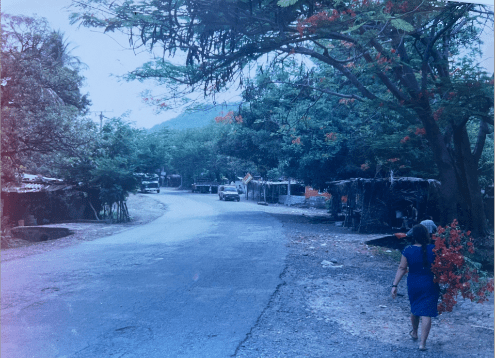

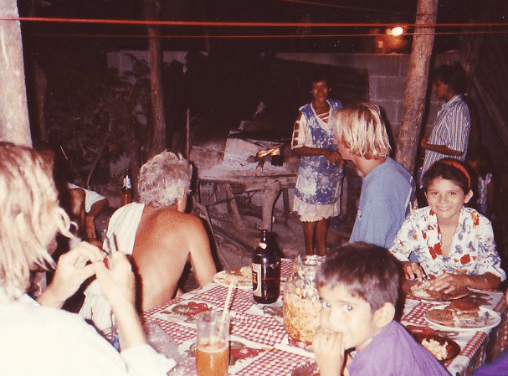
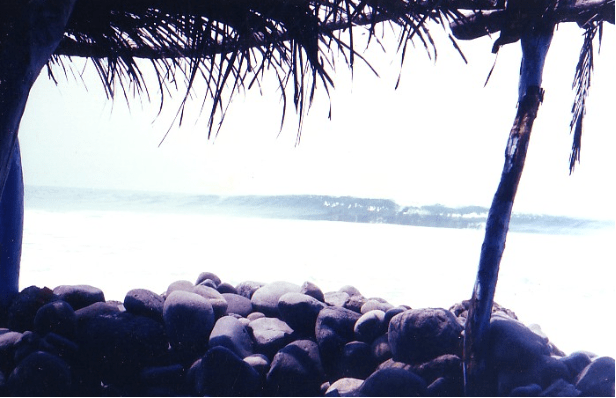

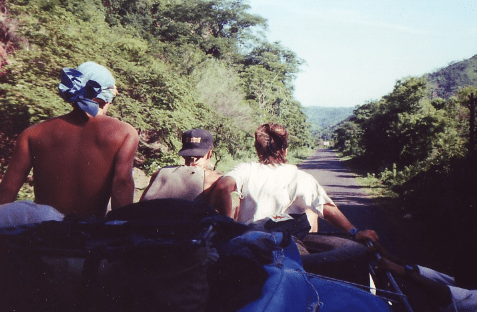


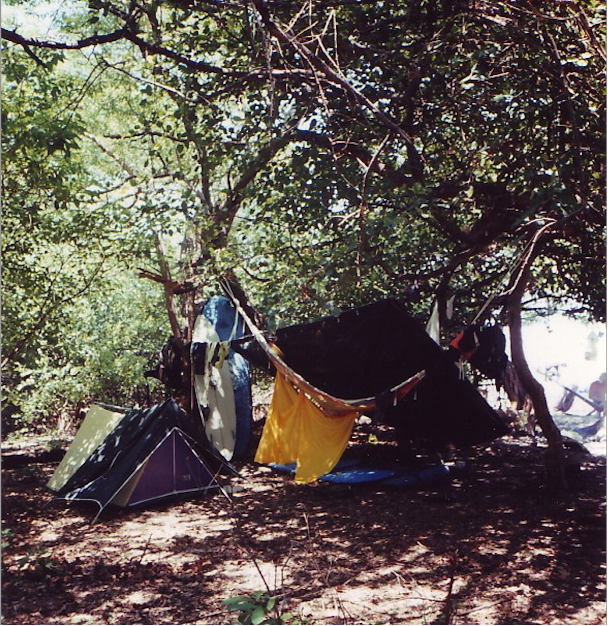
Chapter Nine
Panama (via Nicaragua and Costa Rica)
From El Cuco, El Salvador to Playa Santa Catalina, Panama was fifteen hundred kilometres by a series of buses and boats. Our journey took us backwards on some now-familiar roads through Nicaragua and Costa Rica. It took us about two weeks with some stops along the way.
First up was Playas Negras in El Salvador, which seemed to be one of those towns in Latin America where all the beautiful girls of the region gather… though perhaps our five days hard camping in the wilderness at Punta Scorpio shaped this perception. From Playas Negras we bussed to La Union, spending some of the journey ducking low-hanging telephone wires while riding on the roofrack… idiotically… again.
Having survived that stupidity, we commissioned a kind of water taxi to take us on a scenic, fifty-kilometre, dawn cruise across the Gulf of Fonseca, to a village called Potosi Chinandega in northern Nicaragua. Here we successfully, surprisingly, haggled with the border guard about the price of our entry visa. Then we bussed three hours south to Leon, Nicaragua’s second largest city. Here we found the first newspaper we’d seen for six weeks and discovered Michael Jordan’s Chicago Bulls had just beaten the Phoenix Suns 4-2 in the NBA finals.
After a pointless trek to El Transito to look for surf the next day, Mike, Steve and Andrew headed for the airport at Managua, Nicaragua’s capital city. Steve and Andrew were returning to their respective homes in Australia and Florida. New Zealand Mike was flying to Costa Rica, where we’d meet him a few days later. This left Andy and me as travel partners.
Andy was a talented young surfer from Bird Rock on the southern coast of Australia. He’d started his American surfari in Los Angeles, then travelled south through California and Mexico to El Salvador, where we’d met. He was keen to explore the waves further south in Central America, so we teamed up.
Our first day’s travel took us towards Nicaragua’s southern border. The journey took us through Rivas, a small town an hour’s local bus ride from Popoyo, where Joy and I had found great waves a few weeks before. I promised Andy a small detour would be worthwhile, so at the Rivas bus station we raced to catch the day’s last bus to Popoyo.
The closest the bus got us to the waves left us with a hot, hard, one-hour walk with all our luggage, on dusty tracks that I hoped were the same ones Joy and I had driven down a few weeks before. It’s fair to say that half an hour into this trek Andy wasn’t rating my leadership of the expedition very highly. So it was just as well the waves were pumping when we finally arrived. With the last of our energy, we threw our bags on the sand and paddled out at the reef down the beach. The waves were glassy and purple-gold in the sunset, and we had it to ourselves. We felt like the only surfers in the world. Andy rode the right with great power and style, as I’d imagined he would after watching his sure-footed approach to Punta Scorpio.
Returning to the beach near dark, we set up our tent and settled down to dinner. Ah yes, dinner. We hadn’t had time to buy food before catching the bus back in Rivas, but I’d promised Andy there would be a tienda (a small shop, in Spanish) somewhere on the way where we could buy food and water. This was a pretty safe bet in Central America, but for once no roadside tienda appeared. So we’d been parched and starving even before we surfed.
Digging through our luggage we discovered one small pack of dry biscuits, one old orange and a half-green pineapple I’d bought a few days before in El Salvador in the vain hope it would one day ripen. Andy wisely chose to abstain from the pineapple, but hunger beat me and I shredded the roof of my mouth on the jagged, acidic flesh. This vicious fruit salad was washed down with half a glass of sandy Pacific salt water. With nothing to look forward to for breakfast, we fell asleep knowing a five-hour round-trip back to Rivas for food and water would be needed if we wanted to surf again.
Luckily, in a way, a storm blew in from the sea after midnight. At dawn the ocean was an unsurfable grey mess, so an agonised withdrawal from beautiful, empty waves was avoided. After a long, hard trek out, then a long wait for the ninety minute bus-ride, we arrived back in Rivas and caught up on dinner, breakfast and lunch in one frenzied swoop at the market.
This was the first day of colder, bad-surf, weather we’d seen for a while, and it blessed us with the perfect travel-day. From Rivas it was a simple busride south to the Costa Rican border. Here the sullen border guard denied us entry into his country until either we showed him we were taking anti-malarial medication, which we weren’t, or he injected us with anti-malarial vaccine. Sorry, what? As anyone knows, antimalarials aren’t injected, and we knew that any syringe this bozo stuck into us could be riddled with AIDS, hepatitis and whatever else. As cool as James Bond in a pickle, Andy reached into his daypack and produced a half-finished container of antibiotics, telling the guard this was the anti-malarial medication we were BOTH taking. Genius. We watched as the guard pretended to read the prescription written in English, then inspect the pills as if he was a pharmacist. It would have been funny if the stakes hadn’t been so high. Eventually, reluctantly, he conceded defeat and allowed us into Costa Rica. Whether the danger of paying an expensive bribe was more real than the chance of being stabbed with a needle, it was great thinking under pressure by Andy.
So we ran from the border crossing and caught the last bus leaving for Liberia, the biggest town in northern Costa Rica. Six weeks earlier, on our first day in Central America, Joy and I had passed through here on our way to the great waves at Witches Rock. This time, Andy and I jumped from one bus to another at the Liberia bus station and got the last two seats on the cold, dark, six-hour night-bus to San Jose, Costa Rica’s capital. It had been a hard, good day. In eighteen hours we’d covered only four hundred kilometres, but each of the six stages of the journey, from the walk out of the Popoyo beach campsite in the early morning, to the arrival in San Jose just before midnight, had been an achievement to celebrate.
The next afternoon in central San Jose we went to the bank, posted letters and tripped over our shoelaces at what seemed to be some sort of open-air fashion parade. At the post office, I made one of the few phone calls that year to my parents in Sydney. Back in 1993, making an international phone call from a less-developed country was a real palaver. International phone lines were usually only available at the main post office in the largest towns. You’d wait in a queue to book and pre-pay for three minutes of painfully expensive call time.
Then you’d wait in another queue to use a telephone housed in a stuffy, smelly, allegedly sound-proofed cubicle. You’d pick up the sticky phone and listen while the post office operator dialled the number for you; and you’d keep your fingers crossed that you’d get a connection that didn’t have a horrible crackle or disorienting echo. With phone-time being both rare and expensive, you’d talk as fast as you could and try to stay focused on the most important topics. You kept your eyes on the clock, knowing that when your three minutes were nearly up, the operator would interrupt your conversation to demand more money, or your call would be cut off.
The central post office in San Jose was one of the rare post offices that allowed you to receive return calls from overseas, so when my three minutes ended, my parents phoned me back. Over the last six months, I’d posted them a few post cards and letters to let them know where I was and what had happened to me; but since I was constantly moving in no guaranteed direction, they’d been unable to post anything back. So with six months’ family news to download, the chat was fast and furious. The last minute of the call was spent catching up on cricket news: Australia had just belted England in the first two ‘Ashes’ tests, with Michael Slater averaging over a hundred in his first two test innings and Shane Warne bowling Mike Gatting with what will be forever known as ‘The ball of the century’. (Watch it on youtube if you’re curious; it’s a ripper. And it’s one of Richie Benaud’s best moments in deadpan commentary too).
Later that day we reunited with New Zealand Mike and went to see ‘Falling Down’, the movie where Michael Douglas implodes under the pressure of life in Los Angeles. This film ended any last thoughts I was having about visiting California before crossing the Pacific to Sydney. That confirmed that my path home would meander through the west of South America as far south as my savings would take me.
Our next stop was Puerto Viejo, a day’s bus ride away on Costa Rica’s Caribbean coast. The town’s main wave, Salsa Brava, had recently become another favourite of the American surf magazines, so we thought we’d give it a shot. Andy loved it and said it was a bit like surfing Backdoor Pipe in Hawaii, which he’d done. But Mike and I weren’t good enough to fight for the steep drops and wide barrels in the thirty-strong crowd. Due to its recent fame, Salsa Brava was attracting a lot of good surfers, as well as some wannabee alphas who wanted to say they’d conquered it, even when they hadn’t. This made a challenging wave even more challenging. It was like surfing somewhere like Dee Why Point in Sydney on a weekend… which was exactly what this trip was designed to avoid. After a couple of stressy, unsuccessful go-outs, Mike and I went exploring the tropical jungle coast for undiscovered waves instead. Another highlight of our three days in Puerto Viejo was staying in the bird-and-monkey-filled forest at a cottage called Kiskadee. Here we again met Lundi and Mel, who we’d last seen in El Salvador a few weeks before.
On the last day of June, Mike, Andy and I crossed the funky river bridge at Sixaola that marked the border between Costa Rica and Panama. From there we took the bus to Almirante for the night. In the morning we rode the now-discontinued ferry service through the beautiful Bocas del Toro archipelago to Chiriqui Grande, where a six hour bus ride took us through even more majestic scenery in the Fortuna Forest / Cerro Santiago mountain range. Completing our five hundred kilometre journey that day, we rode another bus to Sona.
The next day, Mike and Andy took the early morning minibus seventy kilometres south on a slow rough road through mostly undeveloped jungle to Playa Santa Catalina, on the Pacific coast. Reputedly, this was the location of Panama’s best wave. While they explored for surf-side accommodation, I stayed in Sona for the morning to gather the provisions we’d need for what we guessed would be a week-long stay. Loaded up with four big plastic bags full of rice, oats, fruit and vegetables, along with my two surfboards and backpacks, I followed Mike and Andy to the coast that afternoon. My first glimpse of saltwater, at Hicaco, was confusing. What I thought was open ocean was the surfless Gulf of Montijo, but I only realised that an anxious half hour later after the bus had headed directly inland to arrive at another coast. Here the road terminated at a tiny settlement called Santa Catalina. But even this stretch of coast looked wrong. Directly offshore, a long island blocked any swell from reaching the ugly black-sand beach. After all the hard travelling, had we come to the wrong place?
The only feature of this alarming dead-end was a tiny, corrugated-iron tienda (yes, Spanish for shop) selling mostly cigarettes and soft drinks to the very occasional bus traveller. I cautiously approached the disinterested shop-keeper to ask ‘Disculpe, senor. Donde son las olas?’, which was my attempt at ‘Excuse me, sir. Where are the waves?’ Barely looking up, he seemed to raise his eyebrows in the direction of a red-dirt path that ran over the hill behind his shop.
It was a long hot slog with my backpacks, double-surfboard-bag and the four plastic bags of food. In two hundred metres, the rough track had crawled up and down three small hills. After fifteen minutes, with no confidence that I’d understood, or could trust, the shopkeeper’s advice, I stashed my surfboards behind some bushes just off the path. Pushing on with just my backpacks and the bags of food, I wondered if I could hear waves… or was it wishful thinking… or gusts of wind in the trees?
A few minutes later I saw Andy coming to meet me on the path. He and Mike had found just one lonely, empty house facing the ocean, but no-one around to ask if it could be rented. In fact, the only sign of life either of us had seen in Santa Catalina was the miserable shopkeeper. Andy took the foodbags from me and led me half a kilometre through the trees to a handsome house built on a headland that looked over the proverbial gold at the end of the rainbow: far out to sea, big, empty, dark-blue-green waves were breaking in a forest-rimmed, dream-scape bay. From four hundred metres away, we could hear the crack of the wave’s lip as it hit the water. It was magnificent and daunting.
In the fading evening light, there was much to do, and suddenly we had all the energy we needed to get it done. We dropped the food and packs in the garden and jogged back to collect my surfboards. We were wondering if we should just try to find a way inside the house on the headland. Through the windows we’d seen that it belonged to a surfer, from the pictures hanging on the wall. Surely a fellow-surfer wouldn’t mind if we let ourselves in and stayed a few days?
Luckily this twisted thinking ended when we returned with the boards and met Mike waiting for us in the garden. He’d found another empty house half a kilometre east with an even better view of the bay, a terrace where we could cook some dinner by candlelight, and a lawn where we could camp for the night. We lugged our gear there, set up our tents, made a simple dinner, and fell asleep listening to the crash and wash of the waves. At first light we knew we’d be having one of the surfs of our lives.
But in the morning, before we’d even had a chance to look at the ocean, our first discovery was the evil genius of the Panamanian ‘no-see-um’. This wretched insect is so named because you really can’t see ‘em. They’re so small they can fly clean through the tiny holes in your average brand-new mosquito net. And, even though you can’t see ‘em, they still have a proboscis that’s big enough to stick through your skin and drink your blood. How does that work? They leave bites more itchy than mosquitos, but they leave more of them, and some of them hurt. Luckily, they only come out to feed at dawn and dusk, and only when there’s no wind, so their assault wasn’t constant. But it took us a few days to figure out the only way to survive them was to stay fully clothed at dawn, dusk and while sleeping; and any uncoverable body-parts had to be soaked in carcinogenic deet repellent. Yuk.
Our second discovery that morning was the bay’s three and a half metre tidal range. The spot where big waves had been breaking at the previous day’s high-tide was now a vast dry rock platform. There were still waves breaking further out in the bay, but they looked smaller and less lined up than what we’d expected. Nonetheless, with the no-see-um itch driving us bonkers, Andy and I decided to go for a surf. We spent about twenty minutes hobbling across three hundred metres of sharp, sometimes slippery, black rock reef before we could throw ourselves in the ocean. The waves were disappointing and our feet got even more scratched up on the long walk back. We didn’t bother with a low-tide surf again.
When Andy and I returned from our surf, we found Italo, the owner of the house, and three of his friends waiting for us. They’d driven six hours from Panama City that Saturday morning and were pretty pissed-off to find our tents and baggage littering the garden of their holiday house. It was lucky that Mike had been there to make our apologies and clear our stuff away, or the Panama boys might have gathered it up and dumped it in the forest. We diplomatically made ourselves scarce by going for a long walk while they shared the ever-improving waves on the incoming tide with no gringo presence. This was a good move on our part.
Once the Panama lads saw we had the good manners to give them their right-of-way as locals, they were keen to be friends. They insisted we stay for dinner and allowed us to camp on their lawn for another night. Better still, Italo wanted us to be his house-sitters for a couple of weeks. We’d pay $150 US for the fortnight (about $3 each a night for one of the world’s greatest surf-shacks!) and we’d pay one of the local senoras another $50 US for cooking our dinners and keeping the house clean. (This was Italo’s way of assisting one of the local families and injecting some money into the local economy.) On the weekends we’d leave the house free for Italo and his mates, and go back to camping on the lawn again. Too easy; no worries. Score!
In the morning we cooked breakfast together, then shared a cracking surf as the tide came in. After lunch, the Panama boys went back to the city, leaving us with the house of our dreams (apart from the no-see-ums) and some badly needed spare food. Downstairs was a combined cooking area (to call it a kitchen would be an exaggeration), and sitting area, though there was no furniture, only cushions. Up a wooden ladder was an open-plan sleeping area with stretcher beds and a front-on view of one of the prettiest bays in Central America. We drank, and washed in, rainwater gathered from the roof. (If you’re interested in going there, I think it still exists as ‘On The Reef’ Pension at Santa Catalina).
We lived in paradise for the next fortnight, and it nearly killed us. It was just as well we’d bought a week’s supply of oats, rice, pasta, lentils, corn and garlic at the Sona market… because there was nearly no food to buy in the area. The locals were subsistence farmers of the land and sea who grew and caught only what they needed. And with no cash economy, there were no shops, apart from the cigarettes-and-soft drinks-only bus-stop tienda. Our housekeepers somehow found us some fish, some sweet potato, and once, at great expense, a papaya. We also found a small mango tree growing wild, though it was barely old enough to produce fruit. To get more food from Sona would involve a tortuous eight-hour round-trip and a day of waves missed, so we tried to make our one week’s food supply last for a fortnight by instituting strict rations. We limited ourselves to two small meals a day. Around mid-morning, depending on what the waves were doing, we’d have a cup of porridge each, teamed with cinnamon and occasionally mango. At sunset we’d eat the food prepared by senora from the food we’d brought and the food she’d found. But our diet was nowhere near enough to fuel our hours of surfing, so we spent each day, even directly after meals, learning to live with hunger. It was a great education in how billions of people live every day on this planet.
A mark of our hunger was the method we invented for not killing each other over food. The necessity that mothered this invention was the arrival of the papaya, which Senora had gone to great lengths to buy for us from one of her friends. But how was it be cut up into three exactly equal portions?
We fetched the two biggest plates we had, and the longest knife, and the three of us sat in a circle on the ground with the papaya. One of us was elected to carefully cut a level cross-section of papaya onto the second plate. Then the second plate, the slice of papaya and the knife were solemnly passed to the left, to Person Two. His job was to cut the slice into three equal pieces. While the other two watched silently, Person Two inspected the slice of papaya for variations in thickness. It was his decision, and his alone, on where the three cuts were to be made. Despite our desperation to get our hands on the next mouthful of papaya, this decision took time, and no comment from Persons One or Three was permitted.
Once the cuts had been made, the plate, papaya and knife were passed to Person Three. He had the privilege, or the curse, if he made the wrong decision, of estimating which of the three pieces was marginally bigger. Understandably, each piece had to be sized up from every angle. While Person Three had the best view, Persons One and Two made their own less-informed guess at which piece was the biggest. So while Person Three edged towards his decision, the air buzzed with silent calculations. Only when Person Three had finally chosen their piece were comments about the wisdom of the choice permitted, and it was a matter of colossal sensitivity. Relationships could be soured for hours by an unkind comment.
Luckily the wisdom of the Person Three’s choice was only a momentary focus because now Person One had to choose from the remaining two pieces. This entailed more tense calculation, then more commentary when the deed was done. This left Person Two with the last remaining piece.
Once we’d got maximum value out of our mouthful of papaya, Person Two had the responsibility of choosing the thickness of the next slice to be cut from the gradually diminishing papaya. And so it went, the roles of slicer, divider, first chooser and second chooser passing to a different Person each cycle. I doubt we were the first humans to develop this system, but it was fascinating to see how we figured out a plan for fairly sharing food instead of killing each other.
Our on-going hunger meant that each of us developed a different bio-rhythm, if that’s the term. In between meals we spent our energy very mindfully, trying to store it up for the daily surfs through the high-tide hours. With differing sleep patterns and metabolisms, we rarely surfed together. This also gave us some space from each other, which by the second week was becoming more necessary.
Luckily I wasn’t surfing by myself when I attempted a late take-off on a sizable wave and got pitched through space with only my toes connected to Elwood, my still-new surfboard. By the time we hit the water, Elwood and I were only separated by half a metre and Elwood had flipped fins-up. The back of my head smashed backwards into Elwood’s rail just a lucky few centimetres from the tip of the outside fin and I saw white for a few seconds.
Andy saw the disaster from the channel and kept an eye on me while I paddled blindly back out. There’s a lot of blood on your elbow, he said. I hadn’t felt anything except the blow to my head, but at the same moment of that impact, my elbow had been smashing through the fibreglass and thick wooden stringer on the bottom of the board. It was a long, solemn paddle back to shore. Luckily Mike had brought some ding-fixing chemicals, so the next day we used most of it to roughly patch up the deep crater.
Despite this cock-up, this might have been the best two weeks’ surfing I ever managed. For six months I’d barely spent a day when I didn’t surf at least once. And most of the waves on this trip had been long, uncrowded and not-too-dangerous; the type of waves that let you step up. You’d think after all this time riding some of the best waves of my life that it’d be unlikely that I’d get excited about yet another wave and the surfing I was doing. But my diary records a dozen surfs at Santa Catalina where I reckoned I’d reached a new level, however modest that was. And this despite the constant hunger, the no-see-ums and the blow to the head.
The low-tides and night-times were spent writing letters, songs, diaries and stories… and planning for the short-and-long-term futures. Andy decided he’d spend the last weeks of his trip back in Mexico, where he’d found his favourite wave a few weeks before. Mike and I firmed up on our plan to work together in the café he was going to open near the university in Dunedin. Mike had enough funds for just another few weeks on the road, so we decided to spend them travelling through the north of South America together, writing songs for the band we’d have as a side-project to the café. When Andy caught the bus out of Santa Catalina at the end of the second week, I went with him as far as the nearest town with a phone to research the cheapest flights to Colombia from Panama City.
On July 19th Mike and I left Playa Santa Catalina and took an all-day series of bus rides to Panama City. As our bus neared the city in the dark, we saw the lights of the Panama Canal from our highway-bridge. The next day we did the usual city stuff: bank, post office, photos developed, and cake shops compared. And we paid for our flight to Cartagena, on Colombia’s northwest coast.
On our last night in Central America, the Panama City boys we’d met in Santa Catalina took us round to their smart apartment, then out into the night. Despite my protests, they were determined to show us what they claimed was the finest strip-club in Latin America. I know some of you will roll your eyes, each for different reasons, but while the others went inside, I hid on the floor of the car’s back-seat waiting to be murdered by the dodgy crew searching the club’s dark carpark for an easy car to rob.
If I was alive at lunch time the next day, I’d be in South America.

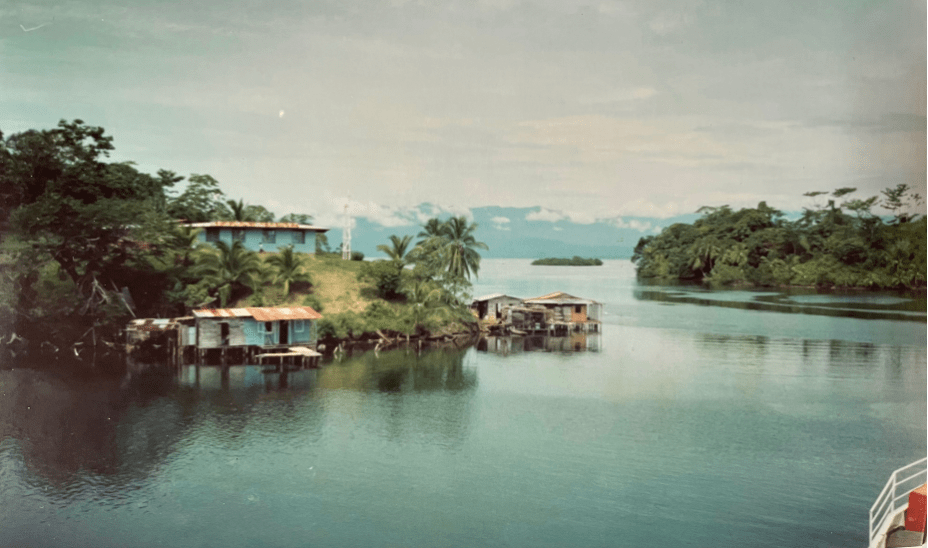
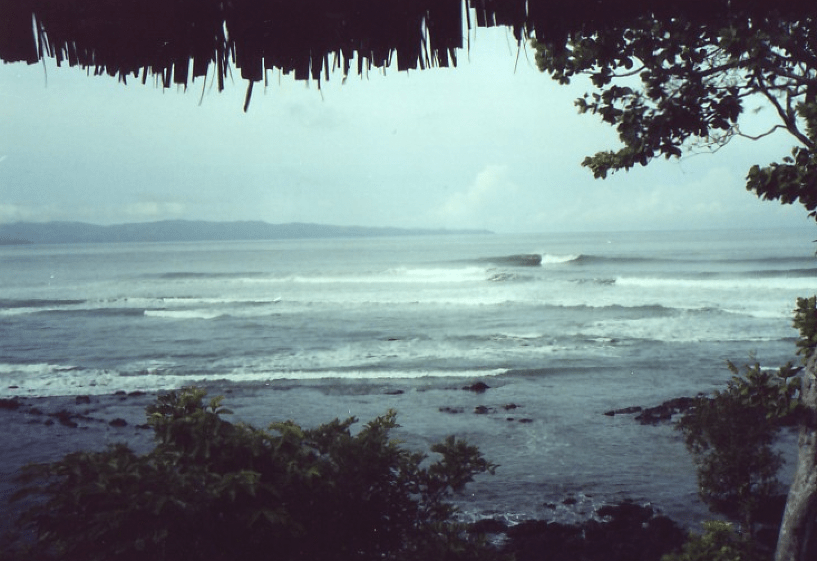
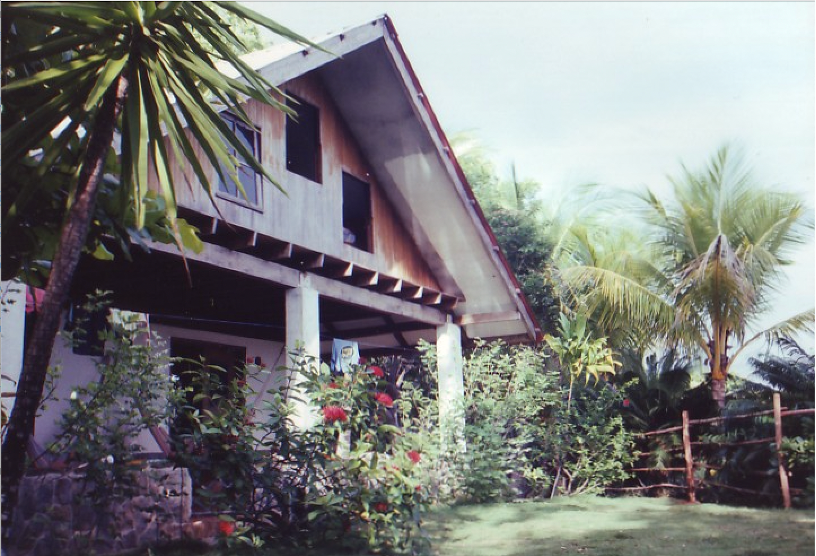


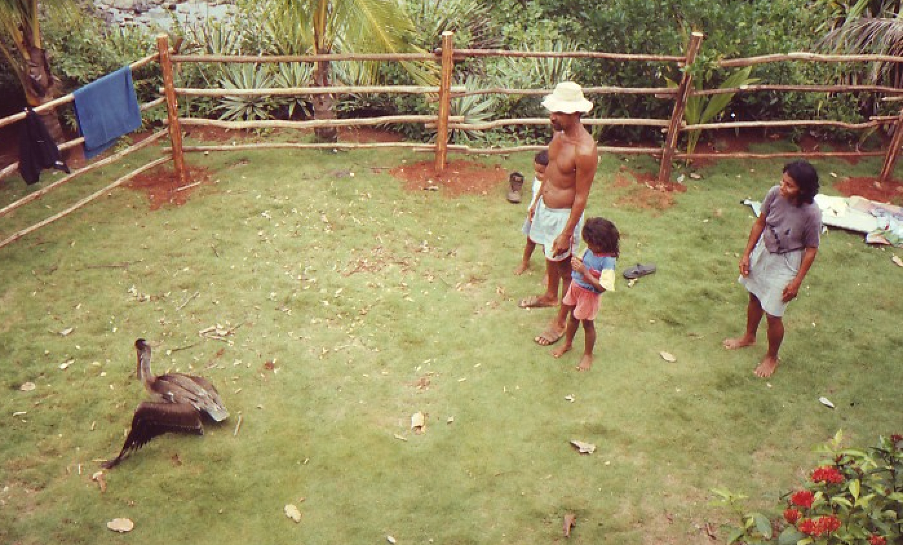

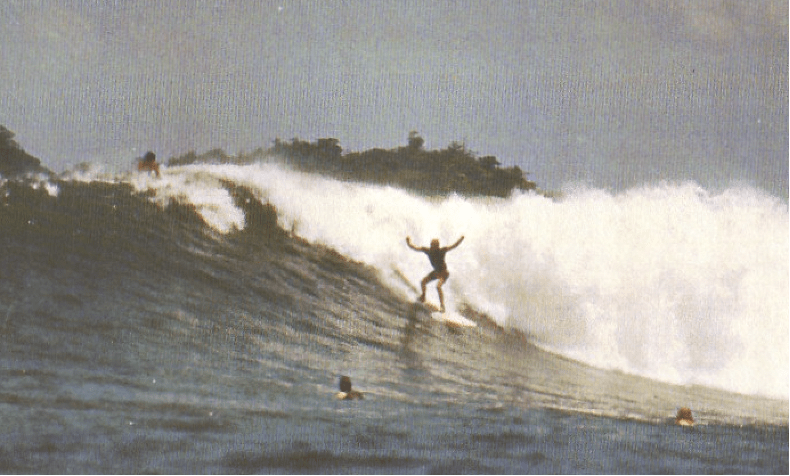
Chapter Ten
Colombia
The US-influenced Western media had done a terrific job of building my expectation that Colombia was a barbaric wild west awash with drug lords, tourist murders, and prospects for the Miss Universe crown. Instead we found a friendly, sophisticated, scenically kaleidoscopic country awash with prospects for the Miss Universe crown.
Sure, as our guidebooks warned us, areas such as Medellin and Cali were too dangerous for foreigners to visit due to the dangers associated with the cocaine trade. There were also regions in the Colombian Andes Mountains where communist revolutionaries were fighting a slow-burning war with the government. But the other 90% of the country was a traveller’s paradise.
That’s not to say there wasn’t the odd dodgy moment. On our second day in Colombia, our media-driven misconceptions seemed to be confirmed when we watched a handbag-thief pursued, then caught, then beaten up by a mob who’d grown bigger as the chase evolved. When the middle-aged lady who owned the handbag finally caught up to the crowd who’d encircled the thief, she was given elbow-room to deliver her own kicks, slaps and verbal abuse. When the police arrived to take the now bruised and bloodied thief away, one of the crowd pulled a gun from his belt and waved it in the thief’s face to further make the point. Quite the scene. The very next night we and a hundred others made a panicked exit from a disco when a brawl erupted and someone pulled a gun from their coat. But we saw nothing more like this in our three weeks there.
But to begin at the beginning….
Looking at a basic world map you’d think it’d be easy to get to Colombia from Panama overland: you just catch the bus west from Panama City to the village of Yaviza and walk it to the border from there. I suppose if push came to shove, you could probably give it a crack. But you’d most likely die in the attempt. This was the start of the Darien Gap. It’s nice to know that there are some parts of the natural world that are still beyond human attempts to tame it. The first fifty kilometres are steep mountains and thick forest on the Panama side; the next eighty kilometres are swampland on the Colombia side. The idea of building a road through the Darien Gap has been floated twice in the last fifty years and both times abandoned as too difficult and too expensive.
The only people who occupy this region are native tribes, some of whom decorate themselves with vivid red and blue dyes, as seen in the film ‘Baraka’. And the only people who venture through this region are entry-level cocaine smugglers who’d think nothing of killing you to keep their secret trails secret. So instead of going missing in the Darien wilderness, we took the soft option: a one hour flight from Panama City – east-north-east, surprisingly – to Cartagena, Colombia. It was the 21st of July, and my journey home was now six months old.
For four days we stayed in Casco Viejo, the oldest part of Cartagena. We walked the three-hundred-year-old streets, finding our favourite cheap restaurants and cake shops. We discovered Colombia’s luminescent fruits: maracuya, gulupa, uchuva, zapote, pitaya, to name a few. We discovered arepas (like what the English might call pasties) and comida corriente (the basic plate of food served by the simplest restaurants) which filled us up each meal for less than two dollars. If we wanted to be extravagant we could spend another couple of dollars on Colombian pastries or crepes and the best coffee in the world. We also discovered a café that agreed to pay Dunedin Mike and I ten bucks each, plus food and drink, for performing our music for a few hours. We called ourselves ‘Bombora’ and began our South American tour.
Our itinerary for the next three weeks was built around an invitation to stay in Colombia’s capital city, Bogota (say boggohTAR), for a week or two in August. This invitation had come from Lundi and Melissa, a travelling couple we’d met in El Salvador, then re-met in Costa Rica. Lundi was a surfer from Queensland and Melissa was his Colombian wife. Melissa was returning to Colombia for a few months to help with her family’s business. So she and Lundi had the use of Mel’s family’s city apartment and they were keen for some company.
With ten days to kill until we could take up their offer, Mike and I decided to explore the scenic inland route through the mountains on the slow way south to the capital from Cartagena. Our ‘Lonely Planet’ advised that the journey to El Cucoy National Park in the high Andes Mountains was one of Colombia’s highlights, so this was the path we chose.
Our twelve hundred kilometre journey began with a bus southeast to Yati, then a ferry down the Magdalena River to Santa Cruz de Mompox. Our guidebook frothed on about the old Spanish architecture in Mompox, but we found it underwhelming. Sure it was old, but I thought it was clunky. And I found it hard to go ‘wow!’ about remnants of the sixteenth entury Spanish invasion of South America that destroyed the lives and culture of millions of the original inhabitants in the name of a loving Jesus Christ. Harrumph.
So the next day we cruised further south down the river to El Banco, where a horse-drawn taxi connected us with a six hour bus-ride to Bucamaranga, where we stopped for the night. This was the launchpad for what must surely still be one of the world’s great road journeys. The next morning, before we’d even reached the outskirts of Bucamaranga, our bus was ascending at what seemed like forty-five degrees into the Andes. Switchback after switchback took us at snail-pace past tidy, though chaotic, suburbs clinging to the mountainside. After an hour or so in first gear, we entered a stunning tree-less plateau well above 3000 metres.
My diary entries were the only way I could record this journey. The scenery had too much width, height, colour and texture to capture in a photo. Even these days, with the i-phone panorama setting, it’d be a challenge. And back in 1993 you had to choose your photo subjects carefully. Photos were made in hard copy, on film that was both expensive and limited in quantity. Each roll of film produced a maximum of thirty-six images that couldn’t be deleted or retaken, and it was rare for anyone to carry more than half a dozen rolls of film as it deteriorated rapidly with age. Through 1993, I tried to limit myself to taking about ten photos a week: a hard target when there was so much to visually record.
That night we stopped in a small town called Pamplona, at an altitude of two and a half thousand metres, and about a third of the way to El Cocuy. In the morning the roads and scenery became even more spectacular, as if that would have been thought possible the day before. The bus wound south on roads barely clinging to dizzying vertical drops into the river valleys below. I can tell from the scribble in my diary that I was writing to overcome fear. It was six more exhilarating hours to Cerrito via Chitaga then onto Malaga, where suddenly it was hot, after the cool of the high plateau.
The bus driver and conductor were having a rest for an hour or two in Malaga and insisted Mike and I accompany them to the café in the park that served, so they claimed, the best pastries, crepes, and coffee in Colombia. They might have been right. Then it was on to Capitanejo via ‘taxi colectivo’ – a taxi that departs only after enough passengers have been found to wedge into every millimetre of the multiple benchseats. Our final ride to El Cocuy skirted ever-more horrifying vertical drops into river valleys. On this road, there weren’t even the flimsy roadside guard-rails that had pretended to protect us on the roads before. Yikes. We’d covered just 250 kilometres from Bucamaranga at an average speed of less than 20 kilometres an hour and survived one of the great two-day journeys that any intrepid traveller would die (perhaps actually) to experience.
On this final stretch of the journey, our bus had been boarded by what appeared to be half a dozen fourteen-year-olds wearing full camouflage army uniform. Each of them carried an automatic machine gun. The one who sat next to me spoke no English, but we attempted conversation via my childish Spanish. He cheerfully demonstrated how to turn his gun’s safety switch on and off. I liked ‘on’ much better. These young blokes were presumably the government’s defence against FARC, that’s F.A.R.C., the Revolutionary Armed Forces of Colombia. This Marxist-Leninist group of peasants had been trying to undermine the Colombian government since 1964, usually through terrorism of various forms. In 1993, FARC had between seven and ten thousand active fighters spread across Colombia’s rural regions. (On a historical sidenote – I promise I’ll keep it short – didn’t Marx and Lenin insist that only urban workers, not peasants, could lead a genuine communist revolution? Didn’t Mao Zedong struggle against this theoretical sticking point too?)
Anyways…
The region of the Andes we were traversing had become strategically significant as the link point between FARC’s forces in the east and west. It seemed bizarre that such a scenically beautiful place could be the home of conflict of any kind. It simply didn’t deserve it. FARC raised a lot of their funds from kidnap and extortion and not long after we were there, they held an American scientist hostage for nearly a year. But if Mike and I were in any danger – our guidebook didn’t warn this route was dangerous – we were blissfully unaware of it. Thirty years later, I wonder if the boy-soldiers had been assigned to our bus to make sure FARC couldn’t use us two gringos as bargaining chips. If so, then muchas gracias!
In the morning we hitched a ride with the daily milk truck into the mountains above El Cocuy town to the Alto La Cueva lookout. After an hour or two gawping at the stunning views, we walked three hours cross-country back to town. That afternoon we busked in the town-square to a growing crowd, a couple of whom invited us to their café to play some more. From there we were invited to that night’s fiesta in the town square. With body and spirits warmed by aguardiente, the local rocket fuel, we all danced in the street to the ever-joyous salsa while the moon rose above the church tower. It was an appropriate end to a magic few days of travel.
The next day was spent on a series of bus-rides on uncomfortable roads through the mountains south to Sogamoso via Soata and Duitama. The Lago de Tota (Tota Lake) underwhelmed us the next morning, though if we’d been travelling north instead of south it would have had a much better chance to impress. With another five hour bus-ride, we reached Bogota in the early afternoon of the last day of July.
From the bus station we phoned Melissa and took a taxi to the address she gave us. We pulled up at a modern, thirty storey building on a busy street in downtown Bogota. She met us outside and we took the lift up, and up… and oh my giddy aunt. The views from every window of the apartment looked across just about all of Bogota to the mountains beyond. And directly beneath us lay the Santamaria Plaza del Toros – the bull-fighting ring – though (thankfully, as far as I was concerned) no bullfight was held in the ten days this was our home.
In the morning – a Sunday, we discovered – Mel took us on foot to her boss’s office. He toasted us with a nip of vodka, then took us out for lunch at a swish restaurant. There we were educated in ajiaco, sort of Bogota’s signature dish, a wonderful soup made of chicken, potatoes, corn and herbs. For dessert we drank sangria. Then it was on to another downtown restaurant for more drinks and food, this time with some girls added to the party so Mel wasn’t the only girl at the table. But Mel’s boss’s hospitality was only just warming up.
In the late afternoon we were taken by chauffeur-driven limousine about thirty kilometres into the country to a restaurant housed in what looked like a large barn. There we were introduced to a huge, old man holding court at the biggest table. This was Don Fabio Ochoa, seventy years old, two hundred plus kilograms, and the patriarch of the world-famous Ochoa family. Three of Don Fabio’s sons ran Colombia’s biggest cocaine cartel. Don Fabio, however, had nothing to do with drugs. As Mel’s boss had explained on the way there, Don Fabio had been born into one of Colombia’s leading land-owning families and his life’s quest had been to breed the world’s finest ‘paso fino’ horses. This restaurant was his way of sharing them with the public. Without rising from his huge seat, Don Fabio greeted our party as if we were family and gestured for us to sit at his table with his elegant wife, who must have been fifty years his junior. For the next three or four hours, multiple courses of fantastic food and drinks and more girls to even up the numbers were brought to our table.
Then came the horses. From stables adjoining the barn-like dining area, magnificent horses were paraded on the flagstones between the two lines of tables. Each horse was ridden, not led, into the crowded restaurant and introduced through a P.A. as if they were rock stars. To my ignorant eye – I know as much about horses as I do about guns and the periodic table – it looked a bit silly. Sure, these were beautiful animals, but they were performing these prancing, dancing steps that seemed beneath their dignity. Still, as the guest of the richest man in Colombia, who was sitting three seats away from me and owned these horses and this restaurant, I worked hard to get interested.
Thankfully, while we watched the show, Mel’s boss explained that these ‘paso fino’ horses are born with a rare rhythm in their gait that makes them arguably the most comfortable, agile and sure-footed horses to ride. Sadly, most people (or am I the only one?) know them only as those ‘funny horses that did that prancey stuff’. But, as I learned, this movement was only used to demonstrate how perfectly rhythmic the horse’s gait was: the faster they could move their legs in perfect time, the better the horse. Apparently, they’re most highly prized as working horses, and especially when rounding up livestock, but it was hard to show this quality in a restaurant! It was a bit like showing off a kelpie-dog by making it walk on its hind legs.
After five or six extraordinary horses had been paraded, there was a short interval to build suspense. Ten minutes later, with an introduction befitting the entrance of a world heavyweight boxing champion, came the star of the show, a magnificent tall, black horse called El Atrevido del Ocho. The crowd went silent in awe. Mel’s boss whispered in my ear that this was the most valuable paso fino horse in the world, worth well over a million dollars. And now I was an expert, I could appreciate how perfectly symmetrical his gait was at any tempo.
After a couple of majestic laps of the restaurant, El Atrevido del Ocho stopped to tower over our table while the rider dismounted. From somewhere, Don Fabio’s three-year-old daughter was produced and hoisted into the horse’s saddle. Totally composed, as if she’d been doing this all her life, which of course, she had, the little girl took the powerful horse for a few more circuits of the restaurant. Under the control of the girl’s tiny ankles and wrists, the horse performed complicated manoeuvres designed to show-off variations of its perfectly rhythmic gait. Its hooves struck the flagstones like flamenco castanets. When the show was over, Don Fabio proudly gave us print photographs of his daughter sitting on a miniature white-with-black-spots pony, surrounded by six dalmatian dogs. Even after the kaleidoscopic events of the preceding six months, this day broke all records for what the hey just happened.
During dinner, I asked Mel’s boss to ask Don Fabio if he transported the horses he bred around the world. Mike, my host in Barbados six months before, made a living from organising the transport of racehorses, especially between Ireland and the USA. I wondered if Don Fabio would be interested in being connected with Mike as a means of exporting his horses to Europe. I watched as Mel’s boss asked Don Fabio this question. Don Fabio gazed steadily over at me, then gestured for the seating to be rearranged so Mel’s boss was on his right and I was one seat further round. I was now in business with the richest man in Colombia. Five bucks to anyone who saw that coming.
Using Mel’s boss as his interpreter, Don Fabio tells me he’s been wanting to sell his horses to the Arabs for years. If the Arabs could ride my horses, he says, they’d know the very best of Arabian horses are nothing more than cows. Yes, he’s very interested in getting in touch with Mike about transportation and we arrange to meet back at the restaurant on Friday.
There being no email in those days, the only way to contact Mike quickly was by phone. Calling Ireland from Bogota required the patience of a saint. International calls had to be made from a post office and often involved waiting in a queue for an hour or more. But at last I got through. After recovering from his surprise at receiving a call from me in Colombia, he was even more surprised by my left-field business proposition. Mike thought he might be interested… well, he was certainly intrigued… but he’d need some time to think. Our Bogota apartment had no phone, so I called him back from the post office the next day.
In this next phone conversation, Mike cut straight to the chase: ‘You know this bloke’s the head of the Ochoa family; the one that runs the cocaine trade?’ Yes, I say. But Don Fabio’s got nothing to do with cocaine. He’s about seventy and breeds paso fino horses near Bogota. It’s three of his sons who’ve turned the family’s land-holdings into a multi-national crime operation.
For a few days, Mike wonders about flying to Bogota for a meeting with Don Fabio. If this came off, Mike stood to open a lucrative new branch of his business and I might receive a percentage from having put them in touch.
So Mel’s boss arranges for us to return to Don Fabio’s restaurant the next Friday. To my slight surprise and great honour, Don Fabio has taken me seriously despite my travelling-hippy appearance and is ready to continue our business discussions. Sadly, however, once we’re seated at the table, I discover my translator, Mel’s boss, has underestimated the gravity of the occasion. He’s taken on one or three too many drinks In the course of the day, and his translation skills go out the window. Don Fabio gets annoyed and business negotiations are concluded with no further progress.
The next day I call Mike to report my disappointment. But he reports that he’s got too much on to open a new branch of his business. Besides, flights across the Atlantic are likely to be disrupted over the next few days by a big hurricane in the Gulf of Mexico. So his impromptu visit to Bogota can’t happen anyway. In a way, it’s a relief. For me too, it was getting too complicated. The rest of South America stretched before me and I didn’t want to delay my journey while waiting for an opportunity that might come to nothing. So everything fell through. I wonder if any of Don Fabio’s horses ever made it to Arabia?
Still, the extra days I spent in Bogota weren’t wasted time. The place, the weather, the people, the culture and the views were a heady mix. City life was chaotic. I was horrified watching my Colombian friend, Fulvia, try to catch a bus to work one day. Buses often couldn’t meet the passengers at the curb-side bus stop because of stationary or speeding cars in the lanes beside them. So the passengers had to dart through one or more lanes of traffic to meet the bus where it stood. Once beside the bus door, with the traffic whizzing past millimetres away, a shoving match ensued – evenly contested by all ages and genders – for the last standing-room available. How thousands avoided death through this process every day was astounding. Conversely, a different type of chaos was induced almost daily by huge processions celebrating something religious, political, or sometimes seemingly just a school excursion, which gave themselves the right to turn major city roads into six-lane carparks for an hour or more.
We visited the brilliant museums and galleries, where Obregon and Botero were the stars. We declared the pasteles on Calle 19 the best so far in Latin America. We spent nights in the apartment looking out over the city lights as if we were in a scene from Bladerunner, listening to Enigma, Edie Brickell and the Gypsy Kings, who I found I could tolerate if the singer stopped yelling. And I tried to read ‘Old Patagonia Express’, Paul Theroux’s account of his journey through South America. But I took offence at the author for pooh-poohing the budget-obsessed travellers he met… who were just like me.
On August 10th we set off for Ecuador, nearly a thousand kilometres south. Again, the buses skirted vertical cliffs through river valleys and many variations of breathtaking scenery. We stayed in simple pensions in Armenia, then Popayan. We met South African Tessa again, who we’d first met in Cartagena two weeks before. She was struggling to recover from finding that the dear friend she’d come to visit in Colombia was barely recognisable due to an enslavement to both cocaine and strippers.
Finally we passed through still more wonderful country, sometimes arid, sometimes lush. In Narino Province, beautiful fragrances filled the bus through its open windows. From the lovely town of Ipiales, it was just a ten-minute ride to Ecuador, where we’re going next.
Viva Colombia linda!
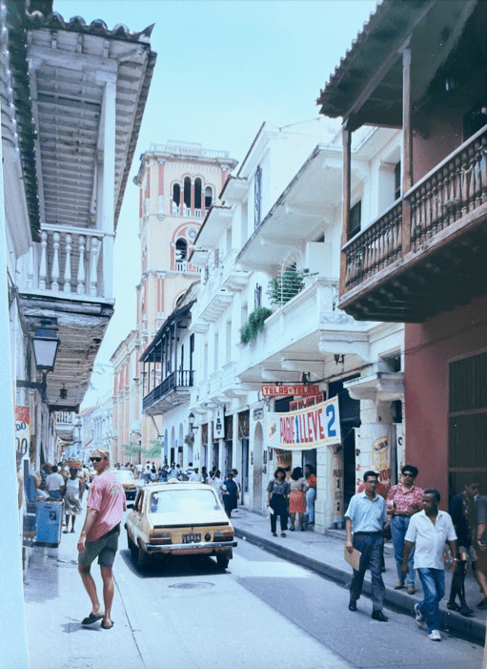

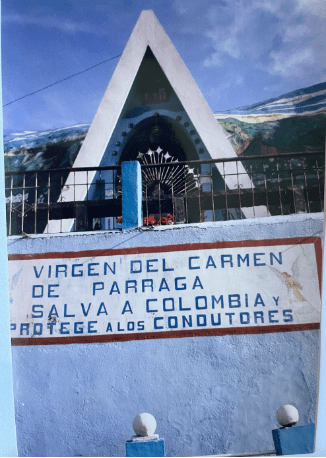


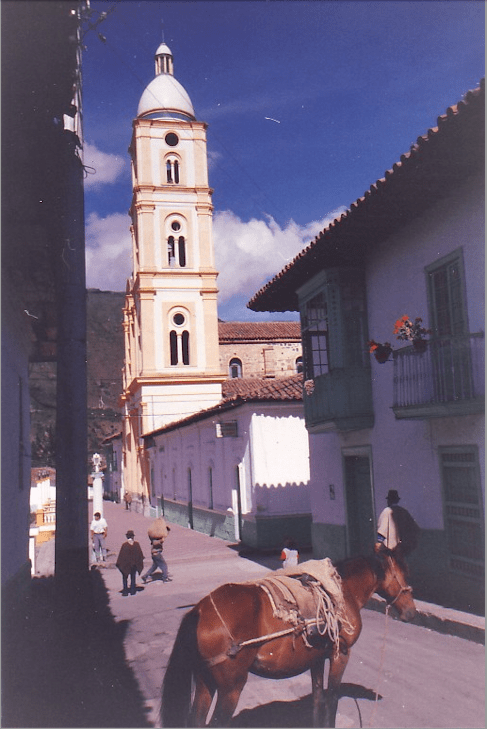

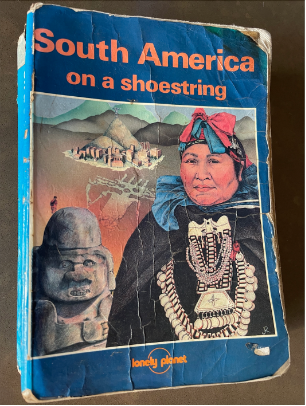
Chapter Eleven
Ecuador
Arriving from Colombia with a guitar, two surfboards and a backpack was an excellent way to get the attention of Ecuador’s customs officials. Would I be the next sad gringo to discover that smuggling drugs wasn’t as easy as it seemed? They called me over and told me, in Spanish, for they spoke no English, to open the surfboard bag. Then they wished they hadn’t. My old wetsuit, boardshorts and towel hadn’t seen the light of day since I’d packed them, still damp, in Panama five weeks before. They spilled out as I opened the boardbag’s long zip, and it’s fair to say the stench left its mark. And what are these two small boats for, the customs men asked, from a distance. When I explained, in the best Spanish I could manage, that these were surfboards, for riding waves in the ocean, they stared back blankly. And fair enough too. We were at least seven hours’ drive and two and a half thousand vertical metres from anything resembling a wave.
If these had been Australian border officials I probably would have been arrested for several hours while holes were punched through my boards to search for drugs. But these were Ecuadorian officials and, as I was to learn, they ranked among the world’s least officious officials. For them, near enough was good enough and the details didn’t matter. This served me well at the border crossing, but worked against me on Ecuador’s railways over the next week or so, as you’ll see. Before long the customs guys grew as sick of trying to understand what the little boats were. Like most people who’d been curious about my surfboards as I bussed through the Colombian Andes, the customs guards knew nothing of surfing, and there’s more than a good chance they’d never even seen the sea for themselves.
Once successfully in Ecuador – and I should clarify here that I wasn’t carrying several kilos of cocaine across the Colombian border. In fact, while I’m on the subject, I’ll say that, when I look back, perhaps the most amazing thing about my nine months in Latin America, was that I was never offered cocaine in all that time. Sure, I chewed a mouthful or two of coca leaves while walking the Inca Trails; and one of the Peruvian surfers tried to take me with him on a dodgy cocaine-buying mission, but that was as close as I got. I never saw it, never took it, never got offered it. Is that some kind of record?
Anyways, returning to our program… Once successfully in Ecuador, I was greeted by the friendliest, most helpful taxi driver in Latin America. He loaded my ‘little boats’ onto his roofrack and drove me the handful of kays to the nearest small town with accommodation, Tulcan. The next day, a series of local buses ferried me two hundred and forty kilometres to Ecuador’s capital, Quito, the world’s highest capital city at nearly three thousand metres. The journey south across a high plateau was decorated with a series of conical, snow-capped volcanos. The snow grew even more remarkable when a roadside sign told us we were crossing the equator, from which Ecuador takes its name, just a half hour north of Quito.
I rented a room in the old part of town, then jogged up El Panecillo, one of the nearby hills, to pay my respects to the silver, forty-metre-high Virgin Mary that blesses the city from above. (A quick note, not related to the story: El Panecillo means ‘the little breadloaf’ in Spanish, and a free subscription to anyone who knows why so many mountains round the world are called breadloaves. I can’t see the similarity.)
Having checked in with Mother Mary, I went downtown to get some admin done… and came face to face with Ecuadorian inefficiency. Two of the shops recommended by Lonely Planet for buying a map of Ecuador had relocated without giving a new address, and the two that still existed had sold out of maps months before. At the British Embassy, the fax machine was broken, and so were the international phone-lines at Quito’s Central Post Office. The contrast between tidy, efficient Colombia and ramshackle Ecuador was to become more apparent hourly, daily.
And while I trekked fruitlessly round the city, poverty built a steady assault on my conscience. A woman huddled in a decrepit doorway with seven children under six begged for coins; and legions of boys with filthy clothes and faces begged to clean my unpolishable hiking boots with near-bristleless shoe brushes. I’d seen poverty in many places during my months in Central America, but it had been of the rural, subsistence variety. This urban poverty was on another level. It was the first time in the trip that I’d felt guilty – not just sad, but guilty – about passing through such poor communities where my visit advertised the health, freedom, and expendable money these people could never hope to have.
That night, however, I saw Quito at what must be close to its best. It was Ecuador’s Independence Day, and the occasion was being celebrated with a free concert in one of the downtown parks. The music played by half a dozen local bands was joyous and intoxicating, and the crowd danced with ten thousand variations of what might have been salsa, or samba or merengue, I still don’t know the difference. But whatever the technicalities, these tunes and rhythms and the movements they induced put Aussie beer-barn-disco-dancing in the shade. For some reason, I was adopted by a ten-strong group of musicians from the Andes who’d toured Europe with their music. I became their gringo sidekick and was included in the steady emptying of a large bottle of ‘aguardiente’, the locally-produced cheap alcohol.
To heighten the joyous mood, the town square was periodically rocked by a range of homemade explosive devices detonated in the midst of the heaving crowd. Some bangs seemed to have little more horsepower than the bungers we used to blow up glass bottles with; and some seemed to have enough oomph to overturn a small car. At every concussion, the crowd roared its approval. How hundreds weren’t killed, I’ll never know. Or perhaps they were. Towards the end of the evening, the ‘official’ fireworks were lit. They’d been arranged on scaffolding on both sides of the stage where the musicians performed, so there was a crowd-crush as thousands happily fought to get clear of the flames and explosions. What better way to celebrate Ecuador’s independence?
The next day I met up with Dunedin Mike, who’d arrived in Quito from Bogota a few days before me to try, unsuccessfully, to change the place and date of his flight back to New Zealand. And with Mike was Lundi, from Queensland, who’d flown down with Mike while his wife, Mel, attended to some family business in her hometown of Bogota.
Our main aim in Ecuador was to find some waves to ride. It’d been nearly five weeks since Mike and I had last surfed, way back in in Santa Catalina, Panama; and Lundi’s surf-drought was longer than that. My one-page ‘Surf Report’ on Ecuador advised that the best waves on the coast were at Montanita, a tiny village about six hundred kilometres southwest from Quito. There was a direct route westwards down the Andes to the coastal plain, but Lonely Planet said that a slightly longer route south through the mountains, then west to the coast through Guayaquil, Ecuador’s second largest city, was a more scenic option. This journey began with a spectacular, old-fashioned train-ride from Quito to Banos, a pretty town in a mountain region a few hours south. After catching a hundred buses through Central America and Colombia, we were all keen to take the train for a change.
But the guidebook warned that Ecuador’s national railways regarded timetables as no more than rough approximations of uneducated guesses. So at mid-morning the next day we took a taxi to the station to find out from the horse’s mouth when the next train was leaving. When we finally tracked down the man who claimed to be the stationmaster, he told us (‘seguro’, which means absolutely, without doubt, in Spanish) there’d be a train today at three pm; and that we should come back at two to make sure we got tickets. Great.
So we returned to our hotels, packed our bags, bought some food and went back to the station at two as instructed… to find the station deserted. The train to Banos had left, half empty, an hour before. There being no-one to ask about when the next train was, and no point in expecting their answer could be trusted, we gave up on the train and took the boring bus instead, stewing on the injustice Ecuadorian railways had dealt us.
Banos was… underwhelming. Compared to the scenery and towns Mike and I had found on our epic journey to El Cucoy in Colombia’s high Andes a few weeks before, Banos failed to live up to its description in Lonely Planet. Still, we spent a couple of days walking through the lush hills and valleys that surround the town, and I got bitten by a dog. It seemed friendly when it approached: tail wagging, eyes wide-open, seemingly thrilled to find one of the biggest dog-people in South America. But it walked straight past my outstretched hand and bit the back of my ankle. It wasn’t hard to fight it off, but its teeth broke the skin and left me wondering if there was a greater risk from rabies or from a visit to an Ecuadorian doctor. I took a chance on the rabies.
That excitement over, we made a return bus-trip to the village of Puyo, further east, to experience yet another Andean road just an hour’s heavy rain away from collapsing into the valley below. Then we moved west to Guaranda. On this route we passed Chimbaranzo volcano and, not far from the road, what appeared to be the first real-live South American llamas we’d seen.
Our room in Guaranda was at the grandly named Hotel Ecuador which was run by two women, sisters perhaps, whose combined age must have been well over one hundred and fifty. The hotel was also a relic of the turn of the century: an ornate, beautifully kept, wooden museum piece, with prices that I’m sure were a few decades out of date too. That night in town, Mike and I found another restaurant that was happy to give us dinner and a drink or two in return for a couple of hours of our music.
The next day, we bussed… to somewhere else. For the life of me I can’t figure out from my diary where it was, but on the way there we had to stop for a couple of hours while the single-lane dirt road round a mountainside got re-built by two blokes and a tractor following a land-slip. On the return journey, we found the freshly re-built road was blocked by another landslip that had come down in the few hours we’d been gone. A range of rocks was strewn across our path, the biggest of them a semi-spherical boulder about a metre in diameter.
Ignoring the chance that several more of the boulder’s mates might soon join it on the road, the driver parked the bus as close as possible to the biggest boulder. Then a posse was gathered from among the passengers. Mike, Lundi and I weren’t invited to join the posse, but we got out of the bus to watch, and to be ready to escape the next avalanche. Under the driver’s directions, the boulder was manoeuvred to the edge of the road using half a tree as a lever. Then it was nudged into the valley below. We watched it thunder down the steep slope, noticing only then that a herd of cows were grazing in a rough field about two hundred metres beneath us. Despite the chaos descending on them from above, none of the cows took any evasive action, and by the grace of God the boulder and the minor avalanche it created thundered and showered across the valley floor just a bus-length wide of them.
This might go to show how right US President Coolidge was when he observed that “four fifths of our troubles would disappear if we just sat down and kept still”. (Mind you, the Republican Party’s decision in the late 1920s to sit down and keep still instead of regulating the US economy led to the Great Depression, which led to global misery and desperation, which led to the rise of fascism in Germany and Japan, which led to World War Two, which killed at least fifty million people. So Coolidge was obviously wrong, and incompetent, and lazy. He would have fitted right in at Railways Ecuador.) Or perhaps the cows in that valley had lived there long enough to get really good at reading avalanches.
The next day we went east to Riobamba, then on to Alausi, another hundred kays south. Here, our guidebook advised, we could experience one of the highlights of any trip round Ecuador: an epic short train-ride on a track called The Devils’ Nose Route. This experience would ease our pain at having been incompetenced out of our train ride from Quito to Banos.
What followed next does not reflect on us well, but we can’t take all the blame.
Having been denied the previous train ride due to incorrect information given by the so-called Quito stationmaster, we left nothing to chance at Alausi. Several times that afternoon and night we went to the train station to find out, from different officials each time, exactly what time the train would be going in the morning. Each time, we got the same answer: the train would leave at nine a.m. – ‘seguro’, which as you now know means ‘absolutely beyond doubt’ in South America. And to make sure we got a ticket, we were told to be at the station at least two hours before then. Great.
So the next morning I got up at six and walked to the station to secure tickets for the three of us. There I was told there would be no train today; they only ran on weekends. You what? To calm down and consider our options, I walked to the end of the empty platform and stared bitterly across the dramatic valley into which the train track disappeared. The grisly array of rat and mouse carcasses carpeting the end of the platform reflected my mood.
As I imagined the next epic train experience we were about to miss out on, up from the valley rumbled a train; well, it was an old bus mounted on a train’s chassis. I followed the ‘auto-ferro’, as the locals call it, to where it screeched to a halt at the other end of the platform. When the driver climbed down from his cockpit, he confirmed – seguro – there would be no train this morning. But – seguro, he promised – there would be a train at one o’clock this afternoon. Okay, that gave us a six hour wait with nothing to do, but we’d come half the length of Ecuador for this adventure, so waiting half a day was better than missing out. But when I then tried to secure three seats on this train, the driver told me I’d have to come back after lunch.
I walked back to the hotel to give Lundi and Mike the news. They weren’t happy, to say the least, about getting dicked around by Railways Ecuador again, but what the hey, at least there was a train that afternoon. With nothing to do except wait for it, we decided to return to the station and camp out to make sure it couldn’t leave without us this time.
We arrived back at the station to find fifty magnificently-dressed tourists – Italians, we find out soon enough – boarding the train. We race to the ticket office to buy our tickets, but it’s closed and the only so-called official we can find tells us the train’s booked out. Say what? “Bugger this for a joke,” says Mike, “let’s get on anyway”. So we do. Pandemonium erupts. The Italians are trying to kick us off, we’re telling them we‘ve been dicked around by Ecuador Railways for long enough and we’re not going to take it any more… and there are plainly at least three unoccupied seats for us to sit in. Meanwhile, the Ecuadorian officials have realised this is their license to make a small fortune and they agree to sell us tickets for five times the normal price. For once, we don’t care we’re being ripped off; it’s worth it to win this battle.
So off we go, the Italians hissing daggers at us every second. The railway ride is every bit as good as the hype. The single track descends into a steep, winding, barren valley; the rails clinging to the vertiginous slope by their fingernails. It’s a miracle of engineering conceived in the 1890s by Americans and built by indentured Jamaican and local labourers, about half of whom died from accidents or disease.
But the Italians aren’t enjoying it much. Instead of letting Mike, Lundi and me fade into the background, they remain bitterly obsessed with our presence. They talk savagely between themselves and with their tour guide, gesticulating and glaring at us every inch of the way. No doubt they’d been suffering their own frustrations with Ecuador’s tourist industry, and that’s where we could have found common ground and shared some funny stories… but sadly it never came to that. After an hour or so, we reach the bottom of the valley and the Italians get out to stretch their legs and take in the grandeur of their surrounds. We take it in turns to have a quick look around, so there’s always two of us in our seats to make sure we keep them for the steep, hot return journey.
An hour and a half later, when the excursion is over and we’re all safely back on the Alausi platform, the tour guide and three of the most outraged passengers attack us directly with further complaint. They cry, they swear, they wring their hands and walk away, then come back to shout more Italian or comically broken English. Lundi and Mike can’t keep a straight face, so I become our spokesman. The Italians won’t empathise with our frustration at having been repeatedly misinformed by Railways Ecuador, and I can’t empathise with why it should matter to them if we sat in the three spare seats. Eventually I volunteer to give them a small sum of money in compensation so they can feel they’ve had a little win. This feeble sum, it was perhaps five dollars, calmed them down and was worth every cent.
Just so it’s clear, I’m not proud of upsetting the Italians, and this was in part our fault; but the train driver and his mates were the ones who sold us our seats, and the Italians could have had a great time by simply ignoring us, or even being social if they wanted. It was an epic adventure on several levels.
From Alausi we headed south on more mountain roads to the gloriously named Chunchi and Gun, and from there west towards Guayaquil. Soon after Gun, the magic of the mountains evaporated during the road’s misty descent to the dull, sweaty coastal plain.
Guayaquil was dirty, smelly and urban: a shock after our four weeks in the clear air and light of the Andes. Lonely Planet directed us to something resembling a surf shop, and there we met Carlos, the lynchpin of the fledgling Ecuadorian surf-scene. He confirmed for us that Montanita was the place we should go. After a dash to Guayaquil’s bank and post office, we take the two-hour bus-ride west through desert and a dozen different cacti, to Santa Elena, where we meet Ecuador’s poverty again.
On the next one-hour bus-ride, north to Montanita, we see the sea for the first time since Panama. But it’s a depressing reunion: the ocean’s waveless, grey and windblown. And despite the equator being just a couple of hundred kilometres to our north, the wind blowing off the ocean is icy. This was our introduction to the Humboldt Current, the river of cold water that sweeps up the west coast of South America from Antarctica, driven by the storms that tear west across the ‘Roaring Forties’ latitudes, eight thousand kilometres to the south.
That night we found a cheap room in Montanita village, but in the morning we walked a few hundred metres up the beach to where the good waves were said to break when the right swell arrived. And there we found our next cool surf-shack. Tucked under the headland, a simple resort of half a dozen separate cabins had been made of wood and local stone. It was a little more expensive than our budgets allowed, but Mike and I did a deal with the owner: in return for cheaper rent, we’d be on-call to provide musical entertainment for the guests at any time of day: a total win-win. Being a Saturday – who knew? – our first gig was that night, and it went down a treat. The owner was thrilled; we were thrilled. Score!
The next day we went for our first surf at Montanita point…and froze! The last time we’d surfed, in Central America, the ocean had been somewhere in the mid-high twenties, a bit like a bath. Here it was barely sixteen degrees, and the cold onshore breeze made it feel even colder than that. At last the old Sydney-winter wetsuit that I’d carried with me as surfboard padding on this trip proved its worth. And boy was I relieved that I hadn’t chopped off the legs, as well as the arms, when I’d been short of boardshorts back in Tortola five months before. Lundi only had a two mill wetsuit with short legs and arms and could stay warm for just an hour or so. Mike only had boardies and a rash vest and, despite having grown up surfing in Dunedin, could only manage half an hour before turning blue.
We got a few days of okay waves on the point, but we were visiting out of season. The best swells for Montanita come from the north between October and March. What we saw were the leftovers of Roaring Forties south swells that hit the point at the wrong angle; and always the waves were ruffled by that pesky, cold onshore breeze.
But our surf-shack was an epic hang and we could spend hours every day working on our music without bothering anyone. In a few days, Mike would be going back to Dunedin to get the café set up, so this was our last chance to write songs and rehearse. Mike was a good lyricist and had a good sense of what made a catchy song, and I provided grooves on my travel guitar, other tunes and the occasional lyric. We were a good team. Every second night we could try our new songs on the ever-changing crew of hotel guests, and the next Saturday we played for a birthday party and brought the house down. Too much fun.
On our last night there, Kees and Courtney, from Vancouver, brought their small battery-powered cassette player to our cabin and we attempted to record our first album, live, by candlelight. I’d love to know what happened to that tape. Maybe Mike’s got it?
I also made a start at turning my travels into chapters, but it’d be another twenty-five years before that project grew legs.
When we weren’t cooking our own food in the resort’s communal kitchen, there was a great pizza place in town, if you were lucky enough to find it open. Or from the village baker you could get fresh hot bread in the morning, and fresh hot empanadas in the afternoon.
For ten days we were part of an ever-changing community of Ecuadorians, Argentinians, Americans and Canadians. One of the Canadians, Paola, was teaching at the International School in Guayaquil. We got on well but after a few days she had to return to her job, and – sorry if you think I got my priorities wrong – I wanted to continue my solo journey to Sydney. We wondered if there might be a way, somewhere down the track, we could spend some more time together. Six years later we made it happen by getting teaching jobs at the same International School in Bali… but that’s a story for another chapter…
On the last day of August, Paola, her friend Chantal, Mike and I, made the six-hour bus-ride back to Guayaquil. Mike was returning to Dunedin to get the café ready for the start of the University year; Paola and Chantal were returning to their teaching jobs; and I was meeting Lundi at Guayquil bus station to go surfing in Peru, just five hundred kilometres further south.
Lundi and Melissa (his Colombian wife) had left Montanita the previous week when Mel’s boss needed her back in Bogota for a few days. But having had to cut short their Ecuadorian surfing holiday, Mel gave Lundi a leave-pass to go on a replacement surfari with me to northern Peru.
You little ripper!
Vamanos a Pacasmayo!
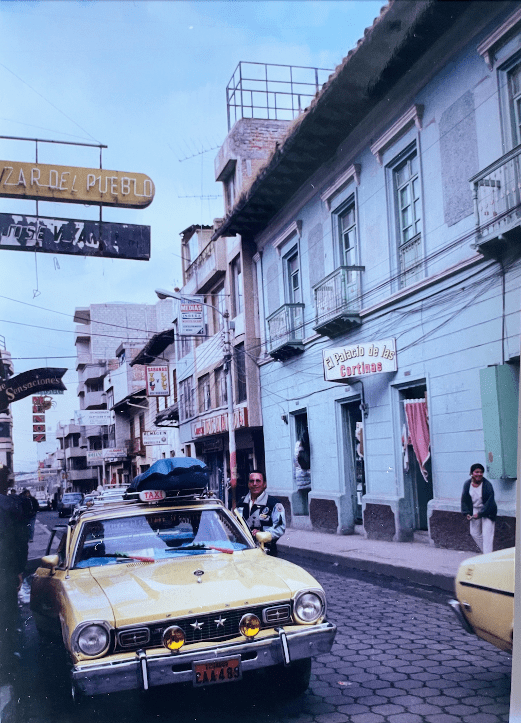
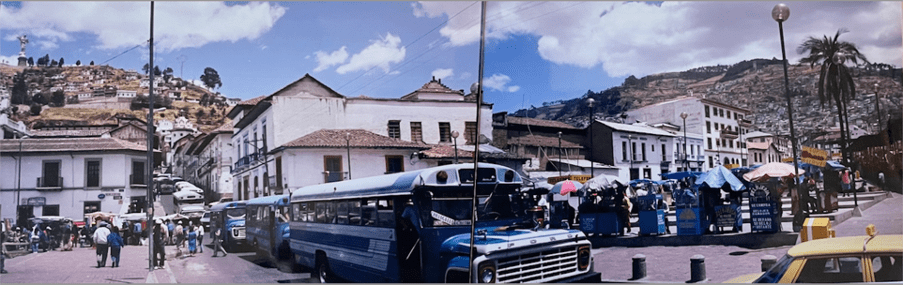


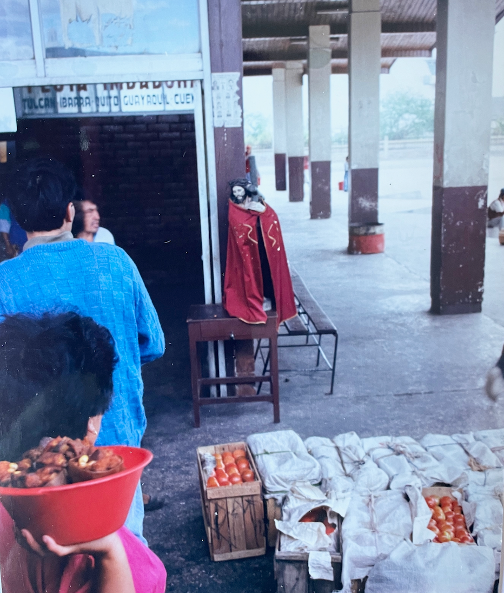


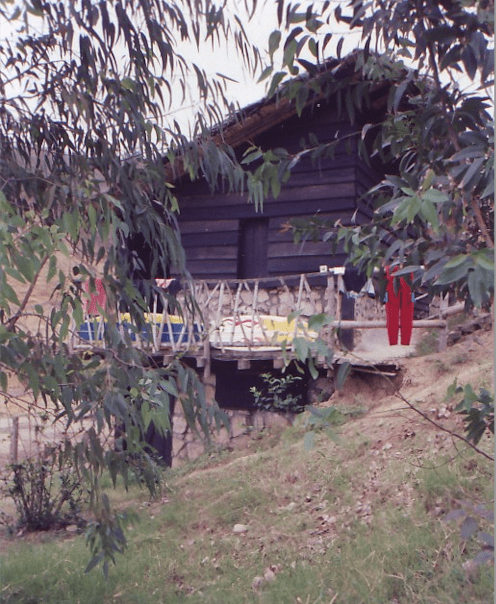
Chapter Twelve
Peru Part One: Surfing on the moon
Peru greeted us with a weapons grade stench. Well, to be fair, Ecuador had to take some of the blame too. The almost-dry river bed that marked the border between the two countries was strewn with oily brown puddles, plastic bags, rotting food and toilet waste. The windless, mid-afternoon heat baked this foul mix into an eye-watering haze, though the roaming pigs found some joy in it.
Lundi and I had kicked off our Peruvian surfari with a five hour busride south from Guayaquil, Ecuador,to the unloved border crossing.From here we took the night bus bound for Lima, the capital city, a thousand kilometres south. Our destination, the little town of Pacasmayo, was a little less than half way along that route. What we couldn’t see from the bus was that the countryside beyond the highway was turning into one of the world’s driest deserts. There are some parts of coastal Peru where rain has never been recorded.
So when we clambered off the bus sometime after midnight at the highway turnoff to Pacasmayo, we felt like we’d landed on a science fiction movie set. Lit up by the orange lights of the cement factory, featureless desert stretched in every direction. A single taxi driver was waiting with fingers crossed near the bus stop for a chance to take the odd night-bus passenger the kilometre into town. That late at night, as the driver explained, we had only one choice for accommodation. It was grim: just a concrete box in a dodgy part of town where every second pale yellow streetlight was broken. The building across the road seemed to be some sort of jail. If this was the best Pacasmayo could offer, we’d be back on the road south within a couple of days.
So, I hear you asking, why on earth had we chosen Pacasmayo? The reason, of course, was to look for surf. My one-typed-page ‘Surf Report’ on northern Peru claimed that the wave a few kays south of town was one of the longest and most consistent in South America. So the next morning, having survived the night, we were up just after sunrise to find if this was true.
Leaving our bags and boards behind, we set out through Pacasmayo’s dusty, empty streets, trusting that walking in the opposite direction to the sun would bring us to the coast and, somewhere along the way, to the centre of town. Our Lonely Planet ‘South America’ had no info on Pacasmayo, not even a town map, so we were flying solo.
After five minutes, we found what appeared to be one of the main streets. And here were some simple shops, and the market place, and as we walked further west, the town started to look like the sort of place we’d be happy to stay for at least a couple more days.
Another few minutes’ walk brought us to the top of a very low rise in this narrow main street, and there, just another few hundred metres away, between the two rows of simple shops and houses, was the ocean. At first sight, it was disappointing: a wind-ruffled grey sea stretched to a hazy horizon. On reaching the end of the street, we found weak, short period waves pushing sideways along a grey beach. To the right, a couple of hundred metres to the north, a decrepit pier stretched four hundred metres out to sea. Just beyond it, a fleet of perhaps fifty small, mostly wooden, fishing boats tugged at their moorings. But turning to the south, we could just make out, perhaps three kilometres away, ‘El Faro’, the black and white lighthouse that marked the location of the wave we’d read about. It seemed unlikely there’d be good waves there today, but before we could think about trekking out for a close look, we’d need to find new accommodation and collect our bags from the truckstop fleapit at the far edge of town.
Walking back through town on the same mainstreet, near the spot where the ocean had first come into view, a quirky, historic two-storey wooden house caught our eye. Its ornate carved window decorations and possibly a family crest at the peak of the street-facing roof put the surrounding simple concrete-block structures to shame. While I fussed around working out which angle of the house made the best photograph, Lundi noticed a tiny cardboard sign pinned high near its wooden entrance gate. ‘Se Alquilar’, it said, which means ‘for rent’ in Spanish. Having seen no other offers of rooms for rent that morning, we knocked on the door, wondering if the sign meant what it said
At first it seemed no-one was home – it was only half an hour after sunrise, after all – but then we heard a distant ‘Espere!’, which means wait. Then came a stumping of feet downstairs, a turning of locks, and there was Coco, just out of bed, mid-thirties, untidy dark mop of hair, greeting us like old friends and insisting we come upstairs to look around.
We loved it at first sight, but didn’t dare to hope we could afford the rent. Coco ummed and ahhed about how much he should charge us, but eventually he settled on a nightly rate of three soles, about a dollar-fifty each. For this, Lundi and I got a bedroom each and the use of the kitchen-dining-living area and the toilet-bathroom. Coco apologised for the lack of internal running water; there was just a single tap outside the front door from which we had to collect big bucketfulls a few times a day. Too easy. Home sweet home!
There was also a ‘good room’ that Coco showed us but asked us not to use. Antique furniture and carpets, photos and paintings, silver cutlery and trinkets locked in cabinets had all been frozen in time, since the days in the early nineteen hundreds when Pacasmayo’s pier, one of the longest on the Peruvian coast, had made the town one of the richest in the land. It would have made a perfect film set; and perhaps the story of how Coco’s family had come to build such a fine house in Pacasmayo might have made an interesting plot.
Hardly believing our luck, we jogged back to the fleapit on the edge of town to collect our bags and boards. After lugging them to our new dream digs (which we quickly christened Casa de Coco), and after finding a shop to buy some bottled water and food, it was at last time to check the surf.
This time we walked down our street as new, proud residents of Pacasmayo. Once at the sea, the path to El Faro began with a walk down a tidily paved promenade that fronted the town’s best streets. But where the town met the desert, the promenade petered out and we scrambled down a low slope to the grey-orange beach. Following the gentle arc of the coast, we scuffed through the desert out to the lighthouse.
Let’s just cut to the chase and say that the ‘Surf Report’ gave us great advice, once again. Okay, Pacasmayo isn’t the place to go if you want to get the deepest barrel of your life, but if you want to go fast until your legs hurt, then go a bit further, this is a great place to do it. Two to three hundred metre rides were not uncommon, and on the bigger days they’d be longer. And the waves were so consistent. In our three weeks there, we saw three excellent long-range double-overhead swells that waxed and waned over a period of about six days each.
It was like surfing on the moon. Apart from the black and white checks painted on El Faro, there was nothing but the light-orange-grey of the desert as far as you could see. It seemed it hadn’t rained for a thousand years. Smooth flat river stones lined the beach, and low walls had been built from these, perhaps by fishermen. These walls gave us shelter between surfs from the constant south wind; and once the every-day sun had fought its way through the morning haze, the flat stones made a luxurious warm grill to spread your towel and shivering post-surf body on.
This was essential as the ocean was cold, only fourteen or fifteen degrees, thanks to the Antarctic Ocean-born Humboldt Current. I was glad, again, that I’d brought my crusty old Sydney-winter wetsuit along for this trip. it allowed me to surf-vive for an hour or two longer than I could have without it. The water was grey in the morning, grey-olive green once the sun rose high, and always opaque due to the fine sand sweeping ever north. On the three kilometre walk out to the waves, we’d pass the occasional dead seal, probably caught and / or killed by the fisherman who worked the town’s main industry. The presence of seal colonies all along Peru’s coast meant there must have been sharks, though in those days it never crossed our mind.
It was a forty-five minute walk along the desert coast from the town to El Faro, so we’d pack enough food and water to surf the whole day. One time, we came in from a morning surf to find our food had been stolen. Just the food, mind you, not our water, our towels, our clothes, or even the little bit of money in our pockets. In the evenings, if the sky was clear, we’d see the desert turn ever-richer red-orange as the sun fell to the horizon. On the late walk back to town, the sky faded to purple-black and a million stars distracted our gaze. How great is living in a desert?
At first, there was just Lundi and me. Lundi was a gentle, thoughtful Queenslander who rode a surfboard well. We’d met by chance in El Salvador a few months before; then again in Costa Rica; then in Bogota, Colombia, where his wife’s family was from; then in Montanita, Ecuador, where this chapter began. His wife, Melissa, had a fortnight’s work in Bogota, so she’d given Lundi a leave-pass for this Peruvian surfari.
On the first weekend, Lundi and I met the small handful of local surfers. They adopted us, introduced us to their sisters, girlfriends, mums and dads. They invited us to their barbecues, their discos; they gave us car-rides out to the waves on weekends. One of them was chief comedian. The first time we met him, he was surfing the point naked: quite an achievement in the frigid ocean. Miguel’s girlfriend, Rosita, gave me lessons in Spanish and introduced me to her mum and four sisters, all with gold-brown eyes, like lions. We spent hours practising our English and Spanish on their sunny terrace across the road from our place. And one of their dads had a room full of what might have been a priceless collection of pre-Colombian pottery and ceramic art that he’d gathered from secret personal discoveries in the nearby desert.
Late one Saturday night after the disco had closed, one of the non-surfing friends of the local boys asked me to accompany him on some unspecified mission. Before long we were walking into the poor, dodgy section of the town that Lundi and I had escaped after our first night. The further we went, the more excited he became. At one point he stopped to ask me how much pasta I wanted him to buy for me. Pasta, the food? I replied. No, no: pasta, from the coca, he said, surprised I didn’t know. Apparently, pasta’s the name for the paste that later gets refined to make cocaine powder. Oh, no, none for me, I said, to his disappointment. I suddenly realised where we were going, but I was stuck. A minute later we arrived at this scary-looking house and he led me through a metal gate into a rough courtyard. Come inside, it’s safer, he said, so I did, but it felt anything but safe. When my mate disappeared into a back room, I waited for a minute, then resolved to run away. I left the house as calmly as possible and walked fifty metres pretending I knew exactly where I was going, which I didn’t. As soon as no-one was looking, or so I hoped, I sprinted to where I guessed the town’s main street might be.
Half an hour later, I was safely back at Coco’s house. But Coco was out somewhere and I didn’t have a key. So I was stuck outside with the occasional group of weekend louts from out of town roaming the streets. To avoid attracting their attention, I curled up tight against the inside of the entrance gate and waited an hour or two, snatching minutes of sleep, until Coco got home. And that dodgy night in the backstreets of Pacasmayo was the closest I got to cocaine in the whole year of travelling through the Caribbean and Latin America.
From Pacasmayo, Lundi and I made day-trips by taxi to the waves in the nearby villages of Puemape and Chicama. In the 1970s, the wave at Chicama had gained the debatable reputation as the longest in the world. However, it only broke well a few times a year, and it was barely waist high the day we visited. But the highlight there was re-meeting Jimmy and Julie from San Clemente, California. I’d first met them a few months before around a campfire on the beach in Pavones, Costa Rica. Since then we’d followed similar but different routes south, so I spent most of the day swapping stories with them instead of surfing the small, slow waves on offer. I gave them our address in Pacasmayo, and sure enough, the next day they turned up and moved in to the third spare room.
Jimmy was like the older brother I never had. We had so many experiences and thoughts about life in common. He was restless, cursed with curiosity, unconvinced there was anything better to spend a life on than exploring, pursuing experience, whether it was in the ocean or the mountains, with company or alone. We spent days discussing our hopes and future plans, expecting that while these nomad days couldn’t be infinite, could they?, what was it that would make us want to change this way of life? How would we know when enough was enough? Seven years later I met him by chance on the stairs at Uluwatu in Bali and found neither of us had got any closer to answering those questions.
Somewhere at the market during these weeks, I found an English language copy of ‘Future Shock’, Alvin Toffler’s 1970 guess at what the late twentieth century and beyond might look like. It made great reading in 1993 and I reckon its analysis of the impact of rapid technological change on individuals and society would still make great reading today. I made about five pages of notes on it in my diary, and here are a couple of quotes I scribbled down: ‘The people of the future can enjoy greater opportunities for self-realisation than any other group in history. The future offers more varied life niches, more freedom to move in and out of these niches and more opportunity to create one’s own niche. It also offers the supreme exhilaration of riding change… changing and growing with it… It presents the individual with a context that requires self-mastery… more exciting than riding the surf or the pursuit of pharmaceutical kicks.’ In another chapter, Toffler notes: ‘[there is] a snowballing belief that reason has failed man.’ Not a bad bunch of guesses from fifty years ago.
A couple of days after we became his house-guests, Coco went back to work in Lima, seven hundred kilometres away, leaving us to look after ‘Casa de Coco’. When he returned a week later, he brought his lovely girlfriend who spoke no English, and a radio-cassette player with a hundred cassettes, all in the wrong boxes. I’m sure Coco was hoping we’d stay for a year, so when I told him I was thinking of leaving in about a week, he came over all sad and persuaded me to stay a bit longer, rent-free.
In another life, I could have happily stayed in Pacasmayo forever. As the local A.M. radio station call-sign of that time proclaimed: ‘Todo es siempre buenasa en Pacasmayo’ (everything is always beyond the very best in Pacasmayo). But on August 14th, I made a reverse-charges phone-call from Christian’s place to my parents in Sydney. We discussed plans for what would be our first family Christmas together in six years. That left me four months more travel-time, with Machu Picchu and so many other places demanding a visit on the road home… if I could stretch my funds that far.
A week later I gave Jim and Julie the key to Casa de Coco and caught the bus further south down the Pacific coast. It was hard to leave one dream home in search of another, but the world was too big a place.


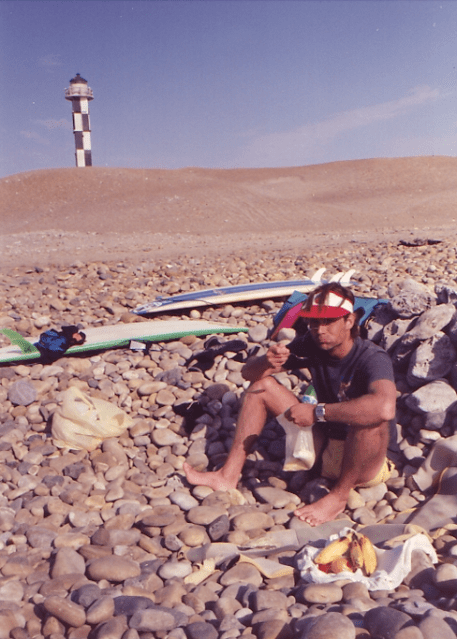

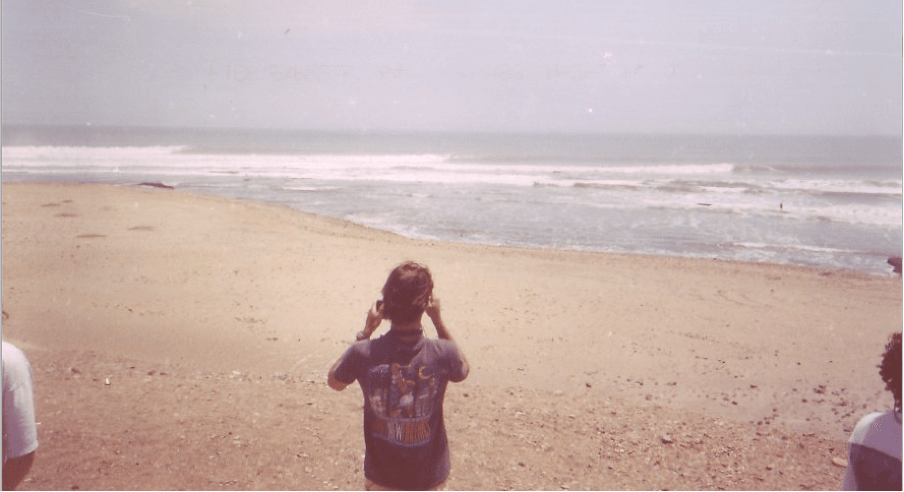


(That’s the fence I hid behind during the scary ‘pasta’ incident)
Chapter Thirteen
Peru Part Two: By bus and train to Cusco
The morning bus ride south from Pacasmayo was epic. For a few hundred kilometres we traversed the coastal desert through Trujillo and Chimbote. Then we followed steep canyons up into the Andes. As we climbed higher, thick clouds rolled in to kill the views I’d come to see, especially Mount Huascaran, which reaches nearly 7000 metres.
As the weather closes in, I pass the time by trying to read a second-hand newspaper. My Spanish is good enough now to make meaning of nearly half the text. One of the smaller headlines sends a jolt of adrenaline through me: ‘Tiburon en El Salvador’. I read that a shark has just killed two teenagers at the beach a kilometre east of where I’d been surfing at dawn and dusk every day just a few weeks before. The long knife-slash next to me as I spun to catch my last wave one night grew a nauseating meaning.
After spending a cold, damp night in a cheap room in Yungay, I took a short busride up to the Chinancocha and Llanganuco (yarnganuko) Lakes in the hope the clouds would clear. They didn’t. But back in Yungay the continued bleak weather well-suited the climb to the town’s six metre tall statue of Jesus. This Jesus, built on an Incan burial mound, forever blesses the valley below where twenty thousand people and their homes – the entire original town of Yungay – was obliterated by a landslide when a section of Mount Huascaran collapsed during an earthquake in 1970. The catastrophe had been predicted by scientists eight years before it happened, but the federal and local governments denied the danger and threatened to imprison the scientists for uneducated scare-mongering. Remind you of anything?
It was still raining the next day when I got to Huaraz, fifty kays further south, but that didn’t spoil the wedding party in what appeared to be a car mechanic’s workshop across the road from my simple pension. The music went most of the night and sounded like a dozen ten-year-olds had been let loose on saxophones, oboes, violins, bicycle bells, some sort of harp and a range of percussion instruments to simultaneously make any noise they wanted. It was brilliant: crazy, discordant, jaunty and jazzy… a pure musical celebration. The women’s outfits matched the music perfectly: white straw hats, dark green socks, bright blue and / or yellow shirts, pink cardigans and yellow scarves accessorised with a sort of woven pashmina with stripes of every colour. Outstanding.
The next morning the weather cleared and I visited the Huaraz market. The scene was just too spectacular to stick to my policy of not taking photos of the local people: the women’s colourful clothes, the mountains behind and the quiet hubbub of the market were too special to trust to my memory alone. So I held my palm-sized, auto-focus camera to my chest and took a snap without looking through the viewfinder. In the far distance I could at last see Mount Huascaran, and wished this was the day I’d passed through Yungay. For the first time, I heard Quechua, the pre-Colombian language of the Incas.
Then it was south to Lima, four hundred kilometres away. The journey back down from the Andes to the coast was scenically magnificent, and once again I entrusted my life to a local driver, who’d probably never sat a test, and his ageing bus. Back at sea level, the road south was plain enough to let me catch up on my diary and ingest the next pages of my Lonely Planet bible to plan the next few days.
The guidebook warned there were a few regions of central Peru that tourists should avoid. The most dangerous was a section of the Andes controlled by a radical communist group called ‘Sendero Luminoso’, which means ‘Shining Path’ in Spanish. Their ‘shining path’ was funded in part by kidnapping foreigners. In 1993, the rumour of the day was that a couple of Dutch backpackers had ignored the warnings and been taken hostage. When no ransom had been extorted, their throats had been cut and their bodies dumped in the desert. Or so the story went.
It wasn’t hard to avoid Sendero Luminoso-controlled territory, but all roads led to the second-most dangerous region of Peru: the capital city, Lima. With brutal budgeting I guessed I’d have enough cash to last until I got to Arequipa, the next city that had a bank that cashed travellers’ cheques, a thousand kays further south. So when my bus from Huaraz terminated at Lima’s north bus station, I took an expensive taxi directly across town to Lima’s south bus station and got the hey out of there.
My next stop was Punta Hermosa, a small holiday town about sixty kays further south, which was home to some of Peru’s best known waves: Pico Alto, La Isla and Caballeros. But the atypically flat, grey and windy ocean convinced me to move on after just two nights’ stay in a funky room at Mama Vidal’s pension. It’d be six weeks before I’d surf again.
It took me thirty hours to bus to Arequipa, Peru’s second largest city. The thousand kilometre journey started well when the first bus that flew south on the highway outside Punta Hermosa saw me waving on the desert roadside and reversed a hundred metres to pick me up. Every connection from Chincha to Ica to Ormeno then on to Nazca went like clockwork: a dream day on the buses of South America. The moonlike desert changed constantly from deep valleys to rocky hills to caves and tunnels dug into the land by the wind. Oh, and I managed to see one tiny glimpse of a hill-side Nazca Line from an altitude of two and a half metres (my seat on the bus) as we sped past.
As ever, one feature of the journey was the steady pulse of roadside memorials to deadly accidents. We stopped at one of them so a passenger could lay some flowers and say a prayer. The rough stone and mortar tower was inlaid with over a hundred car and truck headlights, so I guessed two buses must have collided head-on and / or fallen into the steep valley where we stood.
In Nazca town that afternoon, I had a choice between taking a room for the night or catching the night bus to Arequipa. The bus option would be rugged: I’d have to kill ten hours in Nazca before the bus left at one thirty the next morning; and my ‘Lonely Planet’ advised it was a twelve-hour slog on heavily pot-holed roads. But this option would save me a whole day and a whole ten dollars, and time and money were both running out, so the decision wasn’t difficult.
I found a series of simple restaurants who didn’t mind me writing, reading and learning more Spanish in a corner for hours between lunch, dinner and a couple of beers. Then after a three hour wait at the simple bus-station, I bussed through another brand of desert wonderland, sometimes by the coast, sometimes inland, this time lit up by the all-night full moon. We stopped just once for food and relief, to arrive at Arequipa at two in the afternoon. What a trek.
That night in Arequipa, I stayed in a cheap room at the Hotel Comercio. It was only after paying my bill in advance, as was always the custom, that I realised my fellow hotel patrons appeared to be either prison or asylum inmates… except for the several young women who were audibly renting their rooms by the half hour. Okay, no problem, let’s not get judgey, just say g’day and smile. But after flaunting my first-world wealth by dragging my bags and surfboards up four narrow flights of stairs while they watched, I discovered there was no lock of any kind, not even a flimsy hook, on my room’s door.
The afternoon wasn’t so bad, but when it got dark the odd noises echoing round the building intensified. At dinnertime, I threw as many of the most ‘essential’ items into my daypack and took them with me as I ran to the nearest small shop and bought a bottle of water and the least poisonous packaged food they sold. I was back bunkered down in my room within ten minutes. After dinner, I barricaded the door with my luggage and every squalid piece of furniture in my room. Despite my exhaustion – it had been forty-eight hours since I’d got any sleep – I tried to stay awake by writing.
A large part of these scribblings in my diary are a reflection on the ethics of staying in a hotel alongside poor and desperate people when I was neither poor nor desperate. My choice to stay at the Comercio was driven by my aim to spend as long as possible on the road before returning to my affluent society. How could I blame the locals for resenting my presence, or wanting to steal my stuff? It wasn’t the first or the last time this crossed my mind, and my first-world guilt was to grow stronger over the next few years.
The next day I celebrated waking up alive by bunkering down in my room again. To save money and to guard my belongings, I did none of Arequipa’s touristy things, like the day-long trip to the Colca Canyon to watch real, wild condors hover at eye-level. This rest-day did me good. As it turned out, I wouldn’t get another chance to do nearly nothing for well over a month. The only time I left my grimy room was to get some food and buy my ticket on the night-train (there was no day-train) to Juliaca. There I’d connect with another train to Cusco, (or Cuzco with a z as we spelled it back then), the capital city of the Incas’ Empire.
After another dry-biscuit dinner, I loaded up my stuff and headed to the station. The inmates at the Comercio had warned there’d be thieves on the way, and I’m sure they were among them, so I half-jogged with my thirty-five kilograms of gear, including two increasingly out-of-context surfboards, to arrive at the train without incident.
Every train ticket came with a designated seat, so the only issue for debate was whether my surfboards should travel beside my seat or in the baggage van. The locals gave themselves the right to keep massive rice sacks full of stuff in the aisles beside them, but they wouldn’t allow me the same right with my board-bag. I think I was right in suspecting that if my boards travelled in the baggage van, I’d never see them again. Eventually the conductor settled the argument by allowing me, for a small fee, to tie my surfboards to a couple of unsold seats in a first-class carriage a bit up further up the train from mine. I didn’t know if they’d be any safer in first-class than in the baggage van, but it was either that or leave them on the platform.
The journey to Juliaca was spectacular, with the desert landscape and skeletal railway structures illuminated by another beautiful moon. The best view was from the open window in the filthy toilet, but you could only stay in there to sight-see for as long as you could hold your breath. As we climbed above three and a half thousand metres, frost formed on both sides of the carriage windows and again I wondered if I had enough warm clothes and equipment to attempt walking the Inca Trail. For the third night in a row, I didn’t get much sleep.
The train arrived at Juliaca station in the icy early morning, where there was a three hour wait for the train to Cusco. While the sun eventually warmed me up, the local women strolled the platform, inviting their captive audience to buy homemade food that was both delicious and cheap, and / or alpaca clothing that was rustic, funky and a significant financial commitment. With my growing realisation that I was at least one layer short for these higher altitudes, and after a fair amount of haggling, I spent about thirty dollars on the produce of a whole herd of alpaca: jumper, gloves, socks and a balaclava. It was one of the best investments I ever made.
When the train to Cusco finally arrived, mayhem ensued. Again, as at Arequipa, every passenger had a designated seat, but the pushing and shoving was done by the local people desperate to get on board to sell stuff to the passengers. With only half of the actual passengers aboard, the train driver attempted to shake the hawkers off by pretending to leave. With much honking of the horn and slamming of doors, the train set off, terrifying those of us who hadn’t yet fought our way on board. But the hawkers knew this game, and when the train screeched to a stop just thirty metres down the platform, they ran with the real passengers to the train doors and pandemonium resumed. I’d never seen barging like this, not even among the tour groups taking photos of the Mona Lisa in Paris.
And once again, when I arrived at my seat bruised by the crush, there was much debate about my surfboards. Again, I refused to put them in the baggage carriage while the locals were allowed to clog up the aisles with their stuffed-full rice sacks. I was relying on the conductor to back me on this one, but he caught me standing on the wooden seat while I put my backpack in the rack and tore me a new one in front of the whole carriage. Oh crap. Anyways, after I’d made a grovelling public apology, he allowed me to tie the board-bag to the armrests between the locals’ rice sacks, cages of chickens and the odd baby goat.
At last it’s time for the train to depart, but the conductor has a hell of a job clearing the hawkers off the train, especially as many of them are trapped in the aisles among surfboard bags, rice sacks and farm animals. The last of these stowaways is a couple of small boys with filthy faces and revolting, snotty noses who suddenly launch into raucous, odd-harmonied singing. At first I think they’re taking the piss, but after a few seconds I realise they’re serious. Their music is like nothing I’ve ever heard and really, really good. Unfortunately the train is slowly moving by the time they start in our carriage, so they’re forced to jump dangerously out onto the very last metre of the platform before I’ve got time to give them some money. Just two more of the world’s starving artists, though these two may have been genuinely starving.
The train journey is amazeballs. We meander through sparsely populated farmland and valleys, catching glimpses of ever-higher snow-capped peaks. Half-way there, we pause at a non-existent village named Arravanca while the engine takes a breather. There’s half a railway station, a little chapel and a few more locals selling food and clothing. I’m sure this was the location for the opening scene of the French film ‘The Big Blue’.
It’s dark when the train arrives at Cusco. I find a great place to stay, though the name escapes me, and go out to find dinner.
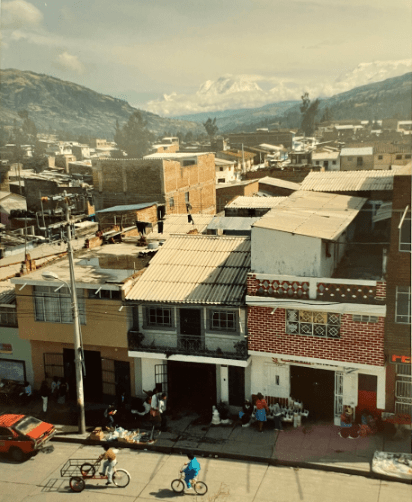



Chapter Fourteen
Peru Part Three: The Inca Trail
A few hours before leaving Cusco to walk the Inca Trail, I discovered I was bleeding internally. My stomach hadn’t felt quite right for a few days, but this midnight toilet visit took things to a new level. I must have picked up dysentery, or a worm or something, somewhere in my travels. I woke before dawn and told the others in my trekking team I wouldn’t be walking the Trail with them. Then I went looking for a medical centre.
After a long, anxious walk through Cusco’s sunny downtown streets, I found the one suggested by Lonely Planet. The girl at the front desk was very helpful, but she spoke no English and my infant Spanish wasn’t up to the task of explaining my illness to her. Aware that most of the fifty sick local people in the waiting room were listening to me with concern, I gave up at the third try and took my place in the queue.
After half an hour I was seen by a very efficient doctor who also spoke no English. His ID badge stated he was a specialist in psychiatry; and fair enough, no offence taken. By then, though, while writing my diary to calm my nerves and pass the time, I’d figured it out. For the past couple of days, we’d eaten lunch and dinner at a terrific vegetarian restaurant called Govinda. Hating to see great food wasted, I’d eaten all my own food as well as any leftovers. In forty-eight hours I must have eaten a kilogram of beetroot. No internal bleeding after all. Fantastic!
Arriving back at the hotel with a spring in my step, I found that Dave, the only other Australian in the now-departed trekking group, had cancelled his start on the Trail that morning to make sure I was okay. What a legend. So Dave and I teamed up with a different group that was leaving the next morning.
By coincidence, not design, it was mostly Australian, and after six years away from Sydney, it was great to share news of homegrown music and footy grand finals. Dave was from Sutherland on Sydney’s southside; then there was Paul from Sydney’s north; Tony and Shonda were from Dubbo, a small town five hours northwest of Sydney. And Patrick and Monika were from Germany. That night, we completed our preparation for the four-day high-altitude trekking-camping adventure by talking and laughing until three in the morning. After way too little sleep, we raced to the station to fight the chaotic crowd for tickets on the three-hour train-ride to where we’d start the Trail.
We were just catching up on a bit of shut-eye when the train screeched to a halt in the middle of nowhere. There was no sign of a station, just lots of trees and hills. We wondered if the train had broken down but the locals were gesturing urgently and telling us to get off. Should we trust them? We’d read that the Trail began somewhere along the railway line between Cusco and Machu Picchu, but we were expecting some sign to confirm that this was the place. In 1993, there was no railway station, as there is now, or visible habitations of any kind; not even a ‘Km 82’ sign. It looked like just another Andean valley.
We got up from our seats and stared outside. A few of the local passengers were doing the upwards flick of a down-facing palm that means ‘over there’ in Peruvian. But ‘over there’ seemed to be just another tree-covered hill. Was this the standard trick they played on tourists? But further down the train, we saw a couple of gringos with serious-looking packs and an air of purpose climbing down from their carriage, so we took a leap of faith. At least if this was the wrong place, we’d have some company. The gringos headed off back down the tracks towards Cusco, and if it wasn’t for them we might never have found the wooden swing footbridge across the Urubamba River and the simple sign on the other side that in those days was the only indicator of the start of the Trail.
As the train disappeared behind us, we found a random, young local guy had also jumped down from a carriage and run to catch up with our group. He introduced himself as Alberto and asked if he could walk the Trail with us. He had no camping equipment and just a couple of bananas. But he seemed like a nice enough bloke, and he promised not ask for a share of our food, so what the hey. Perhaps he needed to hide out from the police or his girlfriend’s father for a few days.
I reckon we walked about fifteen kilometres that first day. It wasn’t long before the other trekkers had skipped out of sight ahead of us, so we walked alone, mostly in silence. Soon we were recognising the flat, grey paving stones laid down by the Incas five hundred years before. These made the Trail easy to navigate in any weather or time of day, by llama or by foot. In occasional light rain we went up and down mountains, crossed several small rivers on footbridges and passed a couple of tiny villages. After a few kilometres we came across Llactapata (yucktapahta), the first of the ruined Inca settlements for which the Trail is famous. In 1993, only a few of Llactapata’s structures were visible across the valley from our high point on the path. Ten years later, the site was properly explored and cleared to reveal a vast network of terraces and dwellings, along the hillside above the few structures we’d seen. How much of the Inca civilisation are we yet to discover? How little do we understand it? After lunch in the sun and a bit of a kip, we climbed steadily up to the ‘three white stones’ landmark, at three thousand metres, where we camped alone in the thick alpine forest for the night.
We woke up cold in the morning. The high clouds we’d walked beneath the previous day had descended to blanket us in thick damp mist. After half-warming up with porridge and instant coffee cooked on our simple stoves, we set to packing the still-damp tents. While we did so, two shy young boys, perhaps brothers, about eight or ten years old, materialised from the forest to ask for matches and a little rice, which we dug out and gave them.
Soon we were donkey-plodding up the long, steep, paved staircase cut into a valley wall that brings you to the highest point on the trail, Warmiwanusca Pass at 4200 metres. Warmiwanusca means ‘Dead Woman’, but I failed to see the connection. Then came an equally steep descent to the Pacamayo River. After another long climb past hanging lakes, we had one of the world’s most scenic picnic lunches in the sun at Runkuracay, before clearing a second high pass to find one of the world’s most scenic campsites not far from Sayaqmarca. We could have explored these Inca complexes for much longer if we hadn’t been drawn on by the more famous ruins we knew lay ahead of us. I reckon we covered about eighteen kays this day. And again we walked in solitude and mostly silence. The weather was perfect: occasional light rain turning to mist that ebbed and flowed with the cold breeze, to obscure, then reveal, the views that changed kaleidoscopically from valley to valley. As the sunlight came and went, the colours changed from grayscale to startling extremes. An exhilarating day.
Paul led the way as our quietly-spoken mountaineer, complete with actual hiking poles. Dave, another experienced adventurer, came next. He’d walked in the Himalayas, among other exotic locales, and included the survival of a rhino attack on his trekking CV. He was the best equipped of us, even down to the bag of coca leaves he’d bought in the Cusco market. Then came Tony, a journalist, who offered occasional, dead-pan, hilarious observations that threatened to derail the steady, pacing rhythm we tried to maintain. Patrick and Monica, and Shonda, Tony’s girlfriend, were quiet and thoughtful; the perfect yin to Tony’s yang. Then there was me, with my bargain-bin camping equipment and a nomadic right kneecap that required strapping to prevent it going walkabout on the steep downhill stages. It had been just a few days since I’d arrived in Cusco uncertain whether I was physically and technologically equipped to walk the three-day Trail. It was only when I met Dave, whose experience and practicality I respected, that I decided to give it a crack. Dave reckoned the Trail would be within my abilities, and without his encouragement, I’d have missed out on one of the best experiences of my travelling life. Cheers, mate!
And then there was Alberto. To his credit, he never asked for a share of our food, though we all chipped in a little of what we ate at each meal. Dave and I took turns in shareing our cramped tents with him. When he shared my tent on the second night, he slept with an open flick-knife beside his right hand. I never asked him what he was scared of, and I knew there were no dangerous animals that high in the mountains. It wasn’t the best night’s sleep I’ve had, as I wondered if Alberto intended to slit all our throats, or whether the danger he was ready to defend against would kill me too.
The next day, with Alberto’s knife-blade still clean, it was about twelve kays of further mind-boggling adventure. We passed through a tunnel carved through rock by the Incas half a millennium before, then made a short climb to another high pass. Then came Phuyupatamarca, the most intricate, graceful and scenically blessed Inca structure so far. In the afternoon we descended in sunshine down a perfectly paved, flower-lined staircase to a lush valley. Clinging to the edge of this valley was the extraordinary rows of steep, tall terracing and buildings of Huinay-Huayna. In the last light of day, while the clouds floated in to flood the valleys beneath us, we fast-walked round to make a rough campsite near the ruins at Itipinku – the Sun Gate. If the morning dawned clear, we’d watch the Machu Picchu ruins emerge from the darkness in the valley beneath us. Another great dinner was followed by more Tony-led hilarity beneath the stars.
These days, you can’t camp at the Sun-Gate, and rightly so. In 1993, it wasn’t compulsory, as it now is, to walk the Trail with an official guide. So any self-guided trekking party could eat, sleep and go to the toilet pretty much wherever they chose. This was obviously no way to respect and preserve what is one of the modern wonders of the world. Thankfully, the freedom we had no longer exists.
The next morning we were dressed, breakfasted and packed half an hour before dawn. First light was grey, then pure white: the every-morning thick, cold, cloud enveloped and soaked us. Sitting outside staring into the valley made us too stiff and sore, so we retreated back into our tents to stay out of the wind. Every few minutes we poked our heads out to see if the mist had cleared. Slowly the cloud-tide ebbed thinner, then lower as first light approached sunrise. The emerging view into the valley was awesome, but where was Machu Picchu? Had we taken a wrong turn? Were we watching from the wrong angle? All we could see from the Sun-Gate were just a few stone outcrops scattered among towering peaks. But, as the cloud-tide receded further, Machu Picchu was revealed by degrees, even more magnificent than we’d expected. How can a view you’ve seen a hundred times on biscuit tins still have such an impact when you’re finally there?
We skipped down the last section of the Trail and left our packs at the entrance to the main complex. We were the only ones there, and we raced around exploring, knowing that in an hour or so the train from Cusco would arrive with several hundred day trippers. Unhindered by the gravity of our packs, we mountain-goated up (winer) Huayna Picchu, the high, triangular peak that soars above the main complex. From here the views were even more stupendous, with the precipitous Urubamba River valley snaking round the site on three sides. Then we descended nearly vertically back down, with wobbly knees, to explore again the many buildings and terraces, all built with bafflingly precise stonemasonry. The tragedy and horror of the destruction of the Incas and their culture by the so-called-Christian Spanish colonisers and the diseases they brought, was deafeningly amplified in that silent, empty space.
At about ten o’clock the Cusco train pulled into the station at the base of the valley and our reverie was swamped by the excited calls and conversations of several hundred tourists swarming up the steep switchback path to discover the site. We retreated halfway down the hill where a modern café sold us overpriced food and a celebratory beer. In the mid-afternoon, we hobbled the rest of the way down to the station in light rain for the five-hour train ride back to Cusco. All the seats had been sold to the day-trippers as return tickets, and nearly all the standing room in the aisles and doorways was filled with hundreds of locals from who-knew-where making the journey to Cusco with huge rice sacks stuffed with who knew what. There was no room on the floor to sit, let alone lie, as we would have liked to do. So we stood the whole way. I was so exhausted I fell asleep standing up for a few minutes at a time, the first and only time I’ve managed this feat.
After a rest day back in Cusco, we went out and discovered the ‘Kamikaze’ disco. I’m not much of a disco kind of bloke – I’d rather a live band any day – but the Kamikaze went off. Sure, you could blame the party atmosphere on the cheap drinks and, at three and a half thousand metres, you were already high. But it was more than that. Cusco was the first major backpacker crossroads I’d passed through in seven months of travelling, and every traveller had come a long way from wherever they were from to explore something real and rare. No-one was wasting time or taking anything for granted. In the Kamikaze that night I re-met, by chance, South African Tessa, who I’d last seen in Colombia six weeks before. She and her friend Sunara, from Sydney, had walked the Inca Trail together just a few days before us. We met for breakfast the next morning and planned to meet a few days later in La Paz, Bolivia, to share the next leg of our journey south.
That night our seven-strong Inca Trail party took the brutal eleven-hour, bumpy, night-bus back to Juliaca. Sleep was impossible unless you’d taken a Valium, as Tony and Shonda had, so the rest of us arrived exhausted. Nonetheless, we jumped directly onto another bus that took us to Puno, on the shore of Lake Titicaca. The next two-hour bus ride to Yunguyo and the Bolivian border featured spectacular views of the deep blue lake and its patchwork-terraced islands radiating in brilliant sunshine.
But before we get to Bolivia, let me take you back to Cusco for the Tale of Two Ankles. Here I’m going to dance around a bit to conceal identities. At dinner on my first night in Cusco, I found myself seated at the same table as Ms A and Mr B. They’d been travelling for a few months, so we had lots of notes to compare. Halfway through one of my descriptions, I mentioned I’d spent some time along the way with someone I’ll call Mr C. (I’ve left him out of previous stories to allow me to tell this one.) At the mention of Mr C’s name, Ms A and Mr B jumped as if electrocuted. “Mr C did this,” said Ms A, and she removed the hiking boot, then the sock, from her left foot and pulled up the leg of her jeans to reveal a horrific scar that ran the length of the outside of her left ankle.
And this was the story she told:
There’d been an open day at the local surf club. To attract new members, the clubbies were offering joy-rides through the head-high surf in a motorised inflatable dinghy. Ms A and Mr B found themselves sharing a ride with Mr C, who they hadn’t met before. Mr C was mates with the clubby guy piloting the boat and persuaded his friend to let him have a go at driving. Having no idea how to drive it, but grabbing the chance for a laugh with both hands, Mr C launched the dinghy up and over a cresting wave way too fast. The dinghy flew skywards and its crew were flung clear… except for Ms A. She’d been at the front of the boat, holding onto a rope attached to the bow, and in her fear she hadn’t let go when the boat took off. So as the dinghy fell back to the water, Ms A was slung-shot head-first towards it. She was lucky not to break her neck, but her left ankle smashed against the wooden bench in the dinghy, and shattered. In agony, she floated beyond the waves until another boat could be launched to rescue her. In hospital, it took the surgeons a week to figure out the best way to put the bones back together. Eighteen months later in Cusco, her ankle was still only at about seventy percent strength. Ms A and Mr B hadn’t seen Mr C since.
A chill had fallen over our table: their anger at Mr C had been dug up; and I felt like I’d seen a ghost. For this was the story I had for Ms A and Mr B:
In the days I’d travelled with Mr C, he’d told me the story of Ms A’s shattered ankle in great detail. But in Mr C’s version, there was one crucial difference: it hadn’t been his fault. He blamed Ms A for not letting go of the rope at the front of the boat. But that was just the start of what Ms A and Mr B didn’t know.
A few months after the surf-club disaster, Mr C had been building a career as a semi-professional skier by making a film. He set up a shot where he’d launch himself across a ski-field access road from a six metre cliff on an off-piste slope. (Yes, you can see where this is going…) He didn’t make the jump. While he’d dodged death by getting most of his body onto the relatively soft slope beyond the road, one of his ankles shattered against the road’s hard shoulder. He’d spent a week in hospital while surgeons figured out how to put the bones back together. When I’d travelled with him, it was still at only about seventy percent strength.
I watched and waited for Ms A and Mr B to react. “You’re kidding,” said Ms A, “which one?”
I know it’s hard to make coincidences interesting on paper, but this was a doozy, all the way down to the left ankle.
And on that note of wonder, let’s cross the border into Bolivia.


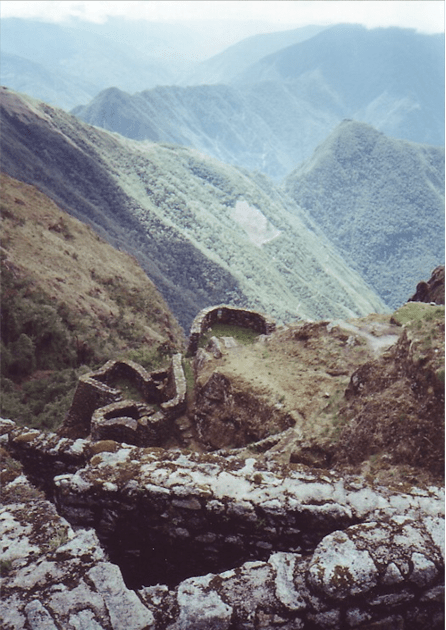
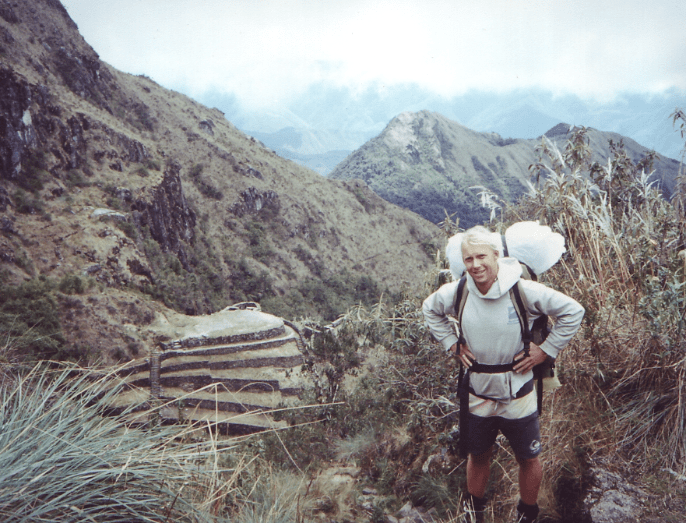

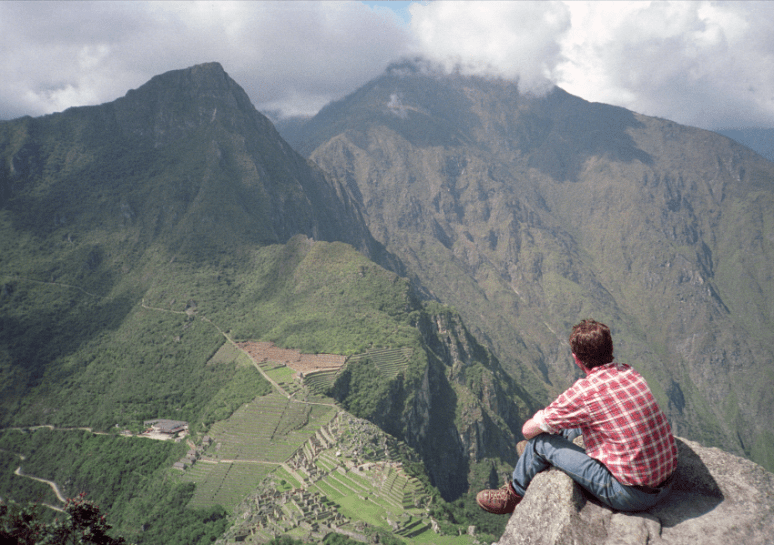
Chapter Fifteen
Bolivia
You’d think after ten weeks of exploring South America I’d have had my fill of spectacular scenery… but no. And Bolivia somehow kept up the cracking pace set by Peru, Ecuador and Colombia. First-up in this leg of the journey came Lake Titicaca. Brilliant sunshine, zero pollution and the crystal air at four thousand metres certainly does wonders for colours: deep blue lake, bright blue sky and the yellows, greens and fawns of the often-terraced farmland. Combine that with the near total silence of two windless days around the Isla del Sol, which we reached via a little town called Copacabana, then a little boat from the Yampupata Peninsula, and you’ve got yowza.
From there, on October 15th, we crossed the Strait of Tiquina by ferry and bussed the hundred or so kays to Bolivia’s capital, La Paz. It seems you’ve arrived in La Paz when you reach El Alto, the modern extension of the city built on the high plateau. Twenty minutes later, the real La Paz comes as a shock when the road disappears off a dizzying cliff at the edge of El Alto and you find the real city lying far beneath you, spread across a broad, bowl-shaped valley. Snow-capped mountains rise in the not-too-distance beyond the city to complete yet another scenic feast. Quite a moment.
We found tidy, cheap rooms at the Yumacocha Hotel, met up with Tessa and Sunara, who we’d last seen in Cusco, Peru, and got in trouble, twice, for talking too loud after lights out. The next day, we said goodbye to Tony and Shonda, our trekking partners on the Inca Trail, who were returning home to Dubbo, Australia… and we learned to adapt to the Bolivian way of doing things.
It reminded me of Ecuador. All the restaurants recommended by the ‘Lonely Planet’ guidebook had disappeared. Possibly they’d moved without giving notice of their new address… which is what the camping equipment shop had done. When by chance we found it where it wasn’t meant to be, it was closed. But a cardboard sign on the locked door promised it was open from 8 to 12 on Saturdays. But when we went back on Saturday morning, it wasn’t. And when you finally found a restaurant that was open for business and clean enough to risk eating in, the waiters and cooks regarded customers as a nuisance. You couldn’t get a hamburger without tomato because the cook couldn’t be bothered not putting tomato on your burger. But it was no problem if you wanted a burger without onion. Go figure. And paying for your meal, or in fact anything, involved at least three separate transactions. These often led to a fourth stage in the process when you had to jog down the street to buy a lolly worth less than a cent to split a paper note that was worth less than ten cents because only exact payment was accepted at the place you started. Outstanding entertainment.
On the other hand, the man who taxied us in his rickety transit van to the jump-off point for the Choro Inca Trail was extremely helpful, though we didn’t realise it at the time. He dropped us off at what he said was La Cumbre (‘The Summit’) and pointed to a barely marked track that disappeared over the edge of a cliff. By now, we had so little faith in Bolivian efficiency that it was hard to accept that the driver’s directions could be trusted. Mist-clouds whipped up from the invisible valley below and, at 4700 metres altitude, it was icy cold. Having other passengers to attend to back in town, the taxi-driver left us alone with our thoughts, sixty kays from anywhere.
A few minutes later, spawning from the mist, came an ancient man, bent nearly double with a sheaf of dry sticks tied to his back. “Si, si, Sendero Choro,” he said, signalling the way he’d come, and he told us in slow Spanish to look for a big pile of rocks a little way further through the mist that marked the only safe path down the cliff. Then with reptilian hands, he reached into the pocket of his ragged jacket and pulled out a handful of coca leaves. He showed us how to chew a few of them to pulp, then add a little corner of the charcoal to unlock the coca’s full potential. I reckoned he was taking the piss, but Dave was sure he’d read something about this in a book, so we all gave it a crack. I’m not sure if it had any effect, but it sure as hell was funny seeing the black dribble running down our chins, so maybe it did. And while this hilarity went down, the mist-clouds thinned and we caught glimpses of where the path was going to take us: bloody magnificent.
We soon found the big pile of rocks the old man had promised and began our descent through the snowline and scree. Suddenly we were walking on flag-stone paving and stairs built by the Inca half a millenium before. We climbed down two thousand metres over the next few hours, singing songs and telling stories as the misty rain and blinding sun played tag. After passing some ruined Inca structures, we entered a lush river valley where llamas romped and had sexual intercourse with each other as the twelve-year-old shepherd boy armed with a wooden stick lost all control of his flock. In the late afternoon, the wind dropped and the clouds cleared. In the golden light of the last hour before dark, we found a flat smooth patch of grass between glacier-strewn boulders and set up camp.
And while we’re cooking dinner, I’ll introduce our crew: Dave and Paul are from Sydney, Australia; Monika and Patrick are from Frankfurt, Germany. The five of us had walked the Inca Trail to Machu Picchu together a fortnight before. Then there’s Tessa from South Africa, who I’d met six weeks earlier in Colombia, then re-met in Cusco after walking the Trail; and Sunara, another Sydney-sider, who’d trekked to Machu Picchu with Tessa a few days before we did. Now, find a seat beside us on this crashmat, and let’s tuck in.
Once dinner had been demolished and the washing up done with water from the nearby stream, we celebrated one of the best days imaginable with poetry and music beneath the stars. It was the perfect setting for Dave’s epic recital of ‘Clancy of the Overflow’, one of Australia’s great anthems. Just in case there are one or two readers and listeners who don’t know, ‘Clancy…’ was written by Banjo Paterson about life in Australia in the late 1800s, and it’s one of the greatest poems ever written. Yes, I know all you TS Eliot fans will pooh-pooh Patterson because he’s a folk poet, but how many poems hit as many truths and emotional chords as this one? I’ll get off my soapbox now. Another Patterson classic, ‘The Man from Snowy River’, features when we get to Chile).
Anyways, I tried, I really did, not to quote from the poem, but I’ve failed. So here are the first two stanzas, some of my favourite lines of verse:
I had written him a letter which I had, for want of better
Knowledge, sent to where I met him down the Lachlan, years ago.
He was shearing when I knew him, so I sent the letter to him,
Just ‘on spec’, addressed as follows: ‘Clancy, of The Overflow’.
And an answer came directed in a writing unexpected,
(And I think the same was written in a thumbnail dipped in tar)
‘Twas his shearing mate who wrote it, and verbatim I will quote it:
“Clancy’s gone to Queensland droving, and we don’t know where he are.”
Oh well, in for a penny, in for an Ezra Pound… Now I’ve got started, I’d better go on…
The narrator of the poem is trapped in his soul-less city job, where he is…
‘… sitting in [a] dingy little office, where a stingy
Ray of sunlight struggles [through] the houses tall,
And the foetid air and gritty of the dusty, dirty city
Through the open window floating, spreads its foulness over all.’
Meanwhile, the narrator’s friend, Clancy, has escaped the city to work as a drover in the free, open countryside, where…
‘…the bush [has] friends who meet him, and their kindly voices greet him
In the murmur of the breezes and the river on its bars.
And he sees the vision splendid of the sunlit plains extended,
And at night the wondrous glory of the everlasting stars.’
Well, as you can imagine, there’s no better place to hear this poem than round a campfire in the wilderness, and all us Aussies got a bit home-sick and emotional. German and South African chins might even have wobbled a bit too, such was Dave’s great delivery.
And while we’re on the subject of culture and history, the Choro Trail on which we were camped is just one of thousands built by the Incas across their vast empire. Until it was destroyed by the Spanish ‘Conquistadores’ in the 1500s, it stretched from the Pacific coast to the high Andes for over three thousand kilometres north to south. The Trail to Machu Picchu is the most famous, but there are many others you can walk without seeing another tourist. And it was only a hundred or so years ago that the Machu Picchu complex was discovered in the high Andean jungle. There’s no doubt other trails and awesome Inca structures structures are still out there in the misty mountains, undiscovered.
Our second day on the Trail began with rain, but it cleared by the time we were too hungry to put off breakfast any longer. A wash in the stream’s ice-water brought us into the world with a start. Then a breakfast of porridge with nuts and cinnamon, and a metal cup of instant coffee, was conjured on our gas stoves. After taking down our tents and packing our bags, we trekked further and lower into the valley. After half an hour, the rain returned and we slipped on the steep Inca-stone steps and wooden footbridges suspended across ever-deeper streams toward our next campsite near Choro village. A simple hut, perhaps a chicken-pen, gave us some protection from the rain and cold while we cooked dinner. Sunara’s marshmallows toasted on the blue-orange gas-stove flame were a highlight as we shared more stories and songs.
Misty morning rain gave us the excuse for another lazy lie-in on Day Three. But as we made a steep two-hour climb through a butterfly-filled forest, the sun cleared the last of the clouds away. Once we emerged from the trees onto a trail cut halfway up a steep river-valley slope, it was t-shirt weather. In another hour or so we came to Casa Sandillani, where Tamiji Hanamura, an eccentric Japanese man traumatised by his experiences in World War Two, had withdrawn from Japan to build a solitary home in deepest South America forty years before. Lunch was tinned sardines and biscuits by a stream, and at nightfall we found a campsite where a couple of beers shared between us put us to sleep within minutes.
The next morning, we walked the last of that section of the Trail to Chairo village where we found a simple lunch accompanied by Winston the dog. (Winston was someone’s pet, not part of the lunch).
An hour or so later, an open-topped truck with a cargo of three dozen joyous humans rumbled into Chairo on its way to La Paz. The driver offered to wedge us on board and take us to the turn-off to Corioco, where we planned to find accommodation that night. Having trekked fifty or so pretty hilly kilometres in the last three days, most of us jumped at the invitation. But Dave decided he’d rather walk the last ten kays instead of enduring the human crush and the risk of disaster if the truck slipped off the road, or even braked suddenly. And for good reason too.
For this region stands unrivalled as the road fatality capital of Bolivia, and probably South America. The most direct route back to the capital, La Paz, is officially named Estrada da Morte, which means Death Road in English, and yes, you can check this on google maps). Its name honours the two to three hundred people who die while travelling on it each year. Yes, that’s each two to three hundred each year. Death Road is optimistically cut into a series of near-vertical, waterfall-laced cliffs that regularly collapse into the valley or onto the road. Either way, it’s fatal. It isn’t wide enough for two cars to pass, but that doesn’t deter Bolivian drivers, even on the hundred blind corners. And there are no barriers to prevent cars from sliding on the ever-present mud and scree over the horrifying cliff edges. It’s the apotheosis (I think that’s the first time I’ve put that word in a sentence) of all the mountain roads I travelled in 1993. And somehow since those days, it’s become a tourist attraction, with people coming from all corners of the world to experience it. Go figure. That’s one South American adventure I’m happy to have missed, because I think we travelled on a slower, less direct route when we returned to La Paz by bus a few days later.
Anyways, back live, end of Herodotean digression… We survived the half hour ride in the crowded open truck to the Corioco turn-off. There we waited another half hour for a bus to take us the last few kilometres into town. We found Corioco absolutely blazing. By a miracle, our visit coincided with the town’s annual Fiesta of the Virgin Mary; and by another miracle we found rooms to rent at Hostal Kory, Lonely Planet’s most-recommended pension.
Even while we showered and changed in our rooms, we could hear the riotous fiesta come drifting up the hill from a few hundred metres beneath us. But that didn’t stop us from catching up on some of the sleep we missed while walking the trail. At dark we walked stiffly down the narrow street to the town square where we found marching bands, psychedelically-costumed marchers and dancers, and a scattering of older locals demonstrating how to be pissed without being an idiot. Somehow the town’s slippery cobbled streets improved everyone’s dancing. We parked up on a corner of the main square and teamed half a dozen variations of street-food with a few longnecks of the Bolivian beer that was sponsoring the Virgin Mary’s festival. Happy daze indeed.
We woke late the next morning to gentle rainfall and the music-hubbub of the fiesta still drifting up the hill through the trees and our windows. When the sun came out, we wandered down for lunch. Just as we arrived in the town square, the Virgin Mary made her entrance atop someone’s converted dining table. She did well to keep the baby Jesus tucked safely against her shoulder while ducking under advertisements for the sponsor’s beer slung high across the streets. The fiesta frenzy continued, mostly without us, through the afternoon and for most of that night.
On October 22nd we returned to La Paz avoiding, I think, Death Road. We tried a different hotel to the one we’d first stayed in, but still got in trouble for talking and laughing too much after lights out. We found new restaurants with new rude waiters; and we farewelled Dave, who was heading south to Patagonia, and Paul, Patrick and Monica who were returning home. Tessa, Sunara and I spent our last day in La Paz connecting breakfast, lunch and dinner with coffees, beers and card games in El Lobo restaurant.
The next day, we went to catch the train that used to run four hundred kilometres across the other-worldly-scenic Altiplano (which means high plateau) to Arica, on the far north coast of Chile. It’s one of the world’s highest railways, reaching 4200 metres on the Altiplano; and it features some of the steepest gradients in railway history, with several sections needing cogwheels beneath the carriage to physically claw either up or down. It was built in 1913 by indentured labourers imported from Paraguay, most of whom were press-ganged into service with false promises of opportunity by massively wealthy American railway companies. Thousands of these workers died from accidents, disease and exposure, their unmarked graves yet another invisible monument to globalisation. Harrumph. The government of Chile paid for the railway as compensation for taking all of Bolivia’s coastline after winning the ironically named War of the Pacific, which started in the 1890s. This decade-long war was fought largely over nitrates, the main components of fertilisers and explosives. Chile defeated both Peru and Bolivia to take possession of these nitrates just in time to make a fortune selling them to European governments who needed them to build millions of bombs with which to kill millions of soldiers during World War One. Head-in-hands emoji. Just a few years after we passed through, the ‘ferrobus’ service ended due to financial mismanagement (who’d have thought?) and maintenance issues caused by landslips and floods. Despite recent efforts by the Chilean government to resurrect the route, these days it’s only open to a few freight trains each month, and they don’t take passengers as cargo.
Okay, enough of the history, geography and social studies lesson. Let’s get back to 1993.
Sunara, Tessa and I bought tickets the day before departure and were told to be at the La Paz railway station by eight in the morning without fail. But, no surprises, the train didn’t arrive till nine, and when it did, it wasn’t a train; just a single combined diesel engine and carriage, sort of like a tram, that the locals called a ‘ferrobus’.
It took half an hour to load the forty or so passengers and their luggage, then for some reason we sat at the platform going nowhere for two frustrating hours. At last we got started, and just departing downtown La Paz was an adventure, as the track rumbled and snaked through the dirty thoroughfares and marketplaces of the rough suburbs that had grown up around it. All shapes of animal and human, often in herds, made an artform out of avoiding being crushed to death by shifting a millimetre away from the rails at the last possible second, often with their backs turned. The abject poverty of the poorest South Americans was again on stark display.
From the suburbs, the ferrobus climbed uphill through a eucalyptus forest, where clumps of corrugated-iron-roofed shanties still clung to the tracks. We passed a school where the morning’s flag-waving lessons were in full swing. We surprised a man and a single sheep (well, I hope it was single) in a short, dark tunnel. Then we passed what seemed to be an Inca wall holding up half a hill. Finally we emerged onto the Altiplano with magnificent views of La Paz far below. In the clear mid-day sky, Illimani, at nearly 6500 metres, soared above the chain of mountains that makes La Paz’s airport one of the most dangerous in the world.
On the Altiplano we pass occasional, squalid shanty-towns wedged against the railway tracks. Expressionless, desperately poor, people stare blankly at the ferrobus wheels as we pass. But at last we roll across a peaceful, scrub-covered plain where it seems we’ve escaped the clutches of the city.
Ten minutes later, at the next small town, we’re suddenly engulfed by a wild riot. Hundreds of furious men hurl abuse and rocks at the ferrobus while helmeted riot police with tear-gas launchers fight the mob back from the tracks. We learn from one of the passengers that the ferrobus is undermining a workers’ strike, or something. Two weeks before, the protestors had knocked the ferrobus from its tracks. It takes ten minutes to inch through the mayhem and return to the open Altiplano, where the soil and rocks grow redder. For the next twenty kays or so, we’re accompanied by a small diesel-powered wagon that runs ahead of us on the rails, presumably to check for booby traps designed to derail the ferrobus again.
The next tiny mud-brick village is strangely daubed with bright blue paint, the next is derelict and deserted. Then we cross a huge, bone-dry river-valley. Even on the straight stretches of track, we never go more than forty kays an hour. It’s already clear there’s no way we’ll arrive at Arica, on the Chilean coast, by six p.m., as advertised. We’ll be lucky to make it there by midnight. And it dawns on me that it’s going to be dark when we make the three thousand metre descent from the Altiplano to the ocean, robbing us of the views we’ve come to see. Not happy, Jan.
At every lurch in the track, there’s a symphony of falling metal trays and other cooking equipment as what might have been lunch, but now might be dinner, is incompetently prepared. The dinner menu is some sort of meat fried in oil, an impractical choice of cooking method given the violent sways and jolts that accompany this section of the track. It sounds revolting on paper, and it smelled worse when it was being cooked, but having expected to be in Arica for dinner, we haven’t brought enough food and have no choice but to buy it, at massive expense. When the much-resented dinner finally arrives, it’s inedible. The oil-sodden, leather-like meat can’t be cut with the cutlery provided and the train’s movement means there’s a constant losing battle to keep the metal plate and tray from sliding off your lap onto the floor. The train driver is served his dinner at the same time as the passengers. He’s had a bit more practice at balancing the metal tray and gets most of his food into his mouth okay. But he slows the train to a crawl for the hour it takes him to do so.
Once the food’s been cooked, served and spread across the floor, it’s time for the in-flight entertainment shown on a tiny TV screen hanging from the ceiling at the front of the cabin. It’s a scratchy video of some sort of hyper-violent-sexual gore-fest. What the? We try not to watch, but the small children onboard don’t seem to be at all disturbed by it.
In the last of daylight we pass tall, light green, phallic cacti and a river flowing back towards La Paz, so it seems we’ve yet to reach the highest point of our journey. Apparently-wild sheep throw themselves against vertical rock faces and / or each other as we pass. Tiny yellow birds splash from near our wheels. In what must be close to the absolute middle of nowhere, an ancient man on an even older bike waits for the driver to honk at him twice before staggerinjg off the rails. I suppose this track must be used as a road by people who can’t afford the ferrobus, but heaven knows where they’re going and why.
Just when it seems we’ll never see another landform again, a series of snow-capped peaks emerge on the horizon. The soil has turned from red to grey and the sky seems to have climbed even higher. Now the soil’s turned nearly white. Is it salt, or snow? As we pass through a scrapyard of rusting, broken machinery teamed with plastic and paper rubbish blowing in the breeze, I realise we’ve arrived at the border with Chile. In the last light of dusk, I take a photo of the tracks stretching west towards the views I won’t see.
There’s a half hour stop while we get our passports stamped and our bags searched. I’m busting for the loo after six hours of avoiding the ferrobus’s filthy toilet. But the toilet in a tin shed at the border hasn’t been cleaned since the War of the Pacific, so I sneak out into the cold, dark Altiplano to relieve myself behind the highest patch of low scrub I can find. I rest my few borrowed sheets of toilet paper on the ground while I assume the necessary position, but at the moment they’re needed, a sudden gust of wind snatches them away. So I celebrate my last minutes in Bolivia by chasing toilet paper across the desert with my pants round my ankles.

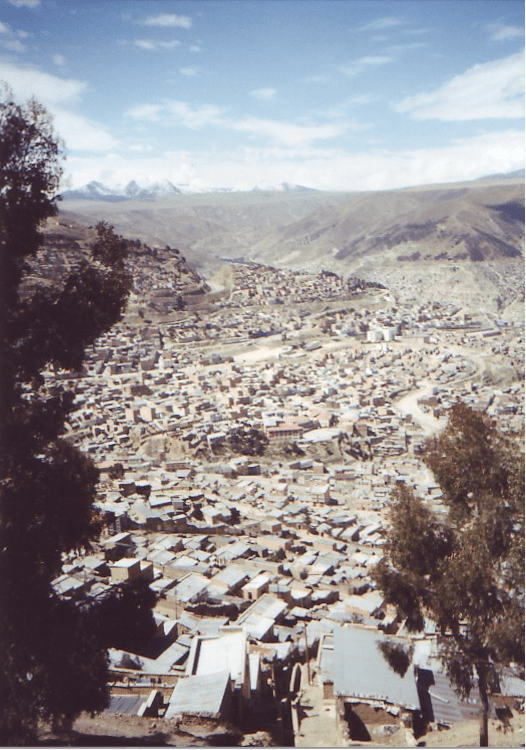


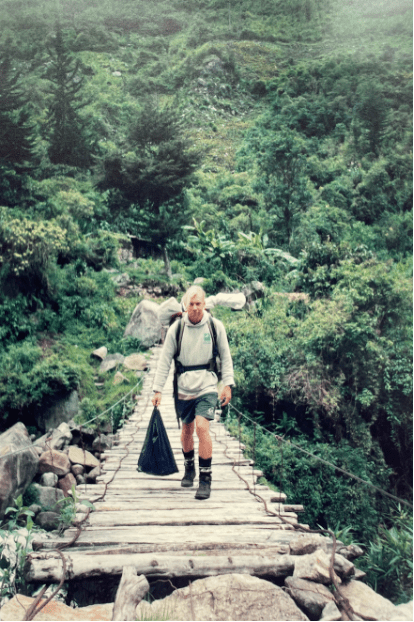

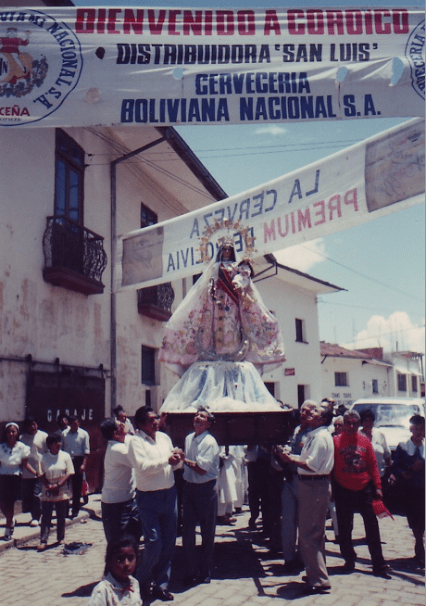
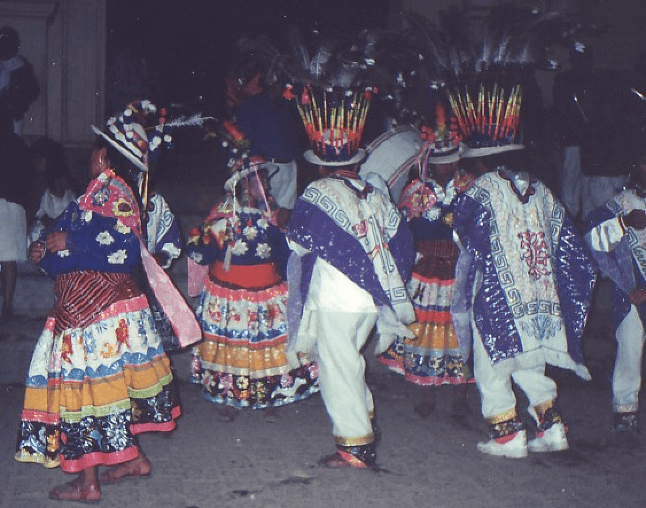
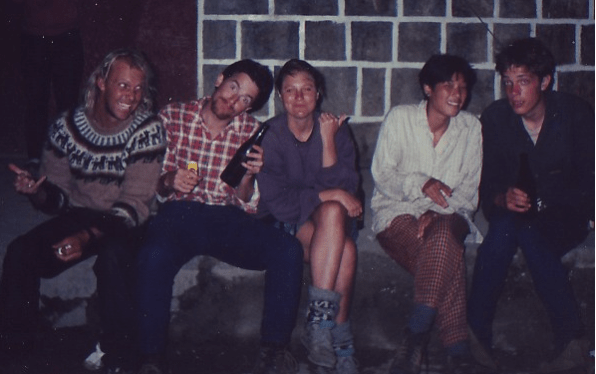
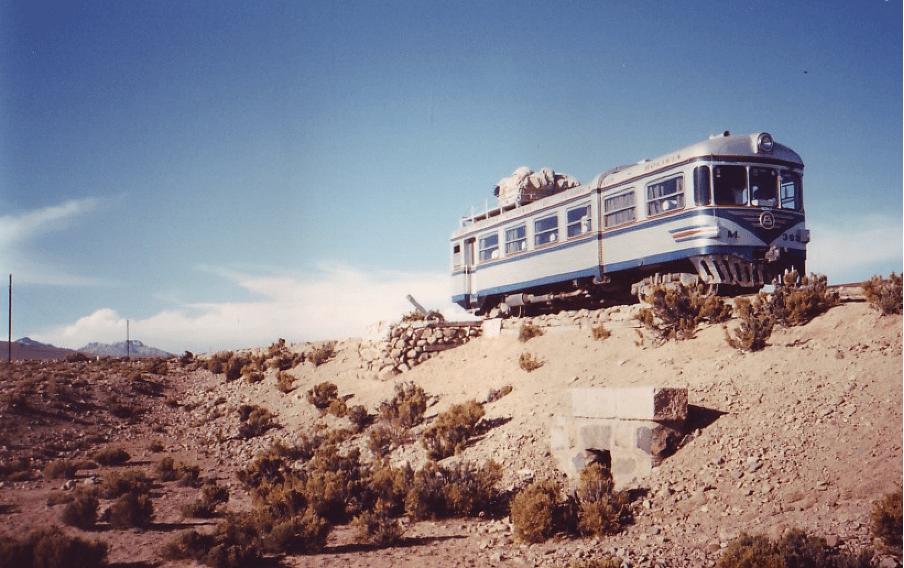
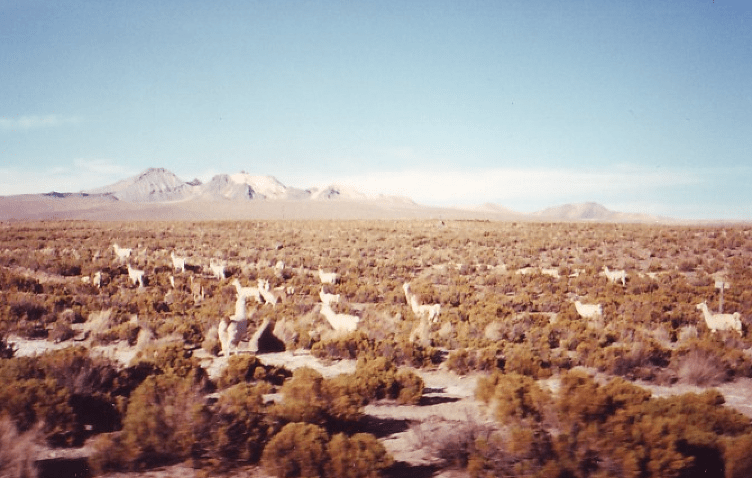

Chapter Sixteen
Chile Part 1: Atacama to Patagonia
Chile started slow, then went ber-nanas.
Our first hours in Chile should have boggled our minds. The single-line railway that leads from the Bolivian border to the Chilean coast descends three thousand metres down a series of switchbacks through otherwise inaccessible desert. The landscape and views must be amazing. But due to Bolivian Railways running six hours late we descended in darkness, with no more than an occasional glimpse of the nearest desert landforms half-lit-up by the light of a quarter-moon. Very disappointing.
The end of the railway line was a small town called Arica, Chile’s northernmost industrial port town, where we stopped for a few days. This time we were three: Tessa, an architect from South Africa, who I’d first met months before in Colombia, and Sunara, a Sri Lankan physiotherapist from Coogee in Sydney, who’d walked the Inca Trail with Tessa a couple of days before me. We’d met by chance in the Kamikaze Club in Cusco, and teamed up for the next couple of weeks to travel through Bolivia, visiting Lake Titicaca and La Paz; then walking another three-day Inca Trail to Coroico, before catching the train through the high desert to Chile.
We woke up the next morning at sea level for the first time in over a month. And after ten weeks travelling through third-world Ecuador, Peru and Bolivia, mostly in the Andes Mountains, it felt like we’d returned to the late twentieth century. Despite Arica being a fairly small town, it was modern and industrial. Indeed, Chile felt like a European country, perhaps Portugal or Spain. Life was more sophisticated, the locals moved faster, including the way they spoke Castillian Spanish. We’d been thinking we’d been getting pretty good at the Latin American lingua franca, but Chile gave us a reality check. And like Parisians, the Chileans showed little patience with our trainer-wheel attempts to speak their language, especially when many of them found it easier to communicate in English.
In Arica, we found a great ice-cream shop and some good cafes, and I found some head-high waves south of town at ‘La Isla’, then some much bigger, scarier ones at a wave called ‘Los Gringos’. But Arica was too much like the modern, high-rise beach-side city suburbs we knew from back home. And everything in Arica was fifty percent more expensive than in the mountains of Bolivia or Peru; so the only accommodation we could afford was a long walk to the sea.
So after three days we caught the night-bus three hundred kilometres south to another port-and-local-tourist town, Iquique… which was a larger, more modern version of Arica. Nonetheless, we stopped there for a week, playing at being city slickers for the first time in ages. We saw four films in a real cinema, including ‘Falling Down’, for the second time, and ‘Sliver’, which was nominated for six Golden Raspberry Awards that year. The surf went flat but we spent hours at the beach in the every-day sun, having picnics while watching the alpha-males-and-females parading their magnificent suntans. I tried to read John Updike’s novel ‘Marry Me’, but gave up at the line: ‘The horizon seemed to exclude some unseen possibility’ – and on reflection… it really is bollocks.
In early November, Tessa caught the bus south to Santiago to meet her boyfriend. A few days later, Sunara and I left Iquique too, though we were made to work for it. Our night-bus broke down half-way up the steep hill that led out of town. We shivered for an hour in the desert dark while a replacement bus was organised. When we finally got going again, I made my habitual, anxious check out the bus back window and noticed we were leaving my surfboards behind on the roadside. This was the first and last time in 1993 that I’d trusted someone else to load my luggage onto a bus. I had to make an undignified scene from the back seat to get the bus driver to stop. Then, when he reversed grumpily back down the hill to retrieve them, the driver would have crushed my boards under the bus’s back wheels if I hadn’t screamed some more. That kind of public display doesn’t come easily to me, especially in the middle of the night.
Once the boards had been roped to the other ton of luggage on the roof, we drove for only five minutes before the cargo and passengers had to be unloaded again. The port of Iquique is one of Chile’s so-called ‘Tax Free Zones’, so tax must be paid on anything bought in, and taken out of, Iquique.
Even at two in the morning, a bus load of people and cargo takes a long while to inspect; then the negotiation and payment of tax, or perhaps bribes, takes longer still. So for several more hours we went nowhere in the cold. Dull dull dull. When we were finally free of Iquique, I was fed up enough to allow Sunara to persuade me to take half a Valium, so we slept most of the four hundred kilometres to Calama. The next day we bussed another hundred kilometres to San Pedro de Atacama, in the Atacama Desert, and that’s where the trip got good again.
As you’ll know, there are some parts of the Atacama Desert where rain has NEVER been recorded. The little, mostly mud-brick, village of San Pedro was beautifully atmospheric. Built beside a small oasis, it possesses the only colourful plantlife for many thousands of square kilometres of orange-gold desert.
Next day was laundry day, and even our jeans dried in under an hour. That afternoon we shared a taxi with two other tourists to La Valle de la Luna, the Valley of the Moon, to watch the awesome desert landforms change colour and shadow-shape as the sun fell back to earth.
We watched the next day’s sunset a little further south at Salar de Atacama, a vast salt-lake, complete with flamingos, that stretched to where the sun eventually met the horizon. The surface of the white, dry lake is a quilt of endless inter-connected, half-metre-wide hexagons made of salt, each of them a slightly different shape. Apparently – have I got this right? – they form when the underground spring water dissolves the salt in the soil, then evaporates in the heat, leaving the salt on the surface. As the sun slid lower, the hexagons turned from white to orange then pink as the sky turned from light to dark blue then purple. Quite the natural wonder. My photos taken with a simple auto-focus camera had no chance of doing the lightshow justice.
Coming home to San Pedro in our shared taxi, we parked up to watch the very last of dusk turn to night. And there, for the first time in six years, I saw the Southern Cross, the star constellation on Australia’s (and New Zealand’s) flag, rise above the horizon.
“I reckon it’s time for a poem,” said a voice from the backseat. Alistair was a fellow Australian we’d met that day in San Pedro. He had an accent any bush poet would envy, and I wish I could have recorded his memorised rendition of ‘The Man from Snowy River’, all one hundred and four long lines of it. Holey schmoley; it was magnificent.
Non-Australians probably won’t know that ‘The Man from Snowy River’ is unofficially Australia’s national poem. It was written in 1890 by ‘Banjo’ Paterson – yep, the same bloke who wrote ‘Clancy of the Overflow’, which you might have heard mentioned in the Bolivia chapter. ‘The Man from Snowy River’ refers to themes we Australians like to think are at the heart of our national spirit: egalitarianism, collegiality, bravery, ingenuity, athleticism; and a love of the wilderness and the underdog. (That’s a lot of themes to develop in a single-storied poem, but they’re all there.)
I’d happily quote the whole thing, but here’s just the final stanza:
‘And down by Kosciusko, where the pine-clad ridges raise
Their torn and rugged battlements on high,
Where the air is clear as crystal, and the white stars fairly blaze
At midnight in the cold and frosty sky,
And where around The Overflow the reed beds sweep and sway
To the breezes, and the rolling plains are wide
The man from Snowy River is a household word today,
And the stockmen tell the story of his ride.’
Somewhere in the middle of the poem – I kid you not – a massive falling star lit up the southern sky, and none of us said anything.
Back in town the next day, Alistair’s stories of his recent trip to Patagonia, at the far southern tip of South America, convinced Sunara and I that we should head down to see it for ourselves. Our time was running out, so it’d be a stretch, but we both knew it was unlikely we’d see this side of the Pacific again. Besides, it was only three thousand kays further down the road; just a hop, skip and a jump compared to the distance we’d already come.
So the next day, after getting a painful tooth fixed by an excellent San Pedro dentist, Sun and I began a series of three night-and-day bus-rides south to Santiago, Chile’s capital. What happened next might just have been the best part of the whole year.
I know, I know I keep saying that, but there it is.
In Santiago, Sun and I had half a day to Get Things Done. With just a few weeks left in our South American safaris, we had to choose which unmissables we’d miss and which ones we wouldn’t. Looking back, it would have been nice to see Santiago’s parks, museums and galleries, but what we saw instead in the weeks to come more than made up.
Once the post office and bank business had been dealt with, the photos developed and new camera film bought, we raced to the train station to buy tickets for that afternoon’s twenty hour, one thousand kilometre journey south to Puerto Montt, the unofficial capital of Chilean Patagonia. Then from the train station we raced to the office of Chile’s national airline to buy tickets for the two hour, two thousand kilometre flight from Puerto Montt even further south to Punta Arenas in a few days’ time. We chose to buy one-way tickets on the plane because Lonely Planet said there was an infrequent cargo boat that took a few paying passengers from Puerto Natales in southern Patagonia, back to Puerto Montt. The staff at the airline office thought this boat no longer ran and encouraged us to buy a return flight which would be a few hundred dollars cheaper than buying two separate one-way tickets. But we decided to take our chances that we’d find the boat, or something similar, to make our way back north, once we got down there.
Everything in order, we took a taxi to our pension, wedged my surfboards and other luggage we wouldn’t need into the storage room, grabbed our backpacks, found another taxi and made it back to board the train just in time. It had been a good day. Now there was time to take it all in.
The train ride from Santiago to Puerto Montt must be one of the great train journeys of the world. I don’t know if and how it still runs, but in 1993 it was serviced by carriages that were time-transported from the 1930s, the Golden Era of rail, before everyone owned a car and every road was paved. Our seats were leather, the walls were real-wood panelled with Art-Deco light-fittings… we felt like we were extras on a movie set. And there was a dining car where you could book a table for two for dinner at seven. La dee dah! The set menu was pretty expensive, perhaps a whole twenty bucks each for three courses, but having lived mostly on tinned sardines, dry biscuits and fresh fruit for months, Sun and I treated ourselves to a silver-service dinner replete with pisco sour cocktails and red wine with the meal. Yeehah.
Returning to our seats feeling pretty damn good about life, we discovered that an unseen valet had magically converted our seats into a private sleeping compartment with two beds. If you woke up in the night you could look out to the distant Andes rolling by through the trees in the moonlight. After one of the best imaginable sunrises – a slow-motion, clear-sky light-show from behind the mountains – teamed with the picnic breakfast we’d bought back in town, the scenery spectacular continued through to the mid-afternoon, this time with added conical volcanoes, as we rumbled through Chile’s Lake District. Wondrous.
In Puerto Montt, the exotic, old-school luxury continued when at bedtime our guesthouse issued us with hot water bottles straight out of Grandma’s English farmhouse. With a couple of days to kill until our flight further south, we teamed up with two American girls to rent a car and explore the Lake District in a bit more detail. We drove north to Puerto Varas, then east along Lake (Yarnkeyhooay) Llanquihue, past two big volcanoes named Osorno and Calbuco, to Petrohue waterfall, where we saw an actual real live otter playing in the wild. How about them apples! After a picnic at Lake Todos los Santos, followed by Chile’s best apple pie and coffee at a lakeside cafe, we drove two hundred kays north to the coast at Valdivia and Niebla, where we camped after a world class paella dinner at Los Molinos.
That night, heavy rain and low cloud set in. Despite driving all the next day, about five hundred kays, hoping the weather would clear to let us see the lakes and mountains, we didn’t see much more of the famed Lake District landscape. To the positive however, when we arrived back late to Puerto Montt, we discovered the cargo and passenger boat arriving from Puerto Natales in southern Patagonia. Once again, the information in Lonely Planet had paid for itself a thousand times over. Further inquiries in town confirmed that there was a good chance we’d be able to make our return journey north on this boat in a few days’ time.
The next day, November 16th, we took our flight south to Punta Arenas, the capital city of Chile’s southernmost province, called Magallanes and Antarctica Chilena. Wow; we were nearly in Antarctica! From the plane, the spectacular views of the lakes, mountains and glaciers were vividly enhanced by five-star in-flight service that included incredible food teamed with pisco sours, red wine, Drambuie and whiskey. Happy daze indeed. As you can imagine, we arrived in Punta Arenas in blazing good form.
We taxied into town and went shopping for the new hiking shoes we both needed, miraculously finding the perfect fit and price at the only shoe shop in town in under an hour. Another hour later we were aboard the late afternoon bus to Puerto Natales, the jump-off point to the Torres del Paine National Park, three hundred kilometres north. At fifty one degrees south, it was just after dark when we arrived at 11 pm to be met by a gang of teenagers cheerfully arguing over whose parents’ guesthouse we’d stay at that night.
With three days of trekking and camping ahead of us in the morning, and ten days of constant movement behind us, we slept like logs, under the influence, once again, of the first luxury item in Patagonian hospitality, a hot-water bottle in a home-made, crocheted jacket.
The next morning we were up bright and early to shop for enough food to enable us to camp in the national park for two nights. Then we shared a hundred kilometre mini-bus ride with two English couples to Refugio Pudeto in the northeast corner of Lake Pehoe. On the way, we caught our first glimpse of the famous Torres del Paine (which means Blue Towers in the local dialect) that give the national park its name. They soared like a vast marlin’s fin above the lake-dotted wilderness. As if the park’s colour palette was lacking a little zing, we found pink-orange flamingos as we circumnavigated Lake Amarga.
From Refugio Pudeto we took a bracing ninety minute ride in a small power-boat south, then west, then north to our first campsite in the northwest corner of Lake Pehoe. There we dropped our bags inside the simple refuge hut and set off on the ten kilometre walk to visit Grey Glacier. With just enough light to make it back to our camp before nightfall, we set a cracking pace, singing and banging metal cups to deter any lurking puma or skunk, two of the park’s wildlife residents we less wanted to see. It must have also kept other humans away, for we didn’t see a single soul the whole afternoon.
Where the track skirts Lake Grey we were surprised to find a postmodern art installation comprising small rafts of blue styrofoam drifting in the lake. Now those of you who know will identify our plum ignorance, but it’s not until we got within eye-shot of the glacier that we realised these blue rafts were chunks of glacier-borne ice that had broken off to sail down the lake with the wind.
An hour’s walk later, we followed a thumb of land that stretched north into the lake to a viewing point no more than a few hundred metres away from a four-kilometre-wide, hundred-metre high, gleaming white ice-face tinged with every hue of blue. Above the valley scraped sheer by aeons of the glacier’s advance, razor sharp crags framed the late afternoon sky. Despite the wind ripping down the glacier, we sat for ten minutes to listen to the squeaks, cracks and sub-sonic rumbles of the ice’s constant movement. No thesaurus has words that get close to describing the effect this has on the human brain. Growing colder every minute, we tore ourselves away to fast-walk back to the campsite. We arrived half an hour after dark, not far off midnight, and somehow managed to set up our tent and cook a simple dinner in the howling gale while remaining friends.
We woke to sunshine and a gentle breeze that warmed us and dried our tent while we made billy-porridge and coffee. Then we packed some food and water in our daypacks, stowed the rest of our stuff in the refuge hut, and struck out to get as close as we could to the iconic towers. Our fourteen kay path took us past Lake Skottsberg and through a wild garden of red, white and purple flowers between groves of red-flowered ‘notro’ trees and low-growing lenga beech. After lunch on the bank of the Rio del Frances near Camp Italiano, we climbed up past the Frances Glacier, a darker and somehow less friendly glacier than the one we’d met the day before. Finally we arrived at a high hanging valley hidden from the wind. The jagged white-grey towers shimmered directly above us in the deepest dark-blue sky. They grew taller, more awesome and changed colour as we walked towards the track’s end at Camp Brittanico.
Our solitary reverie was ended, however, when a cloud bank loomed beyond the lakes to the south. For once I listened to the voice of reason and allowed Sun to convince me we should head back to our camp. She made the right call. We completed the tricky descent out of the high valley just before tearing wind and cold, hard rain whipped in. The storm stole daylight and made the track hard to follow and negotiate. We wanted to rush but were wary of a fall or of losing the trail. It was way too edgy for our liking. If we’d got lost or injured after dark in that wilderness, we’d have been all on our own for the night. Back then, there was no 5G phone coverage, no google maps or digital compass to tell you which way was home. No, it would be just you, your simple, sodden map and the elephants. With night-time temperatures averaging just a few degrees above freezing, it would have been an interesting challenge avoiding hypothermia for the long hours till daylight, dressed as we were in shorts.
Anyways, luckily Sun had for some reason brought her torch and, plot spoiler, we made it back. Once again we got the tent set up near midnight in a gale, this time teamed with rain lashing at forty five degrees. After cooking some kind of hot dinner without setting fire to the inside of the tiny tent, we turned in.
In the warm sunshine the next morning we packed and made the twenty kay walk south along the Rio Grey valley to the national park entrance. Here we met a mini-bus that took us the ninety kays back to Puerto Natales. It had been a cracking few days and both of us were looking forward to a warm shower and a comfy bed. But as we drove into town that late afternoon, there was the cargo boat we’d seen a few days before in Puerto Montt arriving at the dock. What to do? Should we rest up for a day in town before returning north by bus and maybe plane, or should we go by sea? The boat would be slightly slower, about three days, and our time was running out. But the voyage would take us through the fjords and channels of southern South America that we’d otherwise miss. So we gathered up our weary bones and went down to the port. Yes, they had space for two more passengers and departure was in less than two hours. So we raced into town to buy some simple provisions for the voyage, then raced to our guesthouse to collect our luggage and pay for the restful night we wouldn’t be having any more… and made it back to the boat by the skin of our teeth.
Climbing aboard exhausted in the last light of another epic day, we couldn’t believe our luck. There was Dave from Australia, who we’d travelled through Peru and Bolivia with a few weeks before. What were the chances? That night we slept on the open-plan metal floor of the lowest deck of the ship along with the other forty-odd steerage passengers. Lulled by the deep rumble of the engines and the gentle sway of the ship’s passage through the fjords of Patagonia, we had a great night’s sleep.
The next day was spent watching the misty fjords, islands and maze of channels float silently by. The food onboard that came with the price of our fare was surprisingly good and by the end of lunch we’d met a lot of our fellow travellers. There was Arnaud, a mid-forties Dutchman who was living in Curacao; Mark and Marley, both First Nations people, from White Horse in the Yukon region of Alaska; and another Australian chap who I’ll call Scot to conceal his identity, an alpha, wannabee-larrikin from one of Sydney’s private boys’ schools, whose role in life was to write-off anyone he regarded as socially inferior. Mark and Marley became his favourite targets. This was a breed of Australian I hadn’t missed in my six years away, and my main purpose in mentioning this bloke is because this was the first time in the nearly year-long trip I’d come across anyone as Nazi as him. Oh, I suppose that racist from Texas who’d been robbed of everything in Barbados was probably similar, though I never got to know him because he lasted less than a day in the village. Anyways, after an hour or so of Scot’s company, we all gave him a wide berth.
The next day we cruised through more fjords… until the early afternoon, when we emerged from the shelter of the channels into the open ocean. I’d just finished a pretty nice lunch on the top deck and was writing my diary when the first waves rolled beneath us. I hadn’t had a good surf since Pacasmayo in northern Peru about three months before, so I was stoked to see the wide horizon and the wind-driven Southern Ocean swells booming up from Antarctica. Within fifteen minutes, I was helpless, heaving sea-sick for the first time in my life. It wasn’t even that rough. The swells were only about two to three metres and the wind no more than fifteen knots. For the Southern Ocean, this was a calm day. The voyage before, apparently, was so rough that some cargo was lost overboard and one of the trucks had broken free of its chains and smashed the twisted railings we’d noticed on the vehicle deck when we first got on board.
Eventually Sunara came looking for me and found a pathetic lone figure dry wretching at every second lurch and bump. Not my best look. Sun suggested I go down to the bottom deck, where we slept, but what did she know? She hadn’t spent years on a surfboard. Clearly the best thing to do was stay out in the fresh air and ride it out. Soon she started feeling queasy herself and retreated downstairs, leaving me to cling to my fresh air theory. But eventually I surrendered and staggered down to do the opposite of what seemed sensible to me. Within five minutes of lying on the metal floor of the lowest level of the ship, where the ship’s movements were minimised, I felt fine. Thank goodness. And thank you, Sun. How embarrassing.
I’ve since learned that that this six hundred kilometre stretch of open water begins with the Golfo de Penas (the Gulf of Hardships) and ends with the Golfo de Corcovado (the Gulf of the Hunchback). Very appropriate. Between those two gulfs, you’re out in the very non-Pacific Ocean. I wonder what it’s like when it’s rough! Calm was restored the next day when we steamed the last three hundred kilometres up the channel to Puerto Montt, accompanied by a few dolphins and penguins who danced beneath our bow.
Safely back on dry land, we gave ourselves a movement-free couple of hours by going to see ‘The Firm’ with Tom Cruise and Jeanne Tripplehorn, who were in the film, not the audience. Then we returned to Santiago on the twelve-hour, one thousand kilometre, night-bus.
Deep breath.
Now then.
How to spend the last few days in South America?
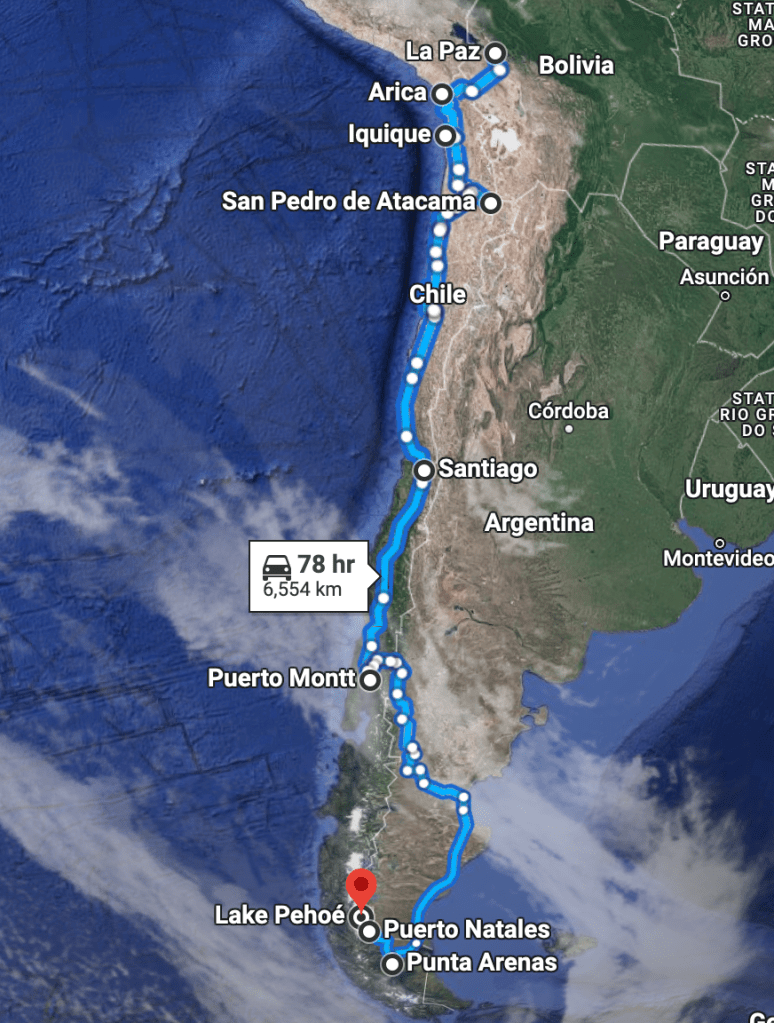
But we didn’t go through Argentinian Patagonia as it shows on this map. We flew from Puerto Montt to Punta Arenas on the way south. Returning north, we took the boat from Puerto Natales through the non-Pacific Ocean back to Puerto Montt. (With thanks to google maps).


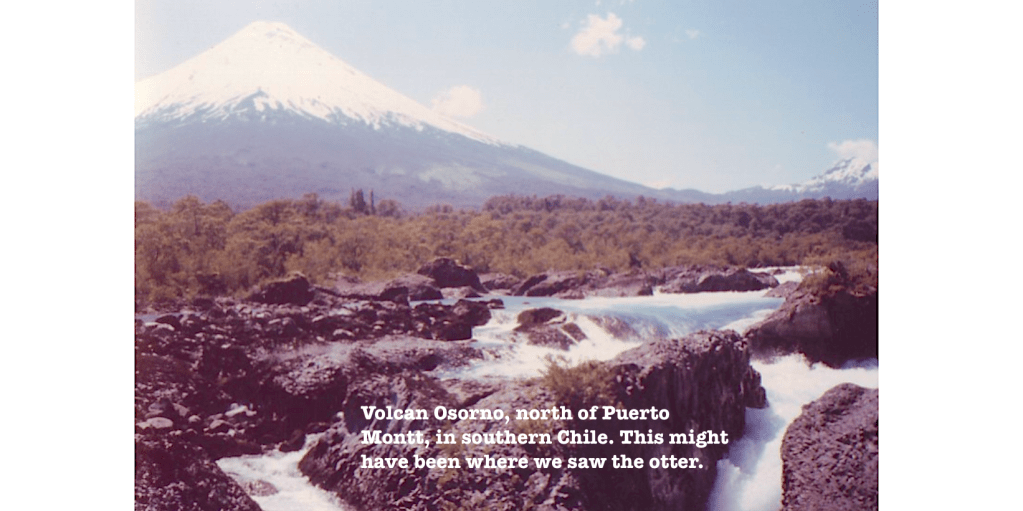
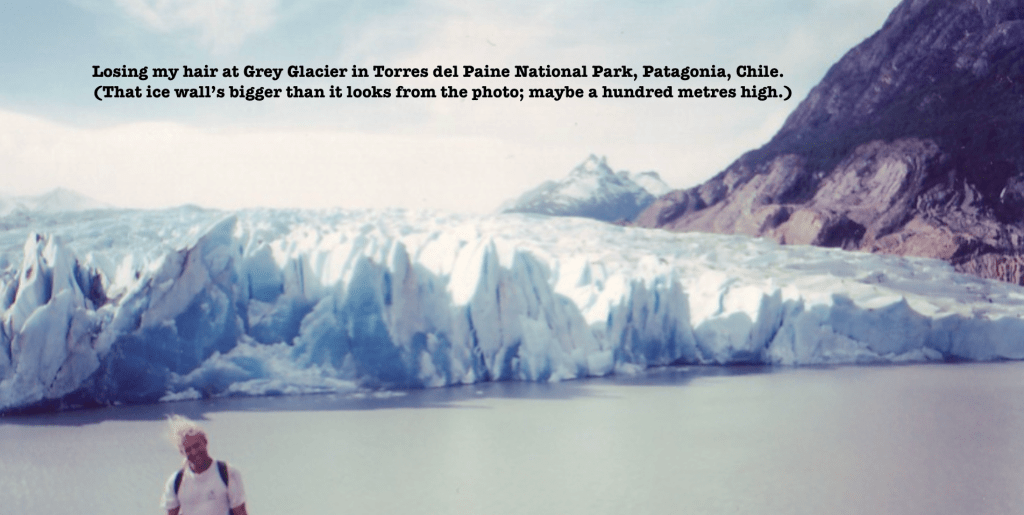
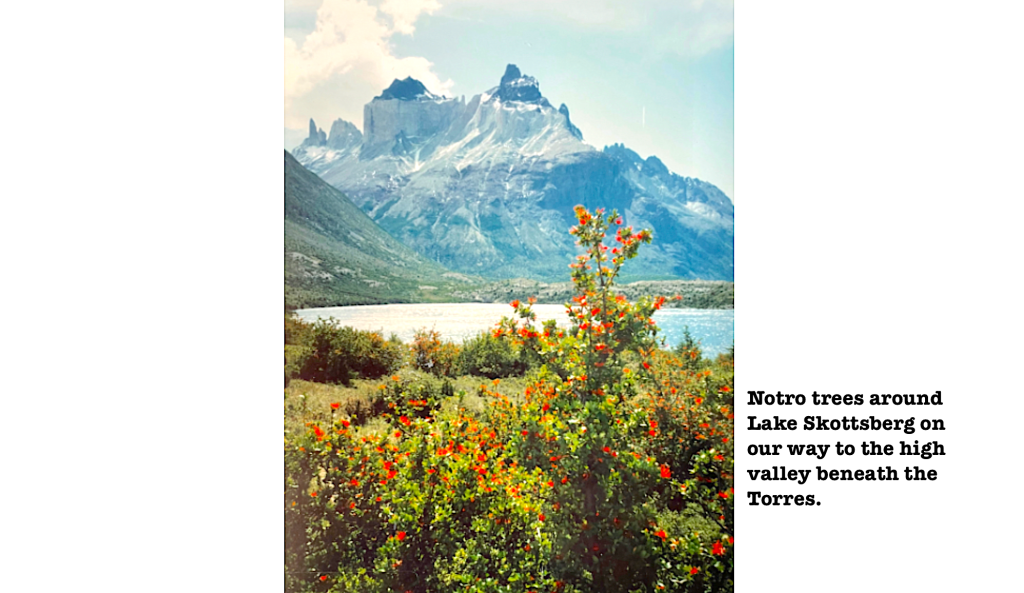
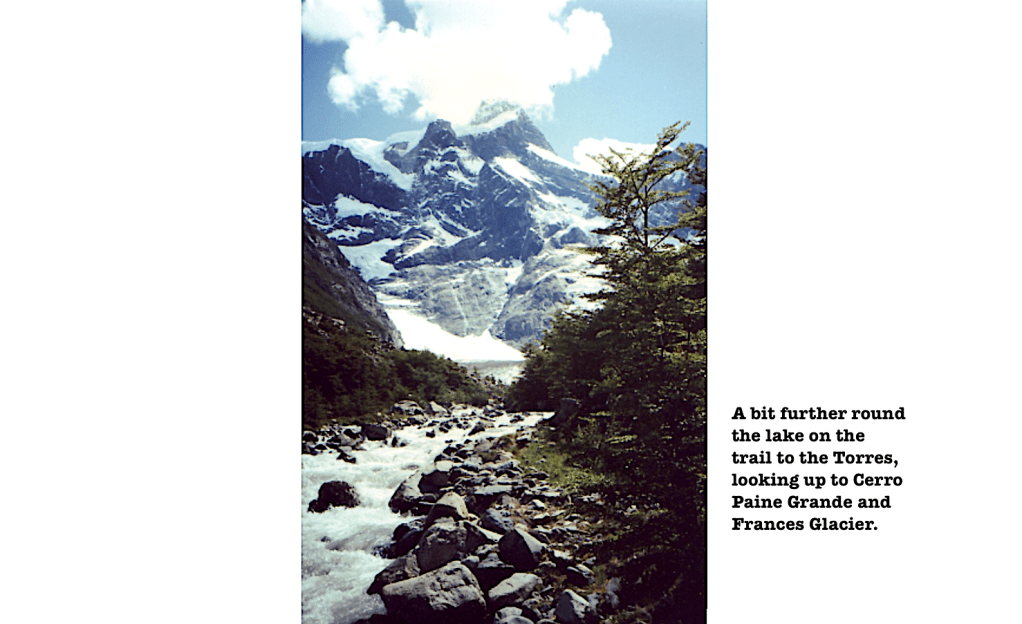

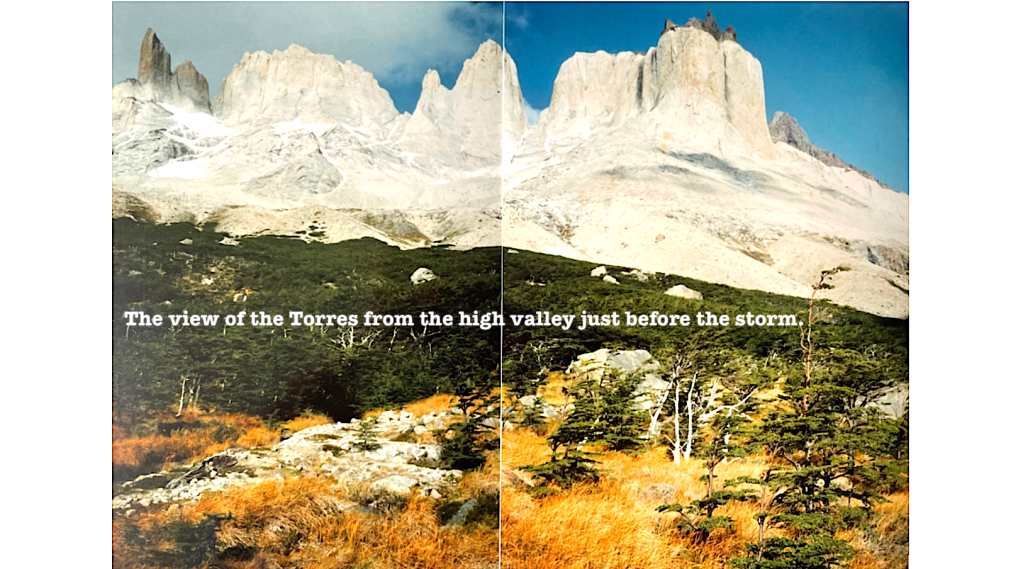
Chapter Seventeen
Chile Part 2: Dos Puntas De Ensueno
I tried everything to make friends. I introduced myself; told him how much I loved his country; asked him how often the waves were this good. But from the moment he discovered me in his backyard, his angry, black eyes told me he wanted me gone. Soon it was clear the only way forward was to show I understood what he was telling me to do.
So when the next set wave arrived, I rode it through three long sections without turning. Where it closed out half way down the bay, I lay down and rode the white water to the rocky shore with my legs bent skywards. This’d show him I knew my place. He’s lived here all his life; I’m just a visitor. Perhaps he’ll let me share his waves if he knows I understand.
it was time for breakfast and a warm-up anyway. I set up my kitchen on top of the bus-sized rock that gives the best view of the bay and cooked up some porridge and coffee on my simple gas stove. Every few minutes, another set of long, empty waves rolled down the point. And then… what was that in the water? A big seal, presumably my new boss, was putting on a killer-whale display. From a spot directly in front of my kitchen and just beyond the waves, he was flicking something a few metres through the air – it might have been a small fish or a piece of seaweed. When it landed, he’d swoop under it and flick it with his nose in the opposite direction to catch it again. It seemed he knew where I was and wanted me to see the show. But was he showing me aggression or playfulness?
After breakfast, it was time to find out. With warm sunshine and the waves firing, I couldn’t just sit there without another attempt to connect. I pulled on my cold, wet wetsuit and paddled out as gently as I could from the sheltered rocky corner of the point.
Focusing too much on whether the boss was beneath me, I timed my entry into open water just as a set arrived. The thick lines of white water drove me deep down and backwards, and I braced for a bite or a heavy bump in the turbulence beneath each wave. Swept a hundred metres down the shoreline by the waves and the current, I made a slow, anxious paddle back up to the take-off spot.
It seemed like a long wait for the next set of waves. I lay on my belly, feet bent skywards, arms stretched out to the tip of my board, with my eyes, ears and sixth sense straining for any sign he was behind me. At last, a set approached, and as the first wave peaked, two small seals darted from near the rocks to streak diagonally inside it. They shimmered beneath me as I paddled, nerves jangling, over the wave’s shoulder. The second wave was bigger and wider and I stared at its steely wall, expecting the adult seal to appear inside it. The peak softened just enough to allow me to spin, drop in and ride almost the length of the bay, each moment watching to see if I had company beneath or beside me.
Still alone as I turned off the wave, I made another cautious paddle back out through the deep, dark water. When I reached the top of the point, three or four small seals were playing happily by the rocks where the waves peaked up. They were great company through that second surf, though the memory of the adult seal’s black, angry eyes haunted me till the filling tide lulled the waves to sleep and I returned to shore to rest.
I was a long, long way from anywhere. Well, that’s not really true: this was definitely somewhere, and a helluva good somewhere at that. The Chile edition of my two-page ‘Surf Report’ had insisted: don’t leave the country without visiting this remote, idyllic corner of the coast. So, in the last days of my five months in South America, I’d finally made it here, and it was every bit as good as the ‘Surf Report’ had promised.
The coast was hilly and wild, unfarmed apart from the small-scale timber-getting in the patches of pine-forest; and waves of rare beauty and solitude wrapped round the tallest of the steep headlands. The thirty square kilometres surrounding the point were privately owned, but the very occasional small groups of Chilean surfers arriving by car on weekends had been tolerated for the past decade or so. However, a couple of months before my visit, a carelessly-left surfers’ campfire had spread to a sizable patch of the surrounding pine forest. And since then, all surfers had been barred from the property.
If I’d known this, I wouldn’t have attempted my visit. But in 1993, before the internet and social media, the sum of what we knew was a tiny fraction of what we didn’t. And in this case, ignorance was bliss. I’d caught two busses the eighty kays from my base camp to the dirt road that led, eventually, to the last crossroads before the entrance to the property. I was waiting, hoping for a bus to take me these last twenty kilometres when a tradie’s truck turned onto the dirt road. He saw me, my surfboard and backpack sitting on the shoulder, and slid to a stop in a cloud of dust. “Are you wanting to surf the point?” he asked me, in Spanish, and he told me about the ban on surfers since the forest fire. Then he tied my surfboard to the right side of his truck, where it wouldn’t be seen by the guard at the gate. He said he’d tell the guard I was his apprentice, and he was probably risking his job by doing this random act of kindness for a complete stranger. What a legend.
The tradesman’s dog sat in the front passenger seat, so I shared the backseat with a fellow hitch-hiker, an off-duty policeman travelling home to his family’s farm. They both knew someone who knew someone who’d emigrated to Australia and for the whole journey they asked me questions about life in Sydney and how it compared to Chile. I told them what I still think thirty years later: Chile’s about the first country I’d choose to re-visit. Amazing country; fantastic people.
As we approached the locked gate, the tradie gave me a trucker’s cap to hide my surfer’s hair and told me to pretend I was asleep. Then, to make sure my surfboard remained undiscovered, he got out of his truck to check in with the security guard.
Once safely onto the property, it was twenty minutes on an orange dirt track that wound round and down hills to the crossroads near where he worked. Wishing me well, he pointed me down a soft-sandy road and told me to follow it three kays to the point. Mil gracias, mi compadre! I hope the last thirty years have treated you well.
I walked in glorious sunshine and solitude past tall swaying grasses and low, bushy trees. The smell of warm, dry dust and a dozen aromatic plants took me home to the southeast coast of Australia. It was closer now than it had been for over six years: only eleven thousand kilometres and nearly due west across a single, vast ocean.
After half an hour, I met a man walking in the opposite direction, the only fellow human I saw that afternoon. His weather-etched face placed him somewhere between forty and seventy years old. After a chat in Spanish about how surfing worked and where I was from, he told me of a shortcut up a steep hill to a ridge where the pine forest began. When I found what seemed to be the shortcut a short time later, I trusted his advice that it would take ten minutes off my walk, and clambered up the narrow, sandy path. The hundred metre climb was made clumsy by the weight of my wetsuit, tent, sleeping bag, bottles of water and three days of food inside my pack, teamed with a surfboard that twisted me both ways as it brushed against the low scrub.
When I reached the top, I found I’d rejoined the rough road and guessed that I should turn left to continue up the hill through the trees. Hoping to confirm I’d chosen the right direction, I listened for breaking waves in the pauses between gusts of southern breeze combing the pines’ highest branches. Ten minutes later, there it was beneath me: the bright blue Pacific; with a long beach stretching north. Then soon after, the southern end of the beach came into view. And there, where the beach met the headland, was the fabled left point… with perfect, empty waves.
I scrambled down through the pine forest, hid my pack behind a rock above the high tide line and fumbled into my wetsuit. Venturing alone into an unknown, empty ocean always gets the adrenaline flowing, a sensation I shared with a small seal who launched from the rocks as I approached to splash urgently through the shallows out to sea. Seals meant sharks, but surely, with no humans to take their food, they’d be well fed, especially in the middle of the day… wouldn’t they?
I paddled round the corner and out into some of the most beautiful waves imaginable. The nearest surfer must have been at least a hundred kilometres away. My solitude made me reluctant to sit where the shallow sandbar dropped into much deeper green-blue, so I missed a couple of the bigger sets, but the ones I got were fast and long and unforgettable. And finally, paddling back out, I saw a bigger set hit the outside indicator, giving me time to paddle wider and catch the last half of one of the biggest, best waves I saw that day. The last sections morphed from dark to light green to light gold where the wave met the rippled white sand of the beach. Paradise.
After ninety minutes, the tide had risen, the waves had grown less consistent, and my shivering had grown so constant it was time to go in.
With salt-encrusted eyebrows, I warmed up in the late afternoon sun by setting up my tent, then scrambling round the rocks to explore and take some photos. I discovered a wide sea-level cave that was a bit too deep and dark to venture into alone. On sunset, I cooked up some rice, onion, carrot, capsicum and a small can of chilli con carne in an oversized metal cup on my simple gas stove. Half a small plastic juice bottle of cheap Chilean red wine complemented the meal to perfection. I could spend five hundred bucks in a posh restaurant and it wouldn’t have been as good. It had been one of the great days.
But now, a wolf was scratching and snuffling a few centimetres from my head. I woke from several hours’ deep sleep and tried to figure out if this was real or the last part of a nightmare. Trapped in total darkness, I lay still, barely breathing, hoping the snuffling would go away… but it didn’t. I started sweating and suddenly I was cold. I slowly pieced together the scene I couldn’t see: I’d fallen asleep not long after dinner and left a plastic bag with the unwashed plate and cup, a not-quite-empty can of chilli-con-carne and some other foodscraps, tucked between my tent and its fly. What a kook. And now the local wolf-pack had gathered to tear me apart.
After another few minutes of pretending I didn’t exist, I decided attack was the best form of defence. Flicking on my torch and summoning an odd yelling noise that me feel like a complete idiot, I heard the wolves retreat into the forest, dragging the plastic bag with them. By the time they didn’t return, I’d fallen back to sleep.
At sunrise I awoke with my throat and liver not torn out, and opened the tent to find a cold, clear, dewy morning. The swell had dropped, but chest-high waves were still rolling softly down the point. With the tide still too high, there was no rush to surf, so I could wait until the sun came up over the inland hills and have breakfast, while giving the sharks time to finish theirs. But first up was a visit to the forest for morning relief, and there I found my cup, plate and cutlery licked clean by the wolves.
Later that morning I caught some beautiful small waves, but it was clear there’d be only ankle-slappers left by sunset. At lunch I finished the last of the water I’d carried in, so I set out to find the tiny village mentioned in the Surf Report as being halfway up the five-kilometre-long beach.
After ten minutes’ walking, with the south wind blowing the fine sand against my legs and back, I saw three young men walking toward me in the distance. They stopped near the high-tide line and knelt down to work on something. One of them stripped to his undies and was wading, then swimming, into the icy ocean. Soon I was close enough to wave hello to the other two. They called me over to where they stood beside an old ship’s anchor, and I watched with them as the swimmer returned clumsily to the beach. Once he could stand in shallow water, we saw he was dragging a beautiful, big, corvina, one of the best eating fish in the ocean.
They explained that each day they took it in turns to swim a heavy, baited line, tied to the anchor, out to deep water, for they had no way of casting it. The fish they caught was their staple diet, and often they had enough to share with the other local families. They asked me to take a photo of them with their catch, along with their little brown puppy, that I realised later was probably the pack of wolves outside my tent the night before.
Then they took me to their village. It was just a handful of simple shacks, invisible behind the low sand-dunes from my campsite a couple of kays away. My new friends showed me to the village’s one communal water tap, where I filled my bottle. Then they took me home to meet their mother, for they were brothers.
Their mum was all-but blind from the woodsmoke that filled their chimneyless kitchen. She said she had ten children, five girls and five boys, all in their twenties, but so far only one had married and moved away. How she’d raised them in such a simple, two-room shack was beyond my modern-world-comprehension.
It was a hundred rough kays to the nearest big town and at least ten rougher kays to the next small village. There was just one small bus in and out each week, on a Wednesday. The small community lived a pretty much subsistence life from fishing and seaweed gathering. As ever, the poorest people were the most generous, and they insisted on giving me a couple of extra plastic water bottles to fill up at the tap. All they asked in return was a copy of the photo I took on the beach, which I posted to them when I got back to Santiago. I hope it reached them safely.
Returning to my campsite in the mid afternoon, I saw there’d be no worthwhile waves that evening or the next day. So I made a plan to pack up and return to Santiago in the morning. That’d give me time enough to find a way off the property and spend half a day in the city before my flight across the Pacific home to Sydney. After writing a few notes in my diary, I went for a walk.
When I climbed up onto the top of the headland, I found a rough trail leading south around the edge of the cliff. After twenty minutes scuffing along the dusty track, I just about tripped and fell off it. About a kilometre away was another bay framed by steep cliffs, bits of beach and a clump of house-size rocks that shaped the sandbar at the southern end. Around this corner, waves, what seemed to be pretty large, long-walled waves, were wrapping.
My first thought was to race back to camp, get my board and get out there. But for once, sanity prevailed. As hard as it was to accept, there just wasn’t time to find a way to the waves and get a surf before dark. But surely there’d still be waves in the morning, even if the swell dropped further overnight. So if I used the last of today to find the path to the point, I could have an early surf tomorrow before heading back to Santiago.
It was hard to focus on following the path when every few minutes another set spiralled down the point. But eventually I found a narrow trail that zig-zagged down the cliff. At sea level I followed a thin strip of beach to another small headland. Here I found a natural tunnel through the rock to another small beach beneath the cliffs. Then a scramble over low, grey rocks brought me to the place that seemed the best jump-off spot to the waves. Job done. Place sussed.
Up close, the waves looked well over-head and some ran for nearly two hundred metres. This point was much more exposed to the open-ocean swell and wind compared to the point where I was camped, so the strong cross-shore made the waves a bit messy, but they still kept their shape as they rumbled down the bay.
In the last half-hour of daylight, I mind-surfed each set, figuring out where the best take-off spot would be. It was frustrating to watch such good waves go unridden, but I’d been right in guessing I wouldn’t have time to get my board for a surf. And to be honest, it was a bit of a relief. Surfing sizable, unfamiliar waves all alone at shark feeding time would have been a bit more edgy than fun. If only I’d discovered this point a couple of hours earlier… Anyways… I took a couple of photos and, not far from dark, retraced the path back to my campsite for dinner and sleep.
The next morning, before the sun had risen over the inland mountains, I was scrambling up the headland with my wetsuit, board and daypack loaded with food and water. Now I was familiar with the path, it seemed shorter than the day before. After ten minutes I got my first glimpse of the waves. As expected, the swell had dropped; but so had the wind, and long waves were still rolling down the point.
Once down the cliff, along the first beach, and through the rock tunnel, I was surprised to find three locals fellow members of the human race. They were gathering seaweed and laying it out to dry in the grass between the sand and rocks while their horses waited patiently in the shade. We waved and smiled silently from a distance. Having company in the bay, no matter how removed, made me feel a little less alone as I paddled out into the vast Pacific.
The waves were epic: long, glassy and running half the length of the bay, getting faster and steeper in the last sections of the ride. My dream-surf was completed by several pelican-squadrons gliding north in regal displays of close order flying, their wingtips almost drawing lines on the open-ocean swells.
It was an hour and at least ten great waves later that the grumpy seal we met at the start of this chapter forced my return to shore for breakfast.
Before I’d finished my coffee that morning, I’d decided to delay my return Santiago to get another surf at this point. Seeing the seaweed-gatherers’ horses on the beach convinced me there must be a direct route from here to the crossroads where the tradie had dropped me. I guessed there’d be a trail inland from the beach that stretched to the south from my new point.
So instead of trekking back to the crossroads after decamping at the first point that afternoon, I’d move my campsite to this bay for the night. Then I’d have an early-morning surf before trekking to the crossroads on the new trail I hoped to find.
I’d be cutting the time for the return trip to Santiago down to the bare minimum: a bit of a gamble as my flight across the Pacific was non-refundable. But these waves, this place, were so worth the risk. How many opportunities like this do you get in a lifetime?
So in the early afternoon, I fast-walked back to my original camp to fetch my gear. Looking down from halfway up the cliff path, I watched two adult seals playing in the deep water directly beneath me. Was one of them the grumpy one who’d chased me in from my first surf that morning, then put on the killer-whale display? Were they the parents of the little seals who’d kept me company through that second surf? Did they know I’d see them from the cliff-path? I know, I know… but I promise if you’d been there, you’d’ve asked the same questions.
By the time I’d scuffed round to my original camp, packed my tent and bag, then fast-walked back round to my new home, the tide had dropped and the waves were cranking. I left the tent construction till later and paddled straight out. As soon as I arrived out the back of the point, the little seals came to say g’day again. The evening was overcast and absolutely still. As I waited for that first wave, the tall headlands were doubled by their mirror-reflections in the ocean’s green glass.
When the first set came, it was bigger that what I’d thought from the beach. I paddled wide of the first two, then turned and went on the third. Looking down as I dropped, it was hard to see where the surface of the water began; it was like riding on air. Then inside the wave, right beneath me and slightly ahead, there was the big seal.
My first thought was that my surfboard fins might hit her, but she knew exactly what she was doing. As I turned off the bottom or banked off the top, so did she, just a metre ahead, and we raced that wave together the length of the bay. She disappeared as I turned off the wave and I didn’t see her on my long paddle back out. But she was waiting for me when I arrived at the top of the point, and this time she’d brought the whole family. Perhaps I’d been accepted; maybe even adopted. We rode those waves together into the dusk till my lips and fingers turned blue in the cold.
Sorry to get all hippy-romantic on you, but… seriously…
My last surf in South America… was… well…
I can’t do any better than Ricky Baker’s ‘magistical’.
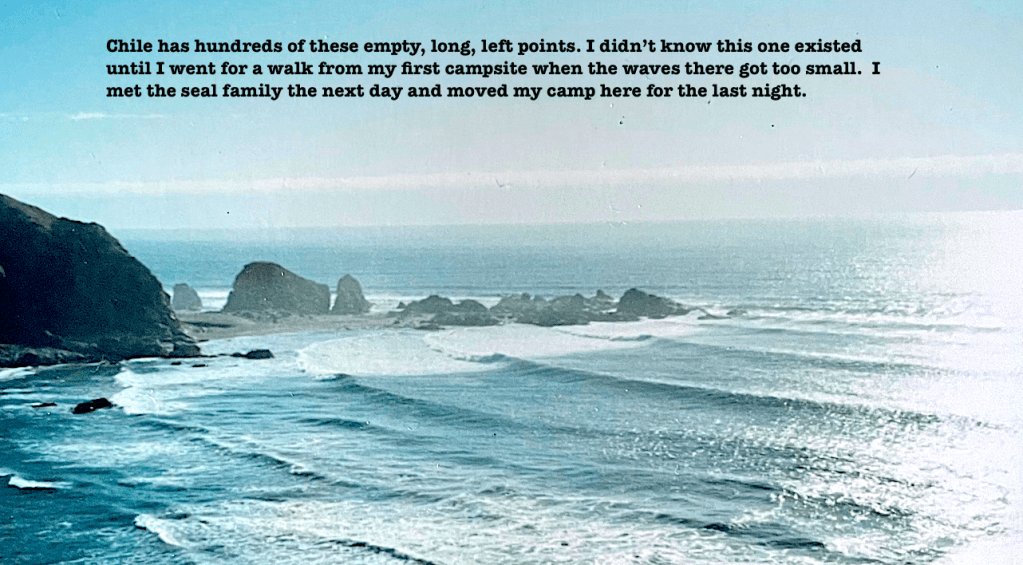
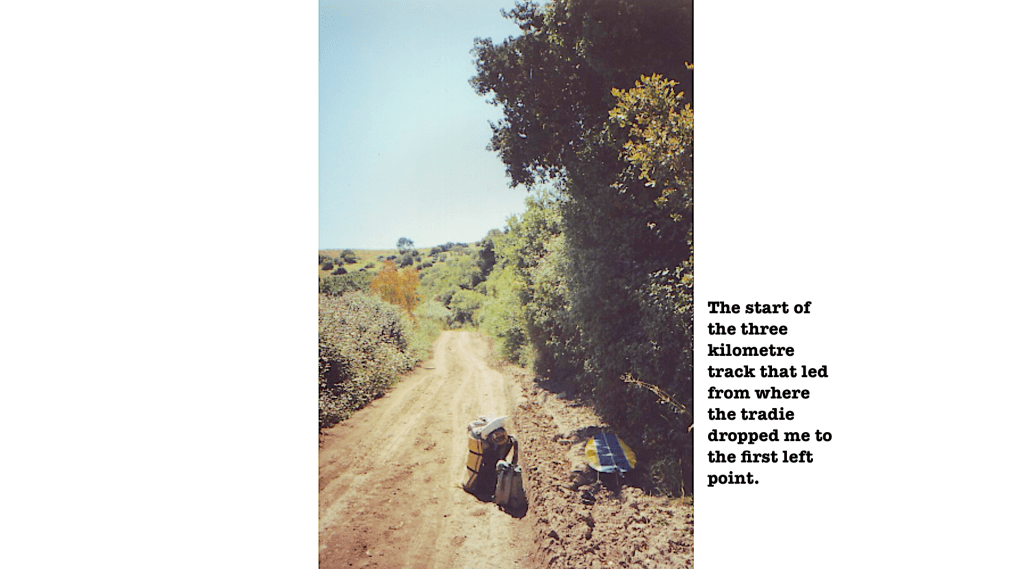

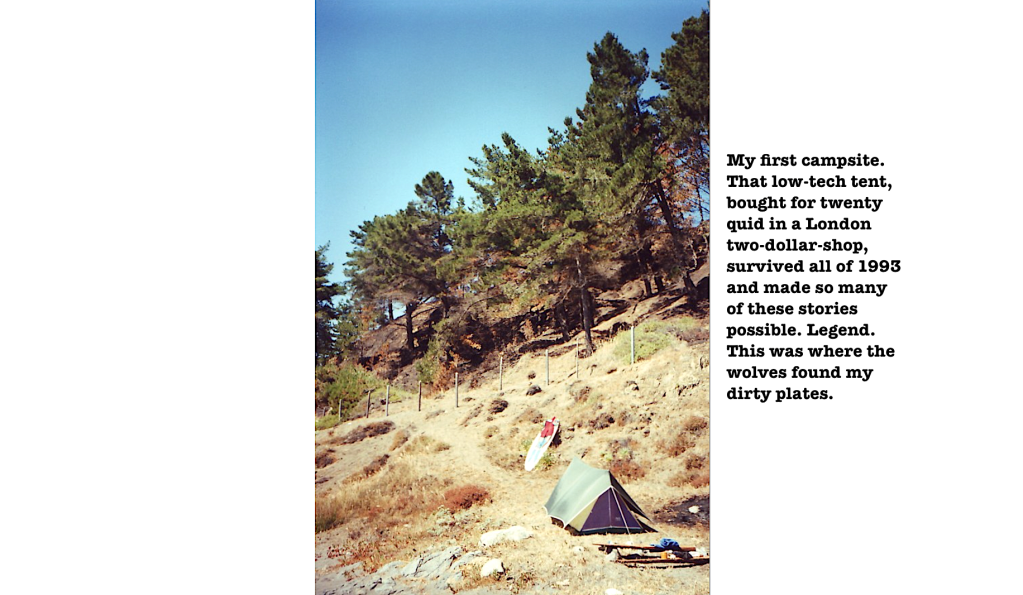


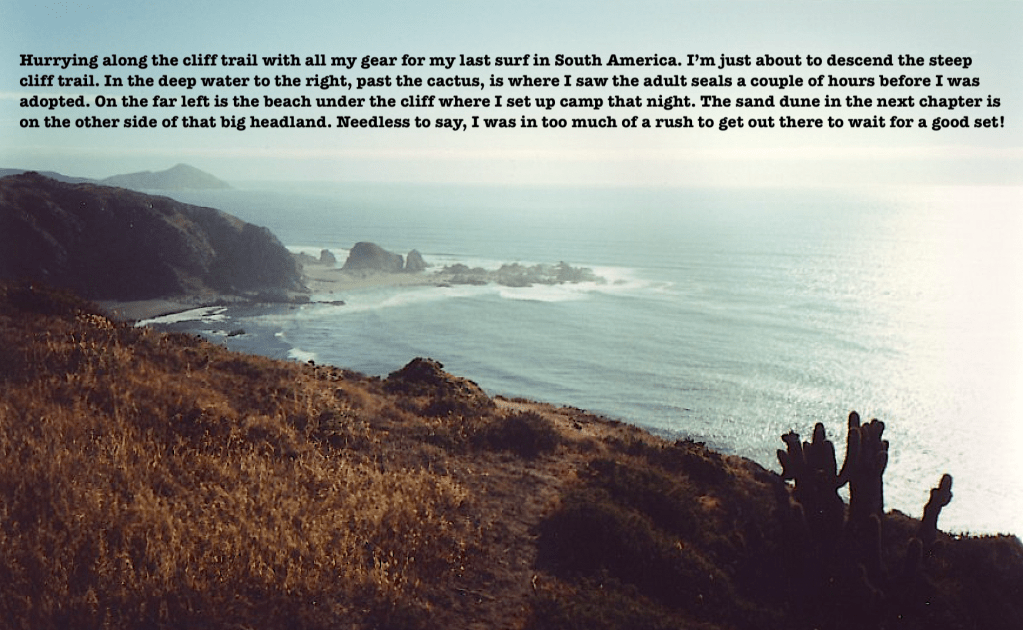

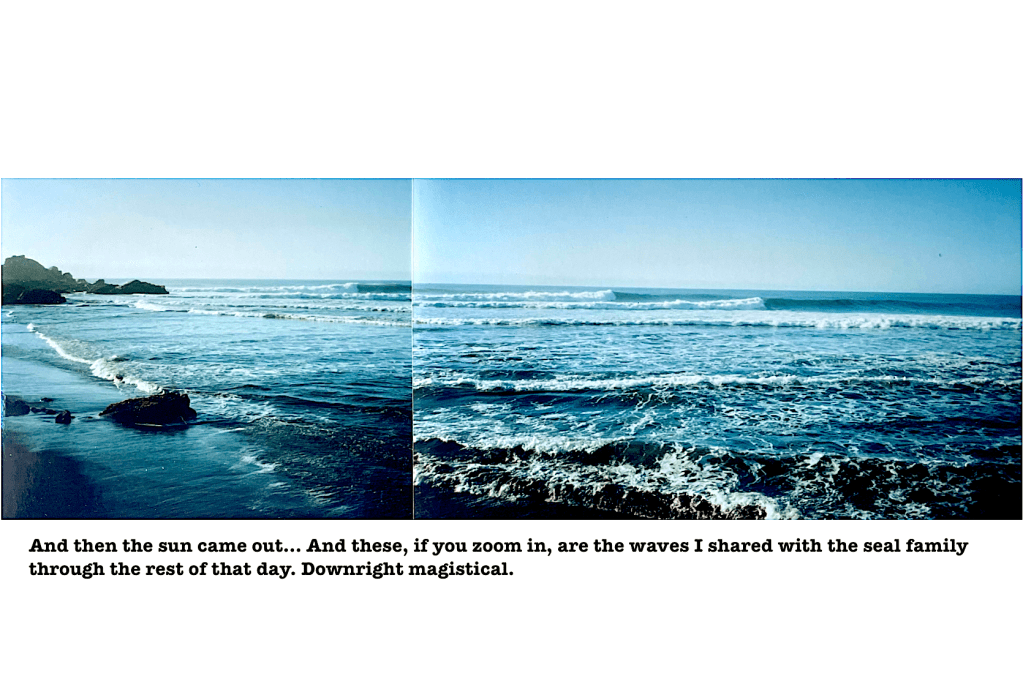
Chapter Eighteen
Chile Part 3: Escape from Punta De Ensueno
Sometime after midnight, a violent storm blew in from the un-Pacific Ocean. Within minutes the gale had driven heavy rain against the exposed front panel of my tent, soaking it, along with the legs-end of my sleeping bag that pressed against it. I tucked my wet, freezing feet underneath me in the driest corner of the tent, buried my head under my hoodie, and tried to get back to sleep.
I hadn’t seen the storm coming – I hadn’t seen a weather forecast for weeks – but it was only fair, after the uncanny good luck I’d been given, that the universe should even things up. The early morning surf I’d hoped to have clearly wasn’t going to happen, and today’s trek back to the outside world, and to my non-refundable flight from Santiago home to Sydney, was going to be a much bigger challenge than I’d anticipated.
I’d pushed the envelope pretty hard by surfing the whole previous day instead of trekking out as I’d planned. I’d pushed it still further by moving my camp here for the night in the hope of catching a few more waves this morning. The camp-move was predicated on a gamble I’d find a different, more direct, trail out to the one I’d followed in.
The previous day, I’d seen seaweed gatherers on the beach with their horses. Presuming the cliff path I’d followed to my new campsite was too narrow and steep to bring horses down, I’d convinced myself there must be an alternative trail inland off the long beach to the south. But, with my eyes focused on the perfect, empty waves rolling round the point, I hadn’t thought of asking the farmers how they’d ridden in, hadn’t seen which way they’d left while I was surfing, and hadn’t had time to search for the alternative trail when the weather had been fine. If the trail I imagined didn’t exist, or if I couldn’t find it this morning, I’d have to trek three sides of a square, some of it slippery and steep, to retrace my original path. The storm was complicating an already sketchy equation.
Sleep was impossible. As the tent pegs’ grip on the sandy soil grew looser, the fly thrashed, the tent spasmed, and the freezing damp around my feet climbed further up my sleeping bag. It was time to surrender, to work with the lemons and make lemonade. So I sat up, pulled on nearly all the clothes in my pack and hung my fading torch from the lurching centre-pole of the tent. With several hours to kill before first light, here was the perfect opportunity to record the last few days in my diary before my memory was muddled by what would come next.
These had been as great a few days as I could’ve imagined when I’d set out on this trip eleven months before. Thanks to one heroic tradie, I’d dodged the ban on surfers I hadn’t even known about and got access to this idyllic, privately-owned corner of the coast. Here I’d surfed some of the most memorable waves of my life, all alone, in perfect weather for three days. There was so much to alchemise into written words that I hadn’t finished before the first hints of a daunting grey dawn started to show. It was time to get started. I packed my last few things and unzipped the front panel.
The storm punched me in the face as I clambered outside. I hadn’t brought a raincoat because I didn’t own one – there’s a great example of how not to go camping – so my three layers of clothes and I were drenched and freezing by the time I’d wrestled the sodden tent into a sad rough bundle. I’d only brought the bare essentials on this trip and with three days of food and water all but finished, I’d been counting on a light and easy load on the trek out. But with the sleeping bag, wetsuit, tent and pack all close to maximum hydration, I’d be lugging well more than twenty kilograms for most of the day. My anxiety ramped up a notch as I swung the clumsy pack on my back, strapped the daypack to my chest, tucked my board under my right arm, and set off south.
The wind had been fierce at my campsite, but when I emerged from the lee of the headland I discovered its full, brutal force. Each savage gust tried to rip my surfboard free from my two-armed hug, wrenching my shoulders from their sockets and my spine from my whatever it’s attached to. After about a hundred metres, I’d been battered to a standstill. This wasn’t going to work. What if the trail was a whole kilometre down the beach? What if I didn’t find it? What if it didn’t even exist? And I didn’t have time to waste on a quest for what might be a figment of my imagination. Reluctantly I saw that it was better to cut my losses and accept that I’d have to have walk three sides of the square.
Retreating north to the headland, the storm attacked me from behind. I half-jogged like a drunkard as each gust tried to knock me off my feet. The thought of climbing up and along the steep, narrow cliff-trail in these conditions took my anxiety to new levels.
But wait: perhaps there was another possibility. To my right, a steep, forty-metre-high sand-dune had been buttressed against the headland. At the top of the dune, the thick pine forest began. Surely if I climbed up the dune and into the trees, then followed a line away from the sea and a little bit north, I’d eventually meet the track I’d walked in on three days before. This’d be an even more direct route to the exit road than the path I’d been hoping to find to the south. And inside the forest, I’d escape the worst of the wind. What wasn’t to like? Decision made.
But getting up the dune to the forest was even harder than walking down the beach. The steeply-angled sand was fine and loosely packed, so that at each step, my back leg slid down nearly as far as my front leg reached up. It was taking me five clumsy steps in my sodden jeans to make a metre of altitude, while the gale tore up the dune to wrench at my surfboard and backpack. Every time I lost my balance or got knocked to my knees, I lost another metre. It would have taken me just a few seconds to give up and slide back down to the beach, but I was driven on by the thought of the dangerous cliff-trail that was the only alternative.
After maintaining composure, just, through a brutal half-hour, I reached the top of the dune. Here I was rewarded with the discovery that the rise to the forest continued on an only slightly lesser slope through a combination of fine sand, tall grass and low scratchy scrub. This was even harder to traverse than the sand-dune, and twice I arrived at crumbly, high cliff-edges that seemed to come out of nowhere. But surely once I reached the forest, all would be well.
At last I reached the embrace of the thick pine trees where I was protected from the wind. But the forest floor was littered with an epic waist-high tangle of fallen pine branches, thick and thin, that made every step a challenge. It would have been hard enough to clamber through with four limbs to engage, but having one arm occupied with a surfboard made it a misery. And after a couple of near twists and slips had threatened to send my nomadic right knee cap round the outside of my leg and leave me crippled in the forest, I had to calm the farm, take my packs off to find the bandage and kneeguard I always wore when I surfed, drop my dacks and anchor my kneecap in place.
Then there was the mist. Immune to the gale howling outside, thick mist clung doggedly to the trees, reducing visibility to about thirty metres, obscuring any landmarks, and making every tree look the same. Before long, I’d lost all sense of direction.
Now, even if I’d wanted to head back down to the beach, I wasn’t sure which way that was; and I knew it was more likely I’d find a cliff edge than the sanddune. I was trapped in the perfect which-way-forward?-and-can’t go-back scenario. Brilliant.
For a while I propped up my mood by putting melodies to the Banjo Paterson poems I’d been trying to learn by heart. But soon I relaxed and allowed myself to guess at how long it would be before my wolf-eaten remains were found.
My communications to my parents that year via postcard and phonecall had been sporadic at best, so it’d be at least eight weeks before they started wondering where I was. The last contact they’d receive from me would be the postcard I’d sent from Patagonia, three thousand kilometres and two weeks ago. They’d eventually call the Chilean Embassy, but I doubted anyone there would find the tradie who snuck me onto the property, or the three brothers I’d met on the beach two days before, or the seaweed farmers from yesterday. Even the last pension I’d stayed in, about a hundred kilometres to the south, didn’t know I’d come to this corner of the coast.
Being savaged by a shark or run over by a bus seemed acceptable ways to die on this adventure, but getting swallowed by a forest seemed lame. And I was intrigued to find how easy it had been to create a situation where I could literally disappear without a trace. Perhaps this discovery might come in handy sometime in the future.
Several times I got close to ditching my board and backpack in the forest. But the certainty that if I did, I’d never see them again, forced me to battle on with them for just another few minutes.
It had been about two hours since I’d packed up my camp, and about an hour that I’d been lost in the forest, when at last I came to something that might have been a man-made path. I followed it in what I guessed was the right direction, but it dissolved into yet another tangle of fallen, dead, blair-witch-project trees.
Getting my hopes up, then crushed, in consecutive minutes brought me a lot closer to my last layer of mental calm. Bracing for even more frustration, but with no alternative, I followed the maybe-path back in what I knew was the wrong direction, and found it joined a slightly more distinct trail. I followed this with zero optimism to find that it led, after another few minutes, to what seemed to be the dusty road I’d walked in on. Hallelujah!
Even better, the rain was on a rest break; and better again, here was an old man scuffing up the hill who could direct me to the crossroads where the tradie had dropped me. We had a quick chat, in Spanish, about the weather, the beauty of the coast and its waves, and how it compared to Australia. Then he directed me down the hill he’d just climbed. Muchas gracias! Buena suerte! I was finally on the way to Santiago and my flight across the Pacific!
But five minutes later, the ocean, then the beach I’d first camped on three days before, came into view through the trees. The track was leading me directly downhill towards them and I was back in Twilight Zone hell again. The old man must have thought I’d asked him for the way to the waves.
Swearingly, I turned round and retraced my steps up the hill. I passed the small path where I’d escaped from the forest. A little further on, the trees grew thicker and darker, and as I moved through their silence, I thought I smelled cigarette smoke. Then I thought I heard voices. And there, on a side-track fifty metres through the trees, stood three grave-faced men, quietly talking. Each of them held a long axe, their business ends resting on the ground between their feet.
And here’s where this Stephen King story would find its gruesome end. It’d be years before erosion would free my spiflicated body from its shallow grave. Or perhaps it’d be when they cleared the forest to make a new suburb in forty years’ time. Anyways, I had no choice but to meet my end with dignity.
Heaven knows what they must have thought as I approached them soaked, scratched, fed-up and filthy. But they kept their axes resting on the ground while I explained my situation. In Spanish, they promised me that the way to the crossroads was the way the old man had told me. This didn’t make sense. I pushed my schoolboy Spanish to the edge of its capacity to explain that I’d already tried that, and it hadn’t worked. I told them about the view of the beach through the trees. Three times I checked they understood that I’d finished surfing and was now looking for the way back to Santiago. Each time, they stoically insisted I had to go back down the hill.
I thanked them and left, still certain they had it all wrong. Back I went on the sandy track through the trees, then down the hill, resigned to spending the rest of the day, and possibly eternity, walking this one dusty track in a dark prequel to The Truman Show. For the third time, I passed the spot where I’d escaped the forest and met the old man. Then I passed the view through the trees to the beach. I’d made my peace with the reality that I was going to miss my non-refundable, fourteen-hundred-US dollar flight, when the road turned a sudden, blind, right-hand switchback and headed downhill to the south… the way I wanted to go. Praise the Lord above.
Soon I reached the flat track lined with wild flowers that I’d walked in on a few days before, and there, on my right, I recognised the uphill shortcut I’d taken on the first day. So the switchback section of the road was the part I’d cut off with the shortcut. This explained why it had been unfamiliar and had seemed so wrong. It was a relief to know I wasn’t going bonkers, but I felt bad about doubting the people who’d been helping me. Though heavy rain returned, I fairly skipped the last kilometre or so of the track back to where the tradie had dropped three days before.
In the rain, not much building was getting done, but the few workers still there showed me where I could find drinkable water – I’d had none since last night’s dinner – and some shelter from the weather in the rough skeleton of what they told me would soon be a new school.
But my celebration at finally attaining the day’s first objective came to an abrupt end when the workers told me there was little chance I’d find a ride out of the property that day. In heavy rain, the dirt access road turned to slippery, orange mud and the hill sections became impassable. This was a possibility I hadn’t anticipated when I’d extended my stay to surf the second point.
Still, if push came to shove, I could trek the ten kays or so of the access road in three to four hours. Once back in the outside world, I could walk until I hitched a ride or found a bus back to the highway. And, despite all that had happened, it wasn’t yet ten o’clock, so I had a couple of hours to rest, eat the last of my food, and try to dry my stuff. I stripped down to my boardies and a singlet, hung my tent, towel, clothes, wetsuit and sleeping bag on the all-purpose rope I always carried, and brewed up some porridge and a nice cup of instant coffee.
An hour or so later, despite the continuing rain, there came the sound – could I believe my ears? – of a heavy truck lumbering toward the crossroad. As it appeared through the trees, I ran a muddy fifty metres to the road as it appeared through the trees and screeched to a stop. Si, seguro, they were heading out in five minutes and si, seguro, I could hitch a ride. Yeehah! I threw my quarter-dry stuff together in record time, roped it to the empty trailer, and took the place I was offered in the middle of the cabin’s bench seat. Vamonos! Let’s go!
It wasn’t long before I was wondering if my luck was good or bad. As we approached the long, uphill section of the road, the driver worked up the momentum we’d need to complete the climb. Even before we reached the first bend, the truck was fish-tailing slightly, but still the co-driver was muttering we needed more speed. Starting up the hill only slowed us a little. Approaching the first bend, a blind corner to the right, the driver took up the perfect position on the lip of the cliff for a full-tilt head-on with anything coming the other way. As he cut the corner, we drifted towards the unbarriered edge of the steep hill. The cabin lurched gently to the right as the rear wheels of the trailer flirted with the valley below. None of us had bothered with the seatbelts, so if we rolled into space it’d be hard to tell whose lifeless limbs were whose. One corner down, ten more to go. Yikes.
But eventually the laws of physics lost their patience. Somewhere not far from the top, a close series of bends caused us to lose too much speed. The tyres lost traction and we slewed off the road. The camber of the bend sucked the truck to the right and into the steeply angled ditch cut into the hill, not into the valley. The Lord be praised again.
Despite the forty-five-degrees at which we were now parked, both drivers had a crack at powering back onto the road while I stood in the rain and tried to help with hand gestures. But the rightside wheels sunk to the axles and it was clear the truck was going to be there for the foreseeable future, and probably beyond.
With surprisingly little regret – they clearly didn’t own the truck – the pilot and co-pilot decided to make the long, muddy walk back down to the crossroads. But I was reluctant to surrender any of the progress I’d made towards Santiago. I asked if I could stay with the truck to wait for another ride if it came, or trek the rest of the way to the exit gate if it didn’t. They were fine with that, as long as I locked up when I left, so I climbed into the cabin to escape the rain and review the situation with my left cheek on the benchseat and my right cheek on the passenger’s door.
I figured I could wait about an hour before I’d have to start walking, but until then I could wait to see if the rain cleared. For the third time that day I was shivering, so I stripped down to my boardies again. And when the clouds cleared a little later, I hung my sodden clothes and luggage on any part of the truck that could be used as a washing line.
I’m writing my diary when I hear what sounds like a car coming up the long hill. I can’t risk the car going past without seeing me, but there’s no time to get dressed, so I clamber from the cabin in my boardies and run into the middle of the muddy road as a fully laden ute sideslips round the truck-crash bend. There are three young blokes on the front seat and maybe four more clinging to the open tray. I’m flagging them down on the trickiest part of the hill, but, heroically, they stop and agree to give me a ride. While I gather my stuff and put on a few clothes, a couple of them collect my board and backpack from the truck and rope them to the tray. There’s an edgy minute when I realise they could make off with all my stuff and leave me behind, but they don’t. When, at last, I’m ready, the five of us who’ll be riding in the tray get smothered in mud as we push the car to get re-started up the hill, then run to catch up and jump aboard from both sides. With the car slewing drunkenly, it was a not insignificant achievement that none of us slipped and fell under the back wheels.
It’s another white-knuckle ride. The rainy Friday has given the boys an early start to the weekend. We drift round each corner a little faster than we need with everyone but me cheering the driver’s great skill. We get back to the property entrance and wait for the guard to come and open the gate. I wonder if he’ll wonder how a surfer is exiting the property when surfers have been banned for weeks, but he seems not to notice me or my surfboard. Whatever. We drive for twenty minutes through the real world farmland for about twenty minutes until we reach a crossroads that the boys reckon is my best chance of finding a bus or a lift that’ll get me back to the highway that afternoon. Legends.
But for over an hour, not a single vehicle passes by. I’ve just about decided which of the three directions I’ll start walking, when two tidily dressed young men emerge from the steamy haze of the evaporating rain. They’re schoolteachers walking home for the weekend and they reckon I must have missed the afternoon bus by just a few minutes. The next one won’t be until early the next morning, but they’re sure – “Seguro!” – that I’ll still get to Santiago in time for my flight.
So Dario insists I stay with his family that night. It’s only a six kilometre walk to his small town, and we spend the next hour or so chatting about Chile, Australia, surfing, schoolteaching and anything else that helps them practise their English. It would have been a memorable time in any context, but three days of solitude made me appreciate their company even more. And, as much as I tried to dissuade them, they refused to let me carry my gear. So I walked light as a feather while they took it in turns to carry my board and backpack. Seriously… Chile.
Dario, his wife, Maribel, and their two young children treat me to a wonderful dinner and the first warm shower and bed I’d known for some time. They dry my clothes, tent, sleeping bag and wetsuit in front of their log burner. If they ever hear or read this, mi casa es siempre su casa.
My second last day in Chile began with breakfast at Dario and Maribel’s, then a short walk to meet the early bus back to the main road. From there I took another bus to backtrack sixty kays south to a great little seaside village called Pichilemu. I’d come here with Sunara for the last days of our two-month, eight-thousand-kilometre journey from Cusco, Peru, through Bolivia, then through Chile from the Atacama Desert to Patagonia and back.
Pichilemu was only two hundred kilometres from Santiago, but it moved at an elegant, horse-drawn-cart pace, and the Hotel Chile-Espana was a great place to hang out. A couple of times we hitched south to the now-much-more-world-famous surf break, Punta de Lobos. Here there were penguins, dolphins, seals, a small, friendly Chilean beach crew on weekends, and great long left waves on a cactus-lined point that stretched out to twin rock towers painted white by the seabirds. Sunara’s flight back to Australia left five days before mine, and it was after she’d returned to Santiago to catch her flight that I’d set out for the solo-surf-camping expedition that ended when this chapter began.
On my last afternoon in Pichilemu, a new big swell boomed in from the south. I’d been planning a lazy day to rest before my flight home, but I failed to resist the urge to hitch the eight kays out to Punta de Lobos for one last look. The swell was huge, windblown and wild and I was the only one there. I climbed down the cliff to get out of the wind with the seals and penguins sheltering on the rocks and pictured the perfect waves that would be breaking, unridden, over the next few days in front of where I’d pitched my tent.
Hitching back to town, I was picked up by a bus filled with vivacious Chilean women on a hens’-weekend (are you still allowed to call it that?) Their good-natured teasing and flirting was merciless and I understood, after ten months in Latin America, to play along as if it was a salsa dance. Soon we reached Pichilemu and they set their helpless male victim free.
That last night at the Chile-Espana, Simon, another surfer from Sydney, arrived on the late bus. He’d been following a similar path to mine down the west coast of South America, always just a few days behind. We’d stopped at many of the same places and met some of the same people, so we sat up swapping stories till way too late. We’d just called it a night at half past four, when half-a-dozen Santiago teenagers returned from the town disco and wanted to ask us a hundred questions about surfing, Australia and what our favourite part of South America was. So my last day in Chile began with no sleep.
But on the five-hour bus trip to Santiago that morning, I must have nodded off for at least a few shakes of a lamb’s tail. For when I arrived in town, I raced round like a lunatic. I deposited my board and backpack in the south bus station storage office, then took a bus across town to the north bus station where the Peruvian alpaca jumper I’d lost on a bus in far north Chile a few weeks before was waiting to be collected. Then I raced downtown to collect more luggage I’d stored at the pension where Sunara and I had stayed ten days before. Then I taxied back to the south bus station to collect my board and backpack. From there I took another taxi to the bus that took me to the airport, where I repacked my boards and bags to be ready for the flight.
After checking in with just a few minutes to spare, the last of my thousand bus rides in Central and South America took me two hundred metres from the terminal to the airplane steps.
Next stop – Easter Island.
Someone get that man a beer.
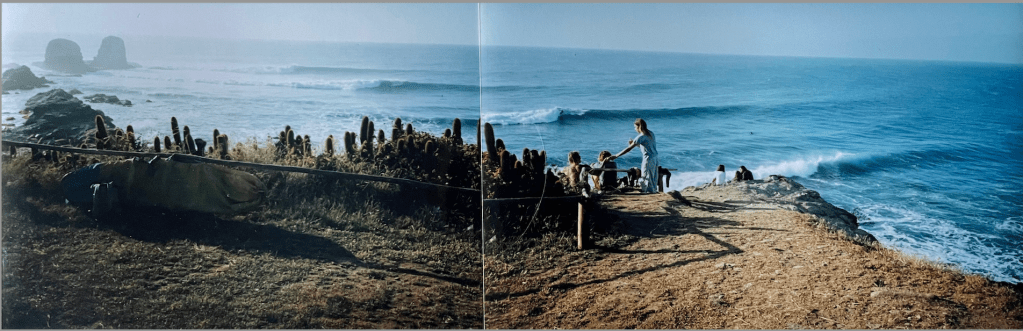

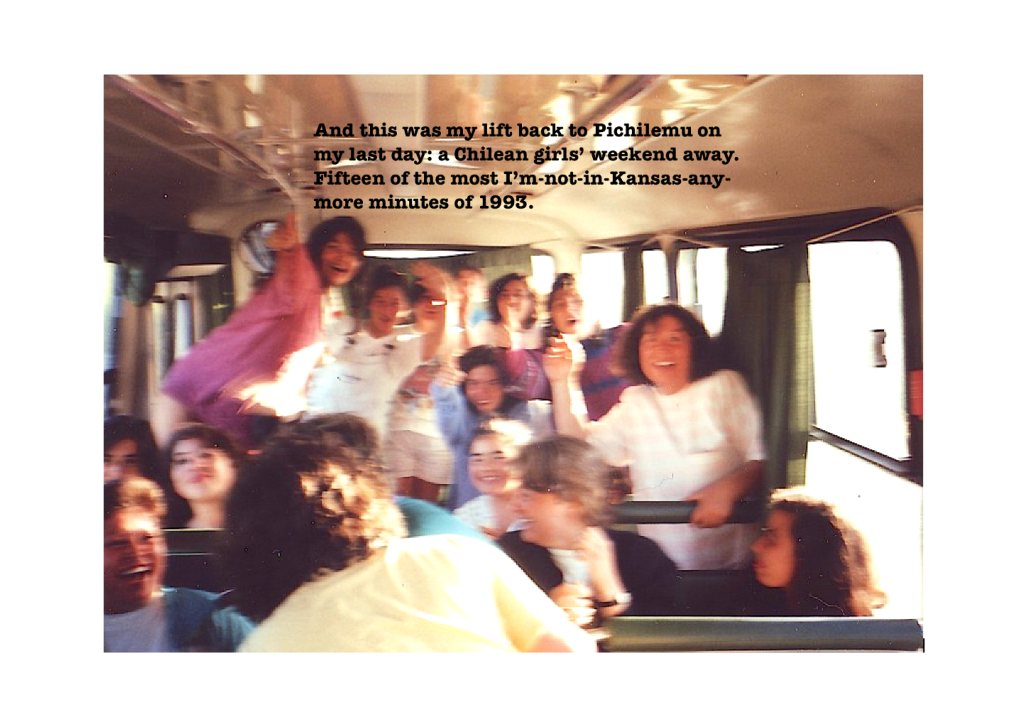


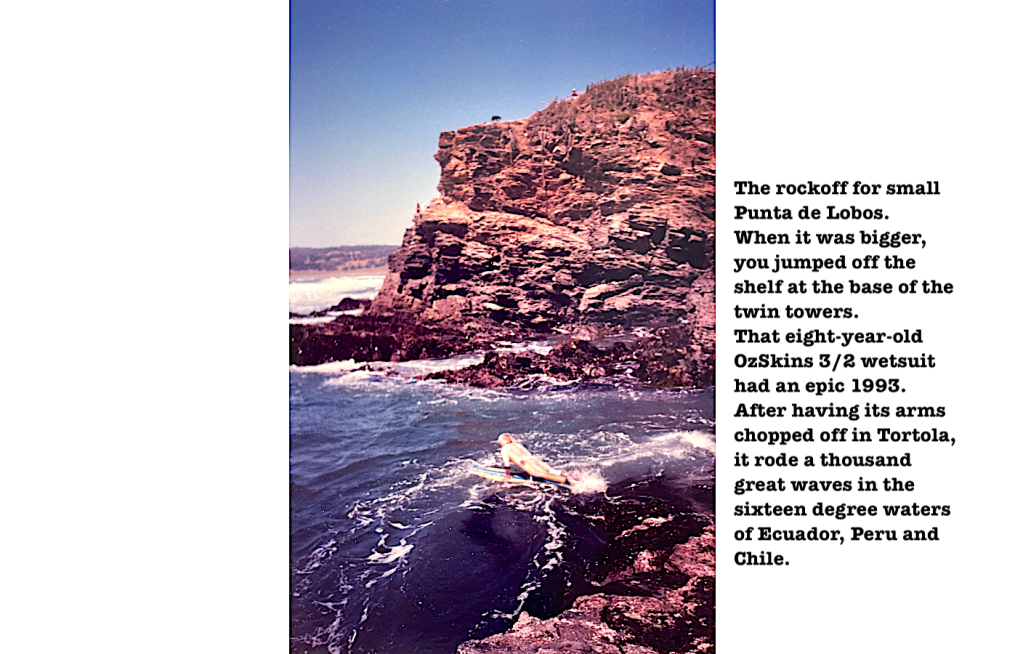
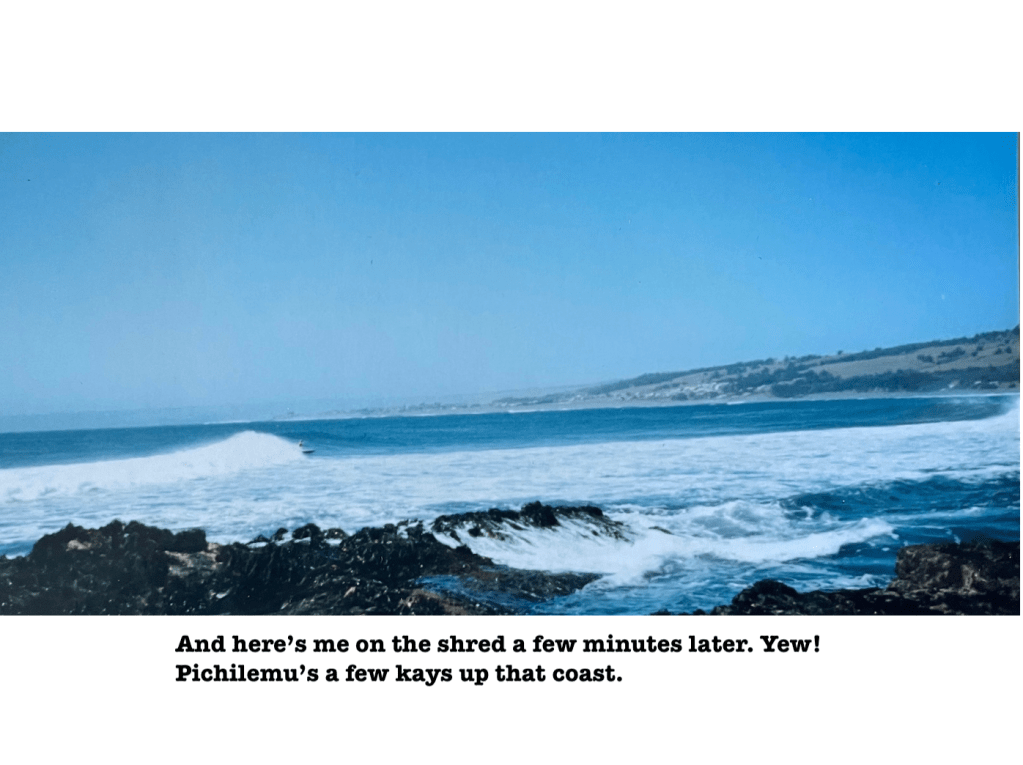


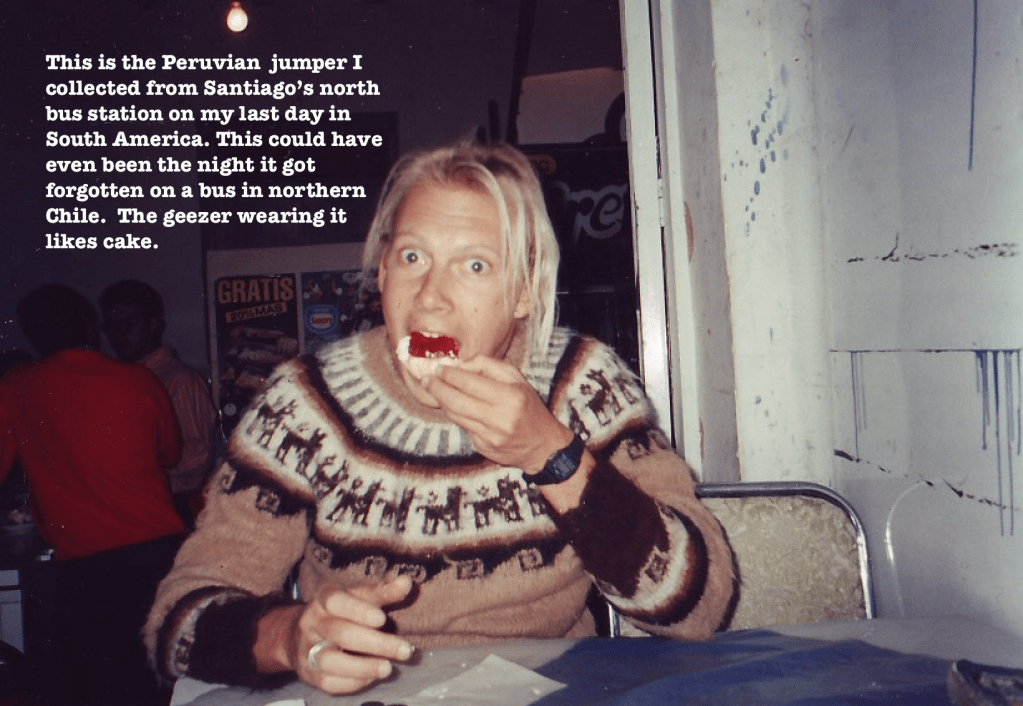
Chapter Nineteen
Easter Island, Tahiti and Home
Just as 1993’s journey back to Sydney had begun with a last-minute choice of Barbados as the first port of call, the last leg of the journey, my route across the Pacific, was decided on the run.
It was in Ecuador, or maybe Peru, that my decision to fly out of Santiago, Chile was made. It was a bit more expensive than a flight out of Los Angeles or Lima, but those few extra hundred dollars bought me a flight that included free stopovers in Easter Island and Tahiti. These destinations had been on my travel wish-list for years, but always under the sub-heading ‘Probably too hard and / or expensive.’ Now, thanks to many months of scrimping on transport, accommodation and food, I had enough of my savings left to visit them. Good times!
The five-and-a-half-hour night flight from Santiago landed in Easter Island around midnight. Among the handful of people collecting their luggage were Tim from England, and Ninette and Lena (Laynah) from Denmark. We were the only backpackers on the flight and we shared the backseats of the minibus that took us from the tiny airport to the island’s simplest and cheapest accommodation, ‘Anna’s Place’. Here I could pitch my tent in the garden for just a few dollars a night.
In the morning we teamed up to hire a car for the day. As a case study in human behaviour, Easter Island must hold the world record for the most enigma per square kilometre. Where, exactly, did the island’s first human inhabitants come from? Why, and how the hey, did they get here in tiny boats about a millennium ago using only seabirds and the sky to navigate? Why did they carve over a thousand huge stone heads-with-truncated-torsos and place them on the fringe of the island, with all but one group staring out to sea? How did they transport these twelve tonne heads five to twenty kilometres from the quarry to the coast? Why did they turn what was once a paradise of palm trees and birdlife into a lunar landscape when they must have known they were destroying their means to survive? And, surely, they must have made contact with the Inca and other South American peoples. If they could navigate to and from the tiny, lonely dot of Easter Island, they must have continued on to the west coast of South America. And, to my amateur eye, the stonework in at least one of the platforms built for the stone heads seemed too similar to the stonework I’d seen on the Inca Trails to be coincidental. Is there any evidence of Polynesian DNA in South America, or vice versa? Anyone? Anyone? Our day bumping around the island’s rough dusty tracks was a truly-once-in-a-lifetime-experience.
The next day we trekked up Rano Kau, one of half a dozen extinct volcanos that built the island slowly up from the ocean floor. Rano Kau is just a one hour walk from Hanga Roa, the island’s only small town, and our escort for the adventure was Hoppy, a little three-legged dog who spawned from somewhere soon after we’d left ‘Anna’s Place’. Unbothered by his missing front leg, Hoppy guided us up the steep track to the summit of the volcano, then lay down beside us while we snoozed in the sun. When another hiker emerged near our spot, Hoppy leapt up to protect us. But he stopped his snarling and barking as soon as we called him back. Then he expected the shell-shocked hiker to give him a good old pat. We met heaps of great little dogs like Hoppy on Easter Island.
On the last day I found a couple of hours to ride a few waves. On the day we’d driven round the island, I’d seen at least half a dozen reefs where great, probably dangerous, waves would break in the right wind and swell. And just a short walk from Anna’s Place, next to a small island that marked the entrance to Hanga Roa harbour, a gentler wave broke left and right along a fairly soft reef.
The ocean felt like a warm bath after the icy waves I’d been surfing in Ecuador, Peru and Chile; and a couple of young locals welcomed me to surfing on their island. Walking home beneath another beautiful Pacific sunset, I passed a couple of epically tattooed, long-haired farmers coming home from work on horseback as if they had all the time in the world, which they did. Easter Island was my first glimpse of the Polynesian culture I was to learn so much about in New Zealand over the next five years.
On December 8th Tim, Ninette, Lena and I took the six-hour night flight west across the Pacific to Tahiti. Arriving in the early hours of the morning, we teamed up to pay a small fortune for a taxi to Papeete, Tahiti’s main port. This was our introduction to French Polynesia’s no-income-tax policy. Tax is raised in other ways, the impact of which I felt most when I failed to resist paying nearly ten American dollars for the first packet of Tim-Tam biscuits I’d seen for over six years.
At the port, we waited in the humid dark for five hours to catch the dawn boat to Moorea, the little island twenty-five kilometres due west from the main island, Tahiti Nui. Dockside we met Wilfred, a teenage guardian angel dressed in peak mid-1980s fashion, right down to the rollerblades. He showed us the best, meaning safest, place to sit with our stuff until dawn. Then he led Tim and Lena to the nearest, early-opening shop where breakfast could be bought. When we returned to Papeete Harbour in the middle of the night a few days later, we realised how lucky we’d been to have Wilfred’s help on Day One. A classic guy.
By the time we boarded the boat, the sun was up and it was Hot. It was the first heat like this I’d felt since Panama, four months before. And, to borrow from Spike Milligan, it felt like you could grab a handful of air and squeeze the sweat out of it. Gazing back to land as we steamed out to sea, we got our first view of the staggering beauty of French Polynesia: steep volcanic hills covered in lush tropical greens reared up beyond the suburbs.
The crossing from Papeete to Vai’are, the small port on Moorea’s east coast, took about two hours. From there we took ‘Le Truck’, the public bus, for the hourlong journey round the south coast of the island to Camping Moorea, now called Camping Nelson, I think. This spot was yet another great recommendation from Tim’s ‘Lonely Planet’ guidebook. For only five bucks a night, you could pitch a tent on a lawn bordered by a white-sand beach fringed by the clearest, bluest water you could hope for. But it got even better. The nice lady who welcomed us asked us if we’d be interested in going on a boat to the nearby islands for a picnic. I was exhausted – I hadn’t had a proper sleep for three days – and the boat was leaving in just a few minutes, so I decided to have a quick kip instead. But as I began to set up my tent, Martin, a surfer from Hamilton in New Zealand, told me the boat-driver could drop me to the nearby reef-pass for a surf. Then Ninette discovered the boatride was included in the price of our accommodation and suddenly I wasn’t so exhausted any more.
Our ride was on a small white outrigger boat. The path through the shallow water near the island was piloted from the bow by a suave old local with an equally suave dog. They made a picturesque couple in an even more picturesque setting. Electric light blue water in the shallows graded to every shade of dark blue as we left the coast; swaying, sighing casuarina trees partly shaded the bright white sand of the island; and in the distance, Moorea’s breathtaking volcanic peaks rose lush and green into a clear blue sky.
After dropping the rest of our small party at the island, the skipper ferried me another kilometre down a shallow channel, then out toward the open sea. Here, about six hundred metres from Moorea’s north shore, head-high ocean swells broke along both edges of a deep-water reef pass.
The left on the western edge was best, but about twenty surfers competed for the waves. So the skipper offered to ferry me about three hundred metres across the channel to the righthander that broke around the eastern edge of the pass. These waves were shorter than the left, and slightly ruffled by the cross-onshore breeze, but with only one other surfer out, the choice was a no-brainer.
And what a surfer this guy was. While I was getting ready to dive off the boat and paddle over to the line-up, he air-dropped into an overhead barrel and came flying out with the spit. For a couple of hours he tore those waves apart in the nicest possible way. From my safety-first spot on the shoulder, I cheered him on, in between my cautious attempts to make the drop on the softer, wider ones and race a few sections.
These weren’t the most perfect waves I surfed in 1993, but the company, environment and atmosphere put them right up there with the most memorable. I learned the other surfer’s name was Phil Treibel from California – I’d seen pictures of him in American surf magazines – and he was on his honeymoon.
After a couple of hours, we paddled about half a kilometre across the lagoon to the hotel where he was staying in a room built above the water. From there he gave me a ride on his moped to save me a long barefoot walk on the hot roads back to my campsite. I arrived home, eyebrows crusted with salt, surfboard under my arm, on the back of a champion surfer’s bike, feeling like a king! Cheers, Phil!
But still the day hadn’t finished giving. After an epic open-air shower, we found it was barbecue-on-the-beach-night at Camping Moorea. We’d bought quite a bit of food to cook in the communal kitchen, thinking we’d save money, but the barbecue was even cheaper, and way better, than the simple food we would have made ourselves. So great.
The next three days were cruisy. We hitch-hiked round the island’s northern bays, meeting interesting characters on every ride. We hired mopeds for half a day and rode up into the mountains. We took the daily boat back out to the nearby islands for picnics beneath the casuarina trees. We snorkelled in the shallow waters between the islands, where I discovered that I’d spent my life living on the much less colourful side of the ocean’s surface. And I shared another unforgettable surf, this time with Martin from New Zealand and a couple of local rippers beneath yet another breathtaking island sunset.
You would have thought that after everything so far this year, the campsite on Moorea would have been the place to spend the last few days before my flight back home to Sydney. But no. There are a hundred and twenty one islands in French Polynesia, and we decided we’d better take our opportunity to see at least one more of them, if only for a night or two. So we took ‘Le Truck’ back to Vai’are and spent more than half a day travelling by boat to Huahine, another dot in the Pacific, two hundred kilometres away to the northwest.
There, at two in the morning, as we staggered sleepily off the boat, we met Jean-Luc, part gypsy, part Frenchman, part foreign legionnaire, part biker, husband, father, fantastic cook and one of the best hosts you could hope to meet. His pension had simple rooms set in gardens near the northern shore of the idyllic Fare lagoon. Among his other guests, Jean-Luc was hosting two Australians: Annie from Noosa and Sam from Manly, both flight attendants on a short break from work. Each night, over sunset drinks, then extended dinners, we shared stories of our homes and travels.
Waking at dawn on the second day in Huahine, I walked across the dewy grass of Jean-Luc’s garden and discovered black dots weaving white tracks on the waves breaking round the distant southern edge of Fare lagoon’s reef pass. I raced back to my room, ate a banana, waxed my board and headed out to sea. After twenty minutes and about seven hundred metres paddling alone across deep, dark blue water, I found the waves were even better, and quite a bit bigger, perhaps double-overhead, than they’d looked from shore. The surfers – a couple of quiet locals and their noisier American friends – were getting mind-boggling barrels from way up the reef. Unlike my over-confidence in Barbados and Panama earlier in the year, I had the sense to recognise my limitations and sit wide to wait for the easier ones.
After an hour or so, it dawned on me that I was alone. The four surfers who’d been my somewhat company had gone, just vanished, but I hadn’t seen them leave. They must have ridden round the reef on that last good set and started paddling across the lagoon to shore. But where were they now? There was no sign of them, or anyone else, as far as I could see between me and the distant coast. Perhaps they’d been collected by a small boat I hadn’t noticed. Perhaps they’d climbed aboard the only boat within sight, a tall-masted yacht about five hundred metres away. Perhaps they’d seen a shark. If so, it would have been nice if they’d told me; or even just said goodbye. Anyways, whatever, it was time to get the hell out of there.
But first I had to deal with the waves that were about to mow me down. Distracted by my search for signs of life in the lagoon, I’d almost missed the stealthy approach of a bigger, wider set. I was out of position to catch and ride one of them; and even if I’d been in the right spot, I wouldn’t’ve gone anyway: the consequences of a cock-up were too grave. The best I could do now was to get round or under them, before they dragged me across the reef. So, despite my urge to head for shore, I had to paddle another fifty metres towards the horizon, up and over five three-metre-high slabs of raw liquid energy, and further out into the bottomless ocean off the edge of the reef.
Once the waves’ detonations had subsided, I set out for land. I paddled toward the reef, not directly into the channel, hoping I’d find a smaller, peakier wave that would let me takeoff on its shoulder and ride the white water as far as it went. I got lucky, and when the hoped-for wave came, I rode it until it dissolved in the deep water of the lagoon entrance. Good start. Now it was just a half-hour paddle back to shore.
But after about ten minutes of steady paddling, I got the feeling the land wasn’t getting closer. A side-ways glance over my shoulder confirmed I was drifting backwards slowly out to sea. This was a low moment.
Now I saw there were a couple of people on the deck of the yacht I’d noticed before, but they were too far away to call out to, and I doubted they’d see me, just a speck in the ocean, if I waved. And besides, if I stopped paddling for a minute to try to get their attention, I’d float further backwards with the current into the increasingly huge and empty ocean. Plus I’d look like a goose.
So I kept my head down, kept paddling, and gave thanks to the long lefts of South America that had got me this fit. If I wasn’t making progress landwards, at least I wasn’t going further out to sea. As I went, I got to thinking: the high tide must have peaked while I surfed, and now the six-square-kilometre lagoon was returning its contents to the ocean for the next five hours. It was just me and the sea. What to do?
To my left, about three hundred metres away, waves were breaking on the reef that fringed the other side of the channel. This fringe reef was much closer to shore than the reef where I’d been surfing. So my best bet was to paddle across the channel to this reef and try to reach land from there. This would mean paddling across the out-rushing current and being swept further out to sea… but what the hey, I had no other option.
To ignore how fast I was approaching the horizon, I kept my eyes fixed on the backs of the waves that, with a bit of luck, would soon carry me to safety across the northern reef.
Once across the channel, I was pleased to find I was free of the current, so I rested for a while. Then I paddled a hundred metres further north up the reef, making sure to stay beyond the line of where the biggest sets broke. As a good sized wave surged underneath me, I watched how it peaked up, then spilled across the reef. As I’d hoped, the waves broke without too much ferocity and I could see no patches of dry reef when the white water surged across it to the lagoon. There was no question of actually surfing one of these waves; my aim was to simply catch the wash of a broken close-out wave and ride it lying down for as far as it would carry me.
After waiting for one more set of waves to break, I paddled hard to get close to the reef before the next set arrived. I timed my run well. The next wave broke thirty metres before it reached me and I caught the powerful white water easily. It zhooshed me two thirds of the way across the reef, then I was able to finger-tip paddle the rest of the way to the lagoon as the last waves of the set added more water to the reef. I’d thought I might have to walk the last part of the way, dodging urchins, sharp coral and a poisonous fish, but it hadn’t come to that. Mission half-accomplished. Queue massive sigh of relief.
Now the full force of the current was evident. Between me and dry land, a three-hundred-metre-wide river was running: not walking; fair dinkum running. It was clear that if I tried to paddle to shore from where I lay, I’d be swept out of the lagoon entrance in less than a minute. But, for some hydrodynamic reason, the water along the inside edge of the reef was almost untouched by the current. This allowed me to easily paddle a few hundred metres further north along the reef to where the distance to land was shortest.
After resting for another minute, I set out on the final sprint. As expected, I went sideways toward the open ocean three times faster than toward the shore, but after a couple of hundred fierce paddle-strokes, I discovered I’d escaped the worst of the current and was in relatively still water. Another few hundred metres later, I’d reached dry land. Hallelujah. Right up there in my top five stressiest ever surfing experiences. Not fun.
After three days in Huahine, Sam, Ninette and I caught the dusk boat back to Papeete. Arriving after midnight, we found no taxis waiting at the docks. So we set out to walk to town, lugging all our stuff, to look for a cheap hotel. When a car pulled up beside us and asked if we needed help, it was clear that neighbourly assistance was not what these five bad-boyz had in mind. Things were progressing quickly from ‘you’re kidding’ to ‘this is really bloody serious’ when a police van came from nowhere and the dodgy locals took off. The police threw our bags in the back of their van and drove us to the hotel of their choice. It was a lot more expensive than what we’d hoped to find, but infinitely better than what they’d saved us from.
The next day we rode ‘Le Truck’ through lush scenery and heavy rain squalls down the west coast of the big island as far as Papara and back. In the evening we took our flight to New Zealand. In Auckland airport, I said goodbye to Ninette and Tim, who had different friends to meet around the North Island.
On the cruisy flight to Sydney a few hours later, I was seated smack-bang in the middle of a joyous crowd of Chilenos heading to Australia for Christmas with their families. I’d asked my family to let me get the train home from the airport to complete the journey in appropriate style. But after waiting six and a half years for this moment, Mum wasn’t going to wait any longer. So as I emerged into the Arrivals Hall to find an excited sea of Chilean expats waiting for their families, there was mine, wedged in between them, waving like billy-o from behind the silver fence.
The last two weeks of 1993 were a blur. With just a couple of months before I’d be moving to New Zealand to work in Mike’s Dunedin café, I tried to catch up with everyone and everything. Christmas Day was the family day we hoped it would be: a daylong feast with presents under the tree and laps of the pool to make room for the next course. Looking back, it was one of the few when all six of us were in the same country. On Boxing Day, I went up the coast to a party with old friends at Johnny’s place at MacMasters Beach. A few days later, we surfed 300-metre long lefts at Box Head together for the first and last time. On New Years Eve, I went to a party in Avalon with about fifty people from skool-daze, my first-ever girlfriend among them. Sometime after midnight, we sat on South Avalon headland and watched the moon ride the glassy waves. There might have even been dolphins, but I’m not sure I can trust my memory on that one.
1994 began as if 1993 hadn’t finished. My Dad, two brothers and I went to the Sydney Cricket Ground to watch a couple of days of the Second Test against the South Africans. Shane Warne took twelve wickets, but Australia spooned their second innings to lose by five runs. I went with Mum and Dad north to Shoal Bay; then went south with Gynt and his mate Murray to camp at Meroo Point. After a few dream-like days of surf and music, we fled the bushfires that tore along the east coast that summer. We stopped in Ulladulla at Victor and Diana’s, then drove home past a horrifying wall of flame tearing through the Royal National Park. I surfed the Bower, Palmy, Newport, Bungan and Crossies, finding them exactly as I’d remembered them in my insomniac hours. I went to see the Cruel Sea and the Celibate Rifles, two Sydney bands I’d fallen in love with during 1993.
In February, from old friends and new, we made a twelve-piece band called The Shambollix. On the last day before I moved to New Zealand, in a sunny Willoughby backyard, we recorded a (still-unreleased) album that includes some of the songs written on the year-long road home.
And that week, if she hadn’t been too shy to come to a Shambollix jam when her best-friend, Flea, invited her, I’d have met Annemarie, the girl I still can’t believe I was lucky enough to marry, twelve years and two and a half times round the world later. But that’s another story.

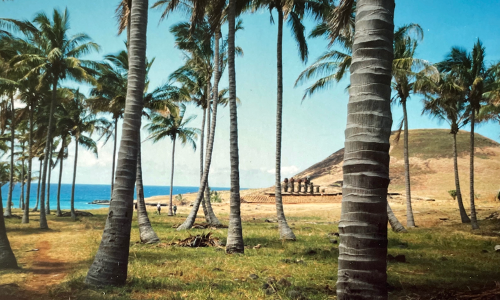

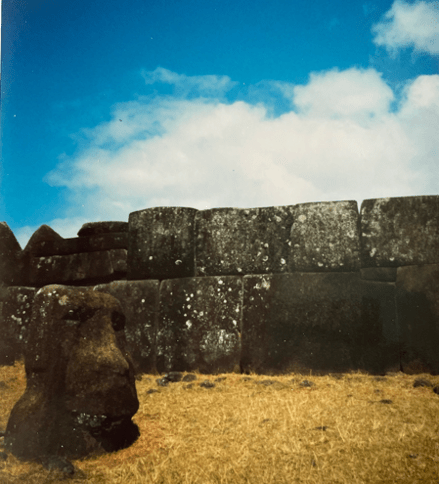
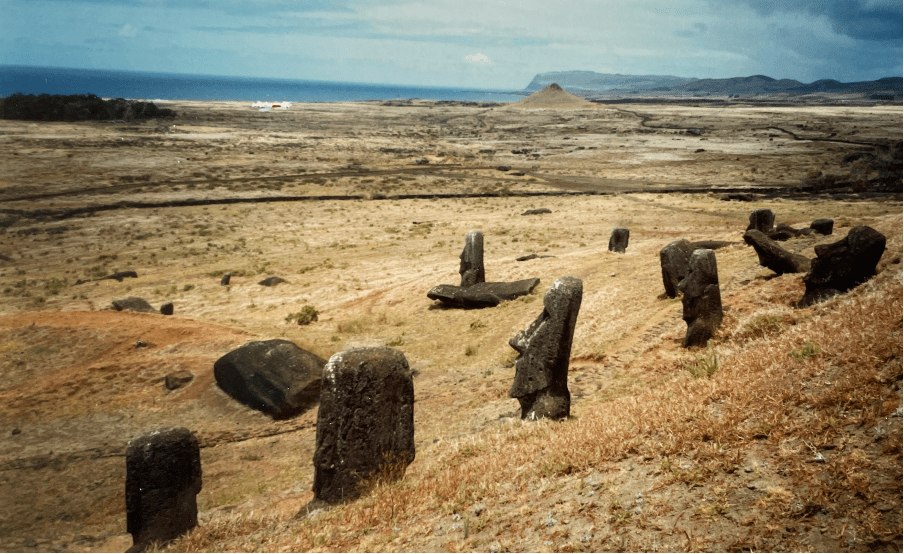

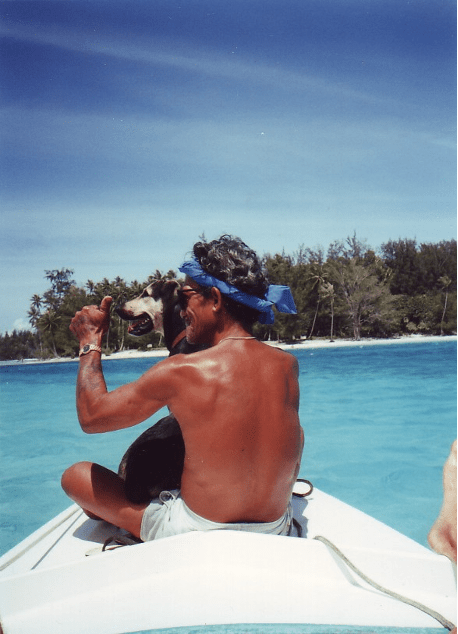


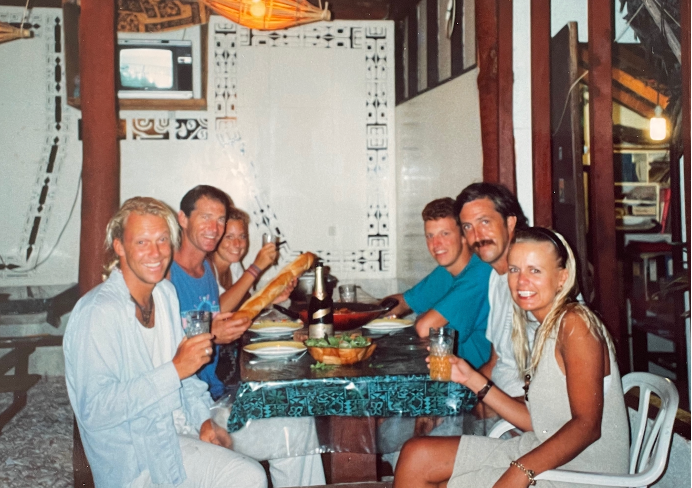
 we're only here once